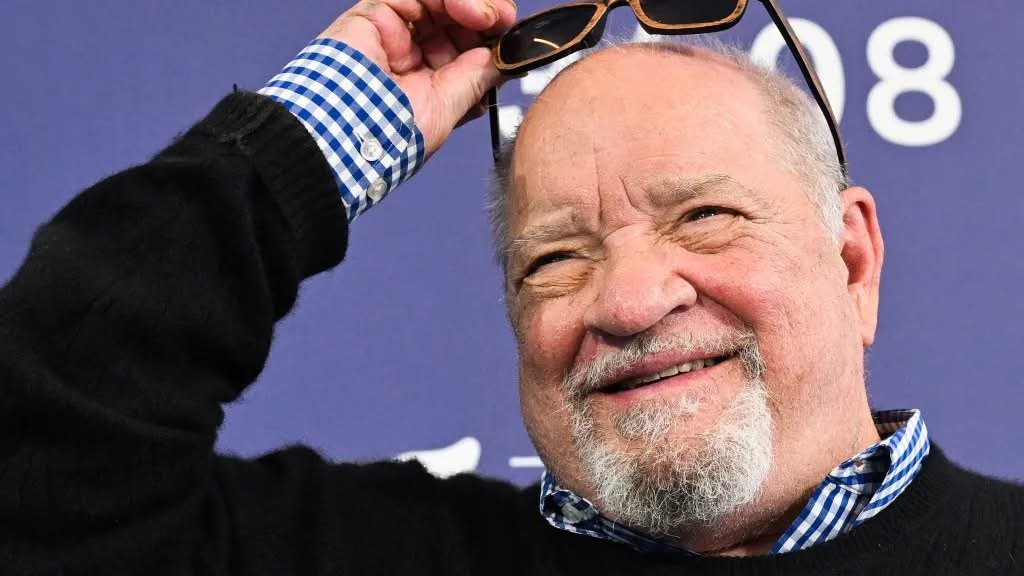
VENICE — After nearly half a century spent writing about isolation, guilt, and redemption, American writer-director Paul Schrader shows no sign of stepping away from the psychological territory that has defined a major part of his cinematic legacy.
Speaking at the press conference for his new film, The Basics of Philosophy, which held its world premiere Friday out of competition at the 83rd Venice International Film Festival, Schrader reflected on the early roots that made guilt a recurring motif in his work.
The 79-year-old filmmaker noted that growing up in a strict Dutch Calvinist environment left a deep mark on his worldview, pointing out that human beings, as Freud suggested, are shaped in their early years, and whatever is ingrained during that period stays present no matter how hard one tries to pull away.
Schrader added that his childhood was steeped in notions of fate, guilt, degradation, and redemption—ideas that accompanied him through his years in Christian institutions and seminary school before eventually evolving into foundational elements of his cinematic universe.
“You can’t escape your childhood,” Schrader said, explaining that this background made it difficult for him to imagine writing about anything other than guilt and salvation.
The Basics of Philosophy frames these ideas within the story of John Jorrisen, a philosophy professor played by Jack Huston. Jorrisen appears to lead a stable, organized, and successful academic life, yet beneath this calm exterior lies an old guilt he has never managed to fully bury.
His life shifts when the person he wronged in the past reappears, forcing him to confront questions surrounding guilt, desire, and self-justification—themes that have long occupied Schrader’s characters throughout a career dedicated to writing about isolated men grappling with internal conflict while documenting their thoughts and confessions.
From taxi drivers and lovers to priests and gardeners, Schrader’s characters have consistently orbited the individual trying to understand himself and face what lies hidden behind his public facade. In The Basics of Philosophy, this struggle shifts to a distinguished university professor whose life seems secure on the outside while eroding from within under the weight of an old secret.
Jack Huston mentioned that what drew him to Jorrisen was that the character does not present evil in its traditional form; he is not a clearly defined monster or an easily recognizable violent figure.
Instead, Huston explained, the character represents an “everyman” who lives among others while carrying a painful fragment of the past inside him. Huston believes this dimension makes the character far more compelling, as it poses a difficult question about humanity’s capacity for atonement and whether guilt can fundamentally alter how one sees oneself.
Sofia Boutella co-stars as Becca, Jorrisen’s partner and colleague in the philosophy department, who finds herself confronted with the reality of the man she loves and is left to decide for herself whether she can accept his version of his past.
Boutella stated that she intentionally avoided passing judgment on Becca, explaining that her responsibility as an actor was to withhold her personal beliefs, giving the character authentic space for hesitation, reflection, and decision-making.
The film’s ensemble cast also features Bill Pullman, Dana Delany, Daniel Zovatto, Shiloh Fernandez, Karl Glusman, and Elizabeth Petruso.
Martin Scorsese’s name appears as an executive producer, continuing a long-standing cinematic partnership with Schrader that dates back to some of the most iconic works in American cinema. This marks the second time Scorsese has taken on this role for one of Schrader’s films, following The Card Counter in 2021, with their collaborative roots extending back to Taxi Driver, Raging Bull, and The Last Temptation of Christ.
Discussing a key scene in the film, Jorrisen finds himself walking alongside a late philosopher, engaging in a dialogue about human transformation and whether people can transcend their nature and past mistakes. When Huston was asked who he would choose to accompany him on such a walk, he selected his grandfather, the legendary actor and director John Huston.
Huston noted that such a walk would have provided an opportunity to ask his grandfather countless questions about life, work, and everything in between, mentioning that while his grandfather passed away when he was young, he was later able to connect with his ideas and life through family members.
Bill Pullman added a touch of humor to the press conference when describing Schrader’s direct approach to casting, calling the director remarkably candid. Pullman shared that Schrader would routinely mention other actors who hadn’t landed the role, joking that he was simply happy to keep his own name on the list.
The Basics of Philosophy serves as a natural extension of Schrader’s thematic universe, while once again posing the question that has trailed him since the start of his career: Can a person ever truly break free from their past mistakes, or are they bound to their history forever?
Between a philosophy professor hiding an old secret and a director who believes childhood leaves its own permanent “programming” within a person, the film aligns with a artistic vision that has spent decades dismantling the relationship between sin, desire, punishment, and redemption.
In Venice, Schrader did not merely present a new film; he returned to the question he seems to have spent his entire career pursuing without a definitive answer: How does a person live with themselves once they discover who they truly are?