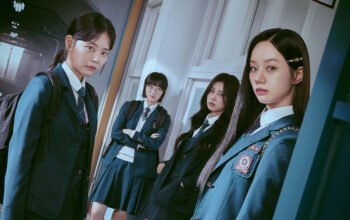
As the Asian television landscape witnesses the unprecedented commercial boom of genuine GL (Girls’ Love) narratives—spearheaded by the Thai entertainment industry’s runaway hits like GAP: The Series and Blank The Series—other regional markets are frantically scrambling to capture that same lightning in a bottle. South Korea’s elite academic thriller, Friendly Rivalry, arrived heavily armed with promotional whispers and visual cues practically begging to be embraced by this passionate global fanbase. However, beneath the carefully curated tension and viral-ready glances lies a much darker, decidedly unromantic reality. When a bleak psychological thriller attempts to wear the skin of a romance to court a trending demographic, the result isn’t just misleading—it’s a fundamental disservice to both genres. Here is why the “GL” label loosely draped over Friendly Rivalry is less about representation, and entirely about exploitation.

The Illusion of “Romance” and the Marketing Trick

One of the most cunning marketing ploys deployed by the production companies was promoting the show under the umbrella of “Girls’ Love” (GL).
This is a categorization we categorically reject, viewing it as a glaring iteration of “queerbaiting.” The showrunners deliberately utilized Sapphic Coding as a marketing lure to wrangle the rapidly growing demographic for this genre, without delivering any authentic commitment to its core tenets.
Our refusal to slap the GL label on this series is anchored in several artistic and objective justifications:
First: The Intentional Conflation of “Toxic Attraction” and “Romance”
The essence of classic and modern GL works relies on exploring emotional development, self-discovery, and building a safe space of mutual love between two women. Conversely, what transpires between Yoo Jae-yi and Woo Seul-gi resides on the absolute opposite end of the spectrum; it is a dynamic built on self-destruction, emotional blackmail, and the erasure of the other’s agency. Critics noted that labeling this pathological relationship—driven by feral dominance and sadomasochistic undertones—as “romance” is a gross oversimplification of the work. It is an insult to both sides: to the bleak psychological thriller genre the series actually belongs to, and to the GL genre, which shouldn’t normalize extreme psychological abuse as a form of love.

Second: Visual Exploitation for Commercial Gain
We observed that the directing and screenwriting actively manufactured situations charged with heavy sensual tension—lingering stares at the lips, dissolved personal boundaries, and touches heavily laced with desire—only to abruptly void these scenes of any genuine emotional payoff, weaponizing them instead into moments of threat or mind games.
This opportunistic use of the camera was not meant to build a romance; it was a calculated marketing ploy designed precisely to farm viral clips for social media, guaranteeing a steady pipeline of the younger demographic hungry for this trope.
Third: Mutilating the Genre to Catch the “Trend”
It is no secret that the Korean entertainment industry is enviously side-eyeing the massive commercial success recently enjoyed by GL series in neighboring markets, and it is painfully obvious they tried to surf this wave via Friendly Rivalry without bearing the burden of featuring an explicitly gay relationship that might ruffle the feathers of conservative Korean society.
Therefore, the compromise was to offer a “toxic obsessive relationship” that strokes the curiosity of the global GL fanbase on one hand, while providing a safe escape hatch for local producers to claim it was “just an intense friendship and school rivalry” on the other.
In summary on this topic, we consider Friendly Rivalry to be an exceptional drama in its psychological autopsy of the academic elite and authoritarianism, but attempting to dress it in GL clothing was nothing but a cynical commercial stunt to ride a trending wave. What binds Jae-yi and Seul-gi is not a love seeking the light; it is darkness recognizing its own reflection, and a pathological codependency that has absolutely zero correlation the ABCs of romance as we know it.
Read the Full Review..‘Friendly Rivalry’ Review: A Brutal, Brilliant Examination of Elite High School Toxicity