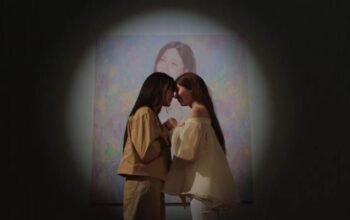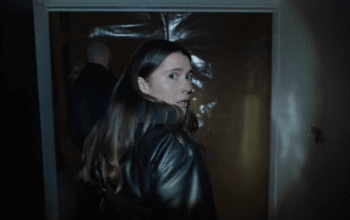
If you are searching for a queer teen drama that speaks directly to your soul and reflects your deepest adolescent dreams and anxieties, but you are well past your sweet sixteen, you might want to skip Thailand’s breakout GL series “23.5,” which earned its stripes as one of the genre’s earliest standard-bearers.
Eschewing the heavy melodrama and dark conflicts that have long defined the genre, the series delivers a visual and emotional canvas saturated in innocence and artistic purity.
It embraces simplicity as an overarching narrative philosophy, turning the mundane details of teenage life into an aesthetic experience brimming with transparent emotional resonance.
Set against the familiar backdrop of high school hallways, the plot kicks off when Ongsa, a shy and introverted student, connects on Instagram with Sun, the vibrant and popular campus favorite.
Operating under the pseudonym “Earth,” Ongsa engages in warm daily chats about astronomy and everyday life, until she is forced to confront the collision between her true feelings and her fear of exposure and rejection.
What sets this narrative apart is how the journey of confession blossoms into an extraordinary model of absolute transparency, governed by innocence and mutual learning.
The script leaves no room for standard awkwardness to choke the flow of emotions or manufacture forced misunderstandings.
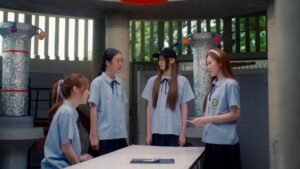
This sincere dynamic turns candid vulnerability into its primary language. The characters communicate without flowery prose or convoluted phrasing, expressing their thoughts and fears with childlike honesty.
This narrative approach offers viewers a masterclass in navigating the daunting trials of first love: the fear of rejection, exposure, or shifting dynamics.
As Ongsa and Sun tackle their most delicate questions with spontaneous candor typical of their age, the relationship becomes a safe harbor of psychological security born from total honesty rather than hiding behind dramatic clichés or paralyzing shyness.

Narrative Philosophy and Structural Design
The series’ dramatic architecture relies on striking simplicity and clarity, steering clear of artificial conflicts or toxic villains designed to inject cheap tension into the atmosphere.
The narrative flows gently through the turbulence of first romance, dismantling traditional coming-of-age tropes with innocent comedy and genuine awkward encounters that invite viewers to empathize and reminisce.
The true strength of the storytelling lies in its ability to elevate everyday school details, such as club activities, science projects, and field trips, into magical moments pulsing with life.

For contemporary viewers, this creative choice champions authentic teen representation, carving out a safe, breathable space far removed from high-stakes, hyper-dramatic tension.
Still, the structural framework encounters a few hurdles.
A strict aversion to major conflicts results in a noticeable pacing drag in the middle episodes. The rhythm occasionally stalls as certain encounters repeat without offering tangible contributions to the emotional arc or pushing the narrative stakes forward, leaving room for redundancies that could have been trimmed with tighter dialogue and deeper internal conflict.

Performances and Chemistry
The crackling chemistry between Milk Pansa and Love Pattranite emerges as the beating heart of the production.
Both leads embody adolescent innocence with astonishing finesse, avoiding melodramatic posturing or theatrical overacting.
Their performances lean heavily on eye contact, subtle gestures, and fleeting micro-expressions, lending their characters immense realism and magnetic charm that effortlessly convince the audience.

Meanwhile, the supporting dynamic between View Benyapa and June Wanwimol proves to be a genuine triumph and an artistic surprise. Far from serving as mere filler, their storyline carries multi-layered psychological depths and a clever, gradual emotional progression.
Their characters navigate concepts of acceptance, assimilation, and introversion with balanced dramatic nuance, occasionally overshadowing the main romance in logical pacing.
Despite their brilliant handling of subtle hesitation, the acting occasionally stumbles in scenes requiring intense dramatic interaction or high-stakes confrontation.
Moments of exaggerated awkwardness from the main character occasionally push the tone toward cartoonish territory, creating minor cracks in the otherwise grounded realism.

Directorial Vision and Visual Aesthetics
Directorially, the series shines in its deployment of soft lighting, warm palettes, and muted pastel tones to craft a dreamy visual space.
The central metaphor, namely the Earth’s 23.5-degree axial tilt, is brilliantly woven into the fabric of the show, mirroring the characters’ hesitation and the skewed angles through which they view the world.
The director transforms this scientific concept into a dynamic visual motif, complementing camera work that tilts and drifts intimately to capture fleeting emotional shifts.
The lens hovers with acute sensitivity near the actors’ faces, capturing passing glances and shy smiles, allowing audiences to dive deep into microscopic emotional details without relying on loud dialogue or forced theatrics.

Critical Flaws
Despite its visual and emotional splendor, the series stumbles into several creative pitfalls that prevent it from achieving artistic perfection.
A noticeable lag in the middle episodes leaves events spinning their wheels for too long without meaningful emotional progression or character growth.
Overplaying certain awkward moments for the lead character occasionally undermines narrative logic and psychological realism. Unjustified, rapid narrative leaps appear during transitional phases of the romance, rushing characters from intense hesitation to total devotion without adequate developmental buildup.
An overreliance on exhausted high school clichés makes certain sequences feel predictable and formulaic.
The treatment of future decisions and complex stakes is overly simplified, prioritizing emotional impulses over practical or academic realities in a way that stretches adolescent credibility.

The Verdict
Ultimately, “23.5” wraps up as an exceptional experiment that dares to treat teenage romance with gentle tenderness as its core narrative engine, reshaping the boundaries of simplicity in youth drama.
The show’s true value lies not in a labyrinthine plot or stormy dramatic tension, but in its ability to cultivate a secure world saturated with emotional beauty that leaves a soothing aftertaste.
Despite rhythmic stumbles and familiar tropes, the series remains a milestone in the evolution of Thai youth programming, proving that genuine warmth toward modest human emotions and meticulous visual care are more than enough to forge a profound and lasting impact.