The global art landscape is undergoing its most radical metamorphosis since the invention of photography.
Across the world’s major cultural capitals, traditional white-cube galleries with quiet, velvet-roped corridors are no longer the sole guardians of artistic expression.
A new era of creative engagement has arrived, powered by artificial intelligence, machine learning, algorithmic data processing, and massive projection technology.
Digital and immersive art institutions are redefining how humanity creates, views, and connects with visual culture.
This movement represents far more than a stylistic trend or a passing entertainment phenomenon; it marks a fundamental shift in perception and spatial interaction.
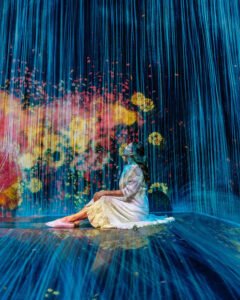
Visitors are no longer passive observers looking at framed objects on a wall. Instead, they step directly inside the artwork, becoming integral components of dynamic digital ecosystems that shift, evolve, and react to their physical presence.

The Pioneers of Architectural Transformation
Leading this global evolution is teamLab, an international interdisciplinary collective of artists, programmers, engineers, CG animators, mathematicians, and architects.
Their flagship venue, teamLab Borderless in Tokyo, shattered traditional museum conventions by creating a continuous, three-dimensional landscape without physical boundaries between rooms or individual artworks.
Projections move freely through corridors, interact with each other, and adapt to the movement of visitors.
The collective’s expansion into the Middle East with teamLab Phenomenon Abu Dhabi highlights the massive international demand for large-scale, sensor-driven spatial installations that blend physical architecture with digital liquidity.
Concurrently, European institutions have pioneered the adaptive reuse of historical and industrial landmarks.
Culturespaces, a major French cultural operator, demonstrated the narrative power of digital translation through its “Lumières” initiatives.
In Paris, Atelier des Lumières transformed a 19th-century cast-iron foundry into a high-definition digital canvas, bathing cold industrial surfaces in thousands of moving images accompanied by symphonic compositions.
Even more dramatic is Les Bassins des Lumières in Bordeaux, recognized as one of the largest digital art centers in the world.
Housed within a former World War II submarine base, the facility projects masterpieces onto raw concrete walls and across vast pools of water, creating dual reflections that amplify the emotional depth of classical and modern works.
Artificial Intelligence as a Creative Medium
While immersive projection centers revitalize historical masterpieces, a parallel movement uses data itself as the primary artistic material.
In Los Angeles, DATALAND—conceived by media artist Refik Anadol—stands as the world’s first physical museum dedicated entirely to artificial intelligence art.
Anadol and his team utilize machine learning algorithms trained on immense datasets, ranging from millions of public nature images to environmental sensor readings and space telescope telemetry.
The resulting “data sculptures” and fluid digital canvases present visual representations of how artificial intelligence synthesizes human memory and collective knowledge.
Visitors do not merely look at rendered imagery; they witness real-time algorithmic thoughts manifesting as shimmering, fluid movement across massive LED displays.
Similarly, ARTECHOUSE, which operates permanent spaces in Washington, D.C., New York, and Miami, bridges the gap between technology, science, and creative research.
By commissioning original works that rely on real-time data streaming, gestures, and generative code, ARTECHOUSE functions as a living laboratory for digital creators exploring the cutting edge of human-computer interaction.
Democracy, Accessibility, and the Future of Curation
The rise of digital and immersive art spaces has also triggered an important conversation regarding accessibility and audience engagement.
Traditional art institutions have long wrestled with perceptions of elitism, complex institutional jargon, and rigid behavioral codes. Digital venues, by contrast, rely on sensory engagement, curiosity, and intuitive interaction.
In London, Outernet provides a compelling model of public accessibility.
Positioned in the heart of the city, its high-definition LED screens bring complex digital installations, generative artwork, and interactive shows directly to street-level pedestrian crowds free of charge.
This model eliminates physical and financial barriers, embedding high-level digital artistry into the rhythm of daily urban life.
Other contemporary institutions, such as Moco Museum in Amsterdam and Barcelona, as well as Superblue in Miami, actively integrate digital media alongside traditional physical contemporary art. Superblue’s expansive industrial warehouse allows artists like James Turrell, Es Devlin, and teamLab to construct monumental, light-based environments that challenge visitors’ spatial awareness and cognitive perception.
A Permanent Shift in Cultural Consciousness
As algorithms improve, display hardware advances, and real-time rendering becomes seamless, the boundary between physical space and virtual reality will continue to dissolve.
The legacy of these pioneering institutions extends beyond visual spectacle; they have permanently broadened the scope of creative expression and introduced diverse, tech-savvy audiences to complex artistic discourse.
Digital museums have proven that technology, when guided by visionary artistic intent, does not isolate human beings behind individual personal screens.
Instead, it can bring people together in shared physical spaces, inspiring collective wonder and offering a profound new lens through which to contemplate the modern world.