The reunion of Jennie Natcha and Jena Angelinain Love on Hire was reason enough to generate anticipation among GL fans. Pairing the actresses’ established screen chemistry with an adaptation of a popular erotic novel seemed a promising recipe for a cheeky romantic comedy. Five episodes in, however, the series has struggled to deliver on that promise.
The problem isn’t its broad comedic sensibility or its willingness to stray from conventional romance. It’s the lack of control behind the execution. From contrived character motivations and uneven performances to clumsy editing and intrusive sound design, Love on Hire repeatedly undermines its own appeal. Most frustratingly, a potentially engaging central romance is sacrificed to a screenplay more concerned with manufacturing situations than developing believable characters.
A Screenplay at the Service of Convenience
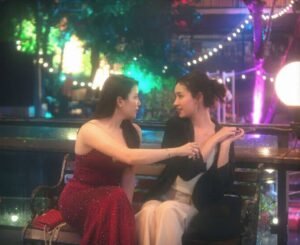
Chat and Nan’s relationship is supposed to provide the show’s emotional backbone, but their interactions often feel engineered to keep the plot moving. Nan’s decision to work for a woman who openly resents her, and Chat’s willingness to let her into her personal orbit, require more convincing motivation than the series provides.
Chat’s characterization is similarly inconsistent. Introduced as a powerful businesswoman willing to use legal channels to protect her interests, she repeatedly makes decisions that contradict that image. Even the fallout from the wedding scandal, which should have lasting implications for her business, conveniently disappears whenever the narrative needs another romantic or comedic detour.
The adaptation also makes substantial changes to its source novel without establishing a compelling dramatic rationale. In the second episode, an insurance company employee effectively assumes the authority of the police, forcing Nan to compensate Chat after kicking her car. Later, a failed blackmail attempt involving a private video is replaced by an abrupt revelation concerning Chat’s former fiancé and an alleged torture incident. The recording becomes a convenient mechanism for arranging Nan’s employment, but its origins and credibility remain inadequately explored.
The first episode offers an even more troubling example of the screenplay’s shortcomings. Chat’s sudden physical aggression toward Nan, whom she follows into a secluded passage after spotting her at a nightclub, lacks the psychological groundwork necessary to make the behavior intelligible. Even if intended to suggest attraction, the scene confuses sexual aggression with romantic tension, leaving a considerable gap in the characterization.
The series’ central problem is not its departure from the novel but its failure to make those departures work. Comic absurdity still requires narrative logic, and romantic development needs more than a succession of convenient encounters.

Comedy Without Comic Timing
Love on Hire embraces broad slapstick, exaggerated reactions and fourth-wall breaks, all familiar elements of Thai television comedy. But the execution rarely establishes the tonal contrast needed to make such devices effective.
The wedding sequence is particularly telling. Reporters, relatives and the bride herself compete in a parade of exaggerated foolishness, turning what should be a chaotic comic set piece into an exhausting display of silliness. Rather than building humor through character and timing, the series repeatedly mistakes louder reactions for better jokes.
The intrusive sound effects make matters worse, underlining nearly every comic beat until the humor becomes increasingly forced. Some viewers responding to the third episode expressed a similar frustration: the issue wasn’t the absurdist approach itself, but how little of it actually landed.
The dialogue suffers from much the same problem. Exchanges frequently feel constructed around punchlines rather than character, while abrupt shifts between serious conversations and comic asides undermine the scenes’ natural flow.
Jennie and Jena: Chemistry in Need of Better Direction
The performances offer another mixed picture. Jena’s broad comic approach has divided viewers, with some finding her reactions excessive and others praising her expressive delivery and natural comic instincts. Her more restrained facial expressions often prove considerably more effective than the exaggerated gestures encouraged by the direction.
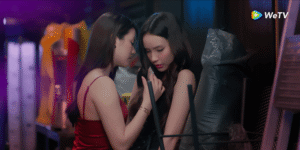
The larger disappointment, however, concerns the chemistry between the two leads. Their reunion carried considerable expectations, particularly given the appeal of their previous work together. Yet some intimate scenes in Love on Hire have struck viewers as stiff and less spontaneous than their earlier collaborations.
Reactions to the fifth episode highlighted the problem, with some viewers finding the romantic tension unconvincing and the physical interaction overly restrained. Others, meanwhile, praised moments in the fourth episode, suggesting that the chemistry has not disappeared altogether. Rather, the series struggles to sustain it consistently.
Screen chemistry depends on more than physical attraction. It emerges through timing, body language, glances and the subtle negotiation of physical distance. A screenplay and director must create the conditions for those moments to register. Here, that process often feels rushed or insufficiently developed.

Technical Shortcomings Compound the Problem
The visual execution offers little compensation. In the nightclub sequence, a distracting light reflection obscures part of Jennie’s face at a moment when her expression should command attention. More broadly, some camera angles and compositions feel underwhelming, suggesting limited visual control over the dramatic material.
Editing is another recurring weakness. Abrupt transitions, particularly in the second episode, leave the impression that important connective moments have been skipped. The fifth episode also drew criticism for feeling disjointed and lacking substantial narrative progression.
Sound mixing is similarly uneven. Background music and effects occasionally overpower dialogue, while awkward audio transitions disrupt the viewing experience. These may seem like minor technical issues individually, but together they diminish the series’ overall polish.

Pacing: Too Much Screen Time, Too Little Development
Several scenes in the third, fourth and fifth episodes feel considerably longer than their dramatic content warrants. Comic situations are repeated without generating new developments, while peripheral storylines receive screen time without establishing their relevance to the central narrative.
Nan’s appearance at the office in her pajamas and certain detours involving Chat’s friend’s romantic life are among the moments that raise questions about the show’s priorities. The fourth episode’s sequence involving a man drinking wine with a secretary, for instance, offers little justification for the time it occupies.
The issue isn’t the presence of subplots or lighter interludes, but their lack of narrative purpose. In a romance that depends on gradual emotional progression, pacing is especially important. Lingering looks, hesitation and silence can carry more dramatic weight than extended exchanges, provided the editing gives them room to breathe.

Chemistry Alone Can’t Carry a Series
Five episodes into its run, Love on Hire gives the impression of a production that needed more time in development and execution. The rushed feel of its performances and technical choices suggests a series that could have benefited from a longer preparation period and more careful attention to its visual and editorial details.
Its central irony is that it already possesses an asset many romantic dramas struggle to manufacture: two leads with an established ability to generate audience interest and romantic appeal. Yet chemistry alone cannot compensate for a weak screenplay, inconsistent direction or uneven technical execution.
Jennie and Jena have the ingredients for an engaging romantic partnership. What they need is a story capable of giving that chemistry dramatic weight, a director who knows how to capture its subtleties, and an editorial rhythm that allows the relationship to develop rather than simply pushing it toward its next romantic beat. At present, Love on Hire has the right pairing but too little faith in the storytelling needed to make it work.