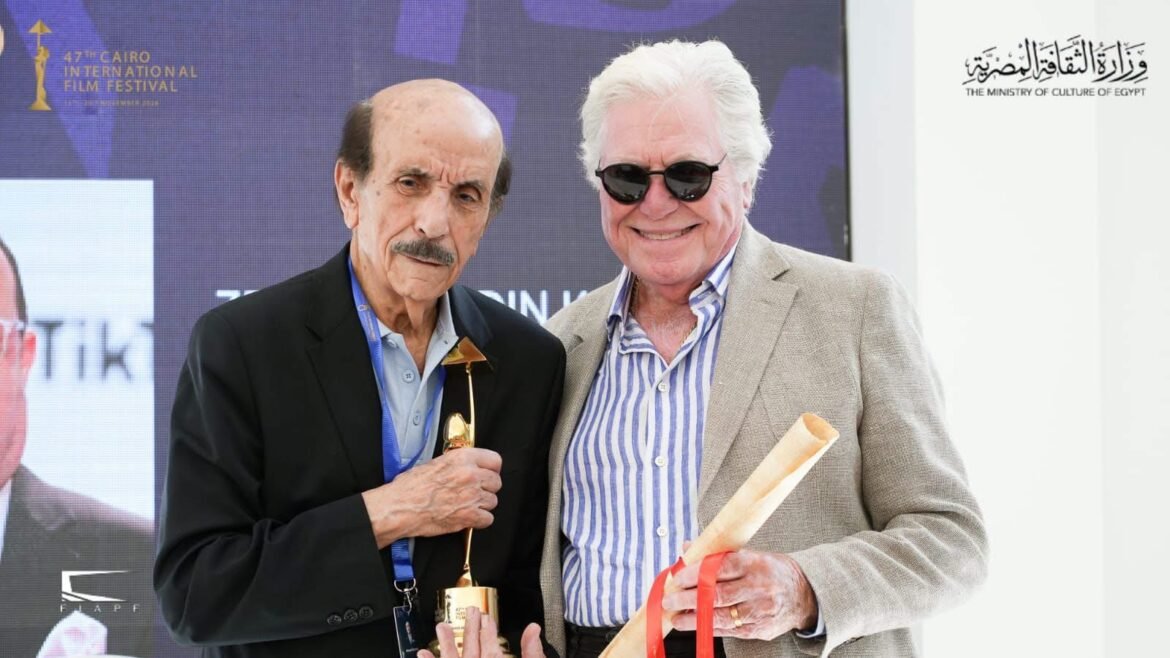
In a tribute that goes beyond celebrating the career of a distinguished filmmaker, the 47th Cairo International Film Festival has presented Algerian director and producer Ahmed Rachedi with its Golden Pyramid Lifetime Achievement Award, recognizing his decades-long contribution to Algerian and Arab cinema and his role in bringing the country’s history, identity and struggle for independence to the screen.
The award was presented on Thursday, Nov. 19, during an open discussion held at the Cairo Opera House as part of the eighth edition of Cairo Industry Days.
The session was moderated by film critic Zein El Abidine Khairy, with festival president Hussein Fahmy personally handing Rachedi the honor.
Fahmy welcomed the filmmaker to Cairo with a warm acknowledgment of their shared cinematic heritage, telling him: “You are among your own people and family here in Egypt. Consider this your second Oscar.” The remark reflected the stature Rachedi has earned across generations of Arab filmmakers and the international reach of his work.
The recognition also marked Rachedi’s return to the Cairo Film Festival after a 17-year absence. His last appearance was at the festival’s 33rd edition in 2009, when he presented Mustapha Ben Boulaïd, a historical drama centered on one of the leading figures of Algeria’s war of independence.
His return, therefore, offered more than a ceremonial homecoming: it provided an opportunity to revisit a career deeply intertwined with the evolution of Algerian cinema.
From Revolutionary Cinema to a National Film Legacy
Rachedi’s filmmaking career emerged from the struggle for Algerian independence, an experience that would profoundly shape his artistic vision.
At a time when the country was fighting to free itself from French colonial rule, he recognized cinema’s potential as a means of documenting resistance and preserving the memory of a people reclaiming its freedom.
For Rachedi, filmmaking was never simply a matter of entertainment or storytelling. It was a way to engage with history, identity and collective destiny.
That conviction informed a body of work concerned with Algeria’s defining historical moments and the people who shaped them.
Among his best-known films are Dawn of the Damned, The Opium and the Stick and Ali in the Land of Mirage.
Together, these works reflect his enduring interest in national memory, liberation and identity, while establishing his position as one of the key figures in the development of post-independence Algerian cinema.
Ahmed Rachedi and Youssef Chahine: A Cinematic Bridge Between Algeria and Egypt
Rachedi’s legacy also extends well beyond Algeria, particularly through his longstanding professional connections with Egyptian cinema. His relationship with the country’s film industry was not limited to festival appearances; it included significant production collaborations with some of its most influential filmmakers.
He was involved in the production of Youssef Chahine’s The Sparrow and The Return of the Prodigal Son, two landmark titles in the Egyptian director’s filmography.
Rachedi also contributed to the production of Bloody Destiny, directed by Khairy Beshara.
His international collaborations included work on Costa-Gavras’ acclaimed political thriller Z, which won the Academy Award for Best Foreign Language Film in 1970, representing Greece. These projects reveal another dimension of Rachedi’s career: beyond directing, he played an important role as a producer, helping foster creative and professional exchanges between Arab filmmakers and the wider international film community.
A Tribute to a Generation of Arab Cinema Pioneers
During his Cairo appearance, Rachedi revisited key moments from his artistic and personal journey, discussing his early experiences with filmmaking during Algeria’s liberation struggle and reflecting on the transformations that have reshaped Algerian and Arab cinema over the decades.
The tribute carries added significance in a year marking the 50th anniversary of the Cairo International Film Festival, founded in 1976.
Honoring Rachedi in this context is also a recognition of the pioneering generation that helped establish Arab cinema’s artistic and professional foundations, leaving a lasting imprint on the filmmakers who followed.
The Golden Pyramid Lifetime Achievement Award is therefore more than a celebration of an accomplished director and producer.
It recognizes a filmmaker whose work has become part of Algeria’s cinematic and historical memory, and whose career helped build lasting connections between the film industries of Algeria, Egypt and the international community.
For Rachedi, the honor is a fitting acknowledgment of a career defined not only by the films he made, but also by the cultural legacy he helped create.
It is Cairo’s tribute to one of Arab cinema’s enduring figures, and a reminder that a filmmaker’s significance is ultimately measured not simply by the number of films he leaves behind, but by the place they occupy in the history of cinema.
Published by: November 19, 2026.