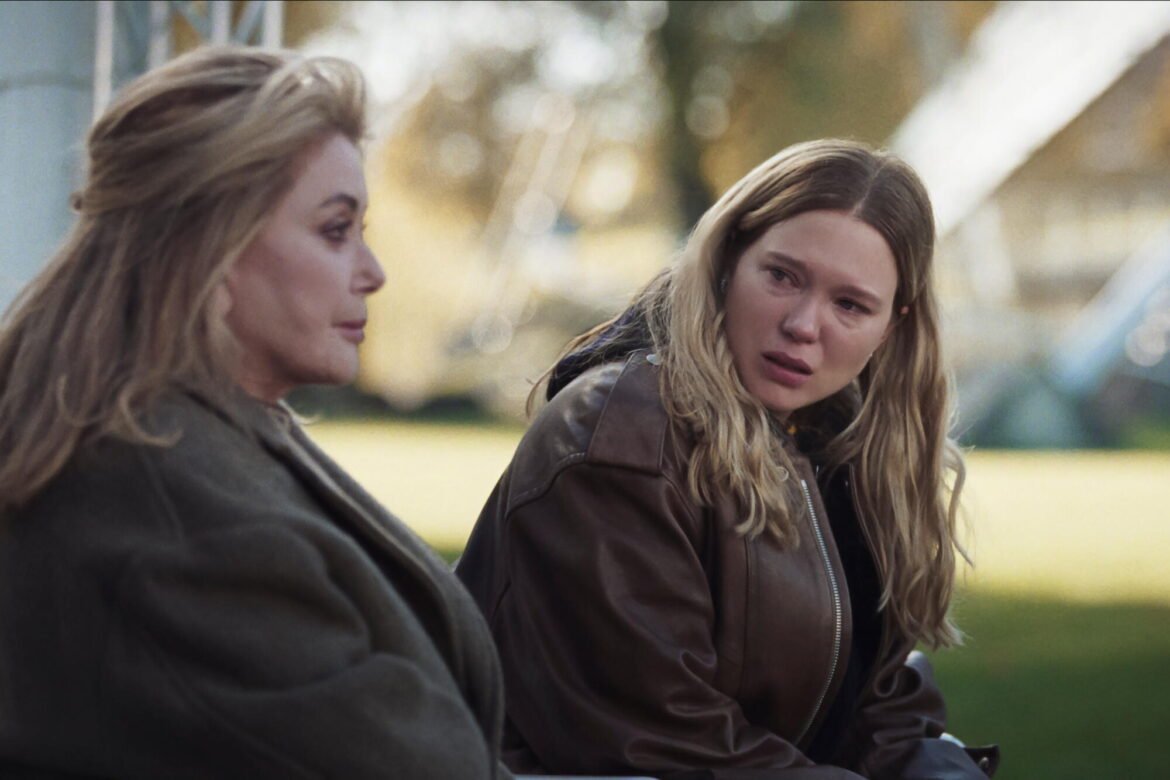
The real horror of ‘Gentle Monster’ lies in a deeply unsettling question: What if the person we share our home, memories and most intimate moments with is hiding a side of themselves we could never have imagined? How can someone whose habits we know, whose trust we have earned and before whom we have exposed our deepest vulnerabilities turn out to be an entirely different person? The revelation becomes all the more disturbing when that hidden identity is not simply a private secret, but one tied to actions so reprehensible that no explanation can make them easier to accept.
Yet the film is less interested in the shock of discovering the truth than in something considerably more troubling: what happens to everything that came before it?

When Memories Become Evidence Against Themselves
One of Gentle Monster’s most compelling psychological dimensions is its exploration of how a devastating revelation can fundamentally alter our relationship with the past.
The crisis does not end with discovering that someone close to us has committed horrific acts. Nor does distancing ourselves from that person automatically restore our sense of security.
Something far more complicated happens within the architecture of memory itself.
Every happy moment shared with that person suddenly becomes open to reinterpretation. Every affectionate gesture, every seemingly ordinary conversation, every instance we once regarded as proof of genuine love and concern becomes a potential source of suspicion.
We begin replaying the past through an entirely different lens, wondering whether we failed to recognize the warning signs or whether the truth was always there, hiding in plain sight.
This leads the film toward one of its most painful psychological dilemmas: If we cannot recognize the people with whom we share our homes and the smallest details of our lives, how can we possibly trust our judgment of anyone else? And was love itself responsible for our blindness? Perhaps the problem is not always the absence of warning signs, but our emotional willingness to interpret them in whatever way preserves the image of someone we desperately want to believe in.

Lucy and the Detective: When Morality Becomes Personal
Lucy’s emotional journey, moving through denial, grief and the painful process of acceptance before ultimately arriving at the decision to walk away, forms one of the film’s most essential narrative threads.
Her struggle is not rooted in uncertainty about the gravity of what happened, nor in any attempt to rationalize the crime.
Rather, she finds herself caught between the truth she understands intellectually and the feelings she still has for the person responsible.
This is perhaps the film’s most emotionally convincing observation: Feelings do not come with an on-and-off switch.
We cannot simply deactivate love because circumstances have made it unacceptable.
A revelation may render a relationship impossible to sustain, but that does not mean affection disappears at the same moment.
The mind may reach its verdict quickly; the heart takes considerably longer to process the collapse of the world it once considered home.
Running parallel to Lucy’s story is that of the detective, whose professional and moral certainties begin to crumble when the crime enters her own family circle.
She is accustomed to investigating other people’s wrongdoing, gathering evidence and confronting perpetrators.
Yet when the same moral framework must be applied to someone she loves, her ability to act with professional detachment becomes severely compromised.
The parallel is more than a clever narrative device.
It places both women before essentially the same ethical test, albeit from different positions. Do our principles remain intact when upholding them becomes personally devastating? Can we demand justice with the same conviction when the accused is someone we love? The film offers no comforting answer, but it makes one thing painfully clear: Moral consistency is considerably harder to maintain when the cost is personal.

Léa Seydoux: An Emotionally Exposed Performance
Léa Seydoux delivers an extraordinary performance built on subtle gestures and emotional precision rather than conspicuous displays of anguish.
She portrays a woman struggling to maintain her composure as her understanding of love, trust and security gradually disintegrates from within.
What makes the performance so effective is Seydoux’s ability to communicate the contradiction between what her character knows and what she continues to feel.
Grief, anger, confusion and longing coexist without ever becoming an exercise in excessive melodrama.
Even in moments when the character cannot articulate her turmoil, Seydoux makes us feel the intensity of the internal battle taking place beneath the surface.
This is arguably one of the finest performances of her career. An Academy Award nomination would be entirely deserved, not as an act of generosity toward an accomplished actress, but as recognition of the remarkable sensitivity and complexity she brings to an exceptionally difficult role.

The Jumping Scene: A Fleeting Moment of Happiness With a Disturbing Shadow
The film’s closing moments contain an image that deserves considerably more attention than it initially seems to demand.
The jumping scene offers what appears to be a brief escape into playfulness and freedom, yet it leaves behind an unmistakable sense of sadness and unease.
Director Marie Kreutzer approaches the material as an opportunity to explore unsettling questions rather than solve every mystery within the narrative.
Several aspects of the story are deliberately left unresolved, most notably the father-son relationship, which remains suspended in an atmosphere of profound uncertainty.
Throughout the film, the child repeatedly plays and jumps.
When he encourages his mother to join him, we witness a genuine moment of happiness on her face.
The scene feels like a brief interruption in an otherwise oppressive reality, a chance to step outside the weight of everything that cannot be endured or understood.
But the image also invites a considerably darker interpretation.
What if the child’s repetitive play is itself a means of escaping his reality? What if these seemingly innocent moments serve a deeper psychological purpose, allowing him to temporarily disconnect from something he cannot confront?
The film provides insufficient evidence to turn this possibility into an established fact, and perhaps that is precisely where the scene derives its power.
It remains suspended between innocence and anxiety. Some questions become far more frightening when no definitive answer is available.

A Reminder of The Leftovers: Jumping as an Escape From Reality
I couldn’t watch this sequence without immediately thinking of a remarkably similar moment in The Leftovers, specifically the second episode of its third season, featuring Nora and Erika.
Following an emotionally devastating exchange between the two women, the scene culminates in their jumping together.
In both works, jumping becomes more than a physical act or an expression of carefree amusement. It functions as a temporary reclamation of the self in the face of an unbearable reality.
For a brief moment, the characters are allowed to breathe outside the boundaries of grief, memory and unanswered questions.
The difference is that Gentle Monster gives the gesture a considerably darker undertone. Having witnessed the revelations that precede it, we can no longer look at the child’s behavior in isolation.
An apparently simple moment of play becomes an open invitation to interpretation, where happiness collides with dread and innocence becomes inseparable from suspicion.
Ultimately, Gentle Monster derives its strength not simply from the revelation of a shocking secret, but from the questions that linger long after the truth comes to light.
It is a film about the fragility of trust and the enormous distance between knowing someone and believing that we truly understand them.
More importantly, it confronts us with an uncomfortable human reality: We may recognize that walking away from someone is the only morally defensible choice, and possess every rational justification for doing so, without necessarily having stopped loving them.


Gentle Monster has been available on Netflix since November 18.
For those who have seen it, two questions remain particularly worth discussing: Can beautiful memories retain their innocence after discovering a devastating truth about the people who shared them with us? And can we really uphold our moral principles with the same uncompromising conviction when the person who has done wrong is someone we hold dear?