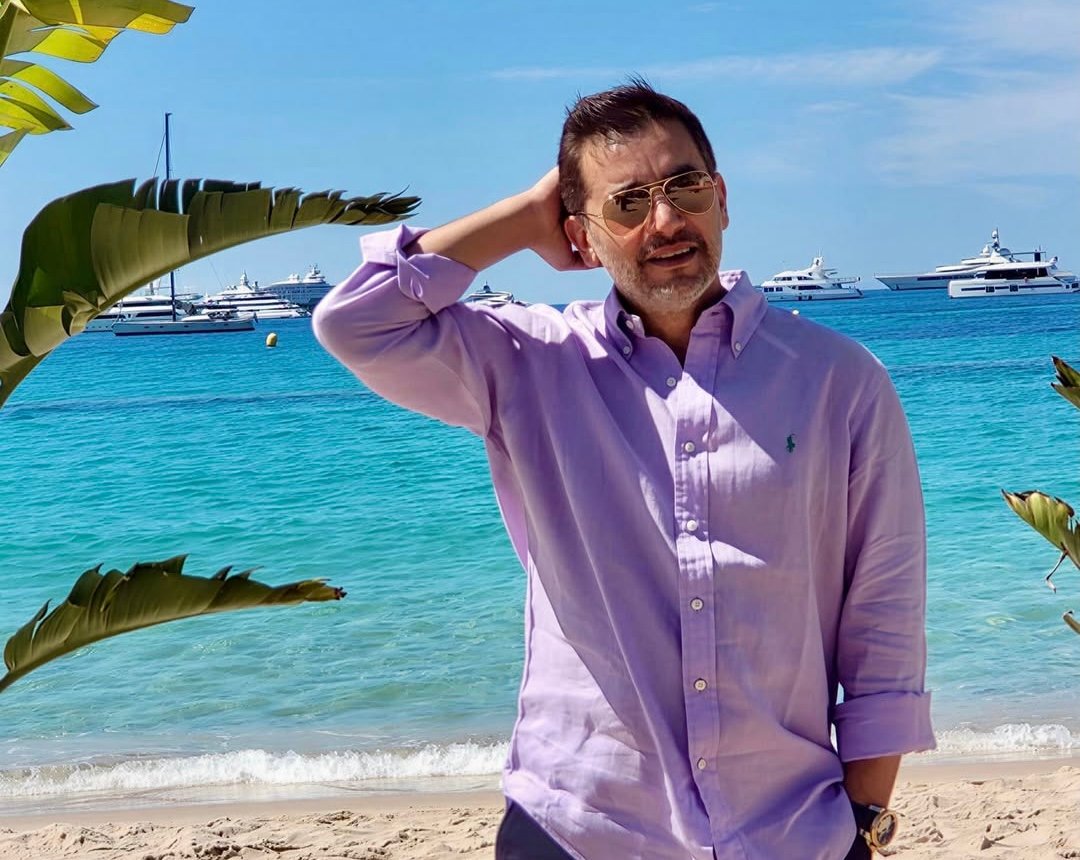
CANNES – By Raghda Safwat
In an industry where stardom can be fleeting, few actors maintain a enduring market value and a loyal fanbase that resist the test of time or extended hiatuses. Egyptian A-lister Hany Salama belongs to this exclusive tier. His career strategy relies on careful deliberation and a highly selective filmography; yet, he remains a permanent fixture in the Arab cinematic landscape, sustained by the lasting impact of his roles and a decades-long track record of critical and commercial success.
Salama’s absence from the screen has never diminished his industry leverage. Instead, it underscores a profound relationship with his audience—one built on absolute trust in his artistic choices and a continuous demand for his signature screen presence, which balances a commanding charisma with dramatic depth. No matter how long the gaps between his projects, his status at the forefront of the entertainment industry remains secure, as audiences recognize that his return invariably delivers a project that leaves a lasting footprint.
In this exclusive interview on the sidelines of the Cannes Film Festival, we met up with Salama to discuss his upcoming slate, his perspective on current industry shifts, and the core philosophy that keeps him relevant in a rapidly evolving market.
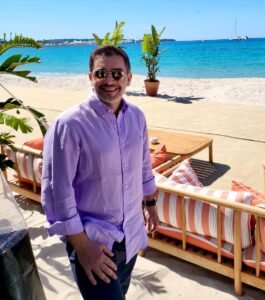
The Interview
What is the primary objective behind your attendance at the Cannes Film Festival this year?
I am here attending a cultural diplomacy initiative spearheaded by the Egyptian Ministry of Foreign Affairs, in coordination with the French Ministry of Culture, to mark the centenary of the late legendary auteur Youssef Chahine. I am traveling alongside the prominent actress Laila Eloui. Our agenda includes attending official screenings, networking with international industry peers, and then returning to Egypt.
How does it feel to return to Cannes nearly two decades after your last appearance here?
It has actually been over twenty years. The moment I arrived in Cannes, it triggered an immense sense of nostalgia. I immediately recalled my first festival run back in 1997 with Chahine, when we were here for the world premiere of his masterpiece Al-Maseer (The Destiny). I returned in 1999 for the screening of Al-Akhar (The Other). A significant amount of time has passed, but being back on the Croisette has made me retrace my early career steps. It is incredibly rewarding to be back at the venue where some of my most definitive features debuted. I certainly hope to return with new competitive titles in the future.
Reflecting on Youssef Chahine’s centenary at Cannes, what message would you convey to him if he were alive today?
I would tell him that the industry deeply misses his vision, his high-caliber productions, and the rigorous cinematic school that shaped our passion for this craft. Ultimately, I wouldn’t be back in Cannes today if it weren’t for his mentorship. May he rest in peace. Our goal now is to continue producing compelling, impactful cinema that resonates globally and secures international distribution.
You view Al-Maseer as a definitive career milestone. Looking across your broader filmography, which other projects give you that same sense of professional pride?
To be frank, I stand behind my entire filmography. Naturally, working under Chahine had a distinct prestige; he wasn’t just a director, he was a full-scale cinematic institution. I was fortunate to kick off my career with a major production powerhouse like Misr International Films. That said, I value the diversity of my subsequent projects. Fortunately, I don’t have a single title in my catalog that I regret. I have navigated this industry for many years; my output may not be hyper-prolific, but I am fiercely committed to a “quality over quantity” approach, prioritizing diverse and challenging scripts.
Looking at the highlights of your career, some critics argue that your talent is currently underutilized by contemporary market standards. Do you agree with this assessment?
There may be some validity to that, but I analyze it through a structural lens. The industry’s ecosystem has fundamentally changed over the years. The operational parameters for actors have shifted, and the entire business model is completely different now. The rapid evolution of digital marketing and the heavy integration of social media have altered industry standards. This has inevitably restricted talent, often capping an actor’s ability to fully leverage their dramatic range. Frankly, this disruption is affecting global entertainment markets, not just Egypt.
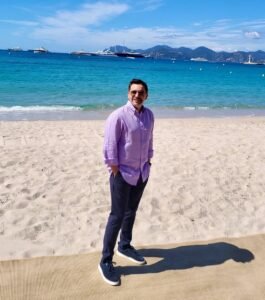
Have you considered counteracting these market limitations by transitioning into production to greenlight your own vehicles?
Unfortunately, filmmaking is not a one-man show; an actor cannot manage the entire value chain. Unlike an individual athlete who commands their own victory, acting relies on multiple moving variables. No matter how skilled a performer is, you need institutional backing to execute the remaining production elements. I firmly believe my role is to operate effectively within the system, as a key component of the machinery, rather than trying to become the machine itself.
But has the idea of producing never appealed to you as a means of maintaining absolute creative control over your career?
No, stepping into production is not on my current agenda. I might explore co-producing or financing projects down the line, but it would stem strictly from a commitment to the medium of cinema itself, rather than a calculated move to produce tailor-made starring vehicles for myself. On a broader note, I believe that regardless of your professional role, your duty is to consistently put in the work. Market success and timing are variables beyond our control. I operate on the principle that every production delay carries a hidden advantage, as long as you maintain momentum and keep pushing forward.
You are known for maintaining a strictly independent stance, refusing to align with any industry factions or “cliques.” While this independent status is respectable, it often carries a professional premium. Do you have any regrets?
Absolutely not. Regardless of the professional cost or the market consequences, earning genuine industry respect across the board is a more than sufficient return for me.
What are your current long-term goals?
On a personal level, my priorities are standard but essential: health, stability, and peace of mind for me and my family. These might sound like conventional cliches, but they are the most valuable assets a person can secure. Professionally, my main objective is to sustain the audience’s critical acclaim. Ultimately, I want to leave behind a respectable legacy and a body of work that holds long-term value.
You have both a streaming series and a feature film slate for release this year. What is the status of those projects?
I have completed filming on Al-Thanb (The Guilt), a ten-episode psychological drama, which is currently in post-production and scheduled for an upcoming release on a major streaming platform. I am also wrapping up the feature film Al-Hares (The Guard); we only have four days of principal photography remaining.
What happened with the series Amir Al-Awamri?
That project was originally greenlit for the Ramadan broadcast season two years ago. However, after about ten days of principal photography, the production was permanently shelved.
Published By :
May 19, 2026