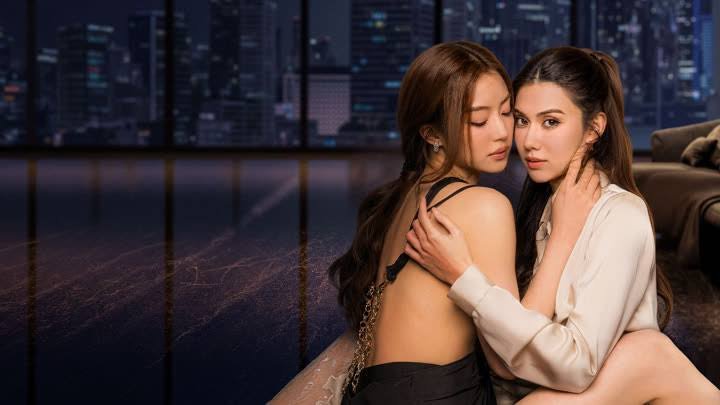
It’s been four years since “Gap” broke the glass ceiling for the GL (Girls’ Love) television genre, unleashing a global frenzy. The market has since exploded into a multi-billion-dollar industry, feeding a voracious international audience with an endless, diverse slate of productions and minting new on-screen power couples daily. Riding the shockwave of this heated dramatic revolution, “Pls Love” arrives to detonate viewer expectations, catapulting the hype to the stratosphere backed by a marketing blitz of unprecedented ferocity.
Months before dropping, “Pls Love” staked its claim. It doubled down on three massive bets: the undeniable star power of the LenaMiu pairing, a commercially proven source material with a rabid fanbase, and a heavy, unapologetic dose of high-stakes, steamy romance—teased relentlessly in every trailer without an ounce of hesitation.






The Steamy six posters
Peaking over the last two weeks, this relentless campaign successfully rolled out the red carpet. It capitalized on a brilliant strategic window, premiering right after the acclaimed “Four Elements” concluded its run, having dominated the cultural conversation throughout the first half of the year. Furthermore, heavyweights like Faye Peraya and LingOrm had already aired their projects, vacating the arena and leaving the late-year market starved for a heavyweight contender amidst a drought of flimsy filler.
But hype alone doesn’t trigger an earthquake. The pilot didn’t just meet towering expectations—it obliterated them. Beyond the masterful release timing, the real jaw-dropper was the staggering evolution of LenaMiu’s acting chops.
The immediate standout in the pilot isn’t just its fiery, breakneck pacing; it’s the profound maturity of its dual leads. Lorena Schuett, known as Lena, commands the screen with laser-sharp focus, mastering the art of silent, simmering emotion. Opposite her, Natsha Taechamongkalapiwat, or Miu, matches that gravity beat for beat. Their blistering chemistry proves that rigorous rehearsals paid off, marking a massive leap from their previous outing, “My Safe Zone“, which now feels more like a screen test than a finished series.

Is the Show Actually Better Than the Book?
Anyone who has cracked open the original novel knows it was an absolute page-turner. Yes, it was hampered by clunky prose and a lack of literary finesse, but it was a commercial juggernaut that cultivated an army of die-hard fans—fans entirely prepared to tear the showrunners apart if the adaptation failed.
The verdict after episode one? The series doesn’t just adapt the book; it eclipses it.
By kicking off in media res before dialing back the clock, the pilot introduces sequences wholly absent from the source material. It’s a justified and logical departure. Adaptations don’t need to be scene-for-scene regurgitations, especially when a structural overhaul feeds the audience crucial exposition exactly when they need it. What works on the page, where readers can live inside a character’s internal monologue, doesn’t always translate to the screen. Television demands visual, efficient motivation, and the creative team behind “Pls Love” clearly understands the assignment.


Architects of the Narrative
The most glaring, and successful, divergence from the novel is the early establishment of Barn’s family dynamic. In the original book, Barn takes agonizingly long to justify her work as an escort, keeping the reality that she isn’t a sex worker a secret. This stretched a painful misunderstanding between the leads far past its expiration date.
The series cleverly rectifies this. It also immediately unpacks the loaded backstory of Peem’s family, providing essential context for her deep-seated prejudice against sex workers. While it doesn’t excuse her cruel behavior, it illuminates her motives, a crucial screenwriting maneuver that allows the audience to invest in a deeply complex protagonist.
Lena’s dialogue delivery is equally sharp, dropping whip-smart one-liners that propel the narrative forward at a ferocious clip. The pilot expertly doles out just enough intel to outline the stakes and the central conflict without spoiling the whole hand. Topping it all off, the creators injected a fearless, edgy pulse into the debut.
Bravo, #LenaMiu. You’ve forcefully demanded our attention, stepping into the ring with absolute swagger, and frankly, we weren’t ready.

The Defining Moment

The absolute pinnacle of the pilot is undoubtedly its cold open. Peem swaggers into Paradise Casino, only to be blindsided by the sight of the woman she spent a steamy, unforgettable weekend with in Pattaya—the same woman she can’t get out of her head—standing on an auction block, waiting to be sold to the highest bidder!
It is a staggering gut-punch. The audience feels the whiplash right alongside her, especially since Barn had previously confessed she was a virgin.
What makes this sequence a masterclass in tension is the emotional baggage attached to it. Peem isn’t just staring at a crush in an unexpected setting; she is filtering this shock through the lens of deeply buried childhood trauma involving her mother and the profound bigotry it spawned. Peem was experiencing genuine attraction toward Barn, and in a single heartbeat, the woman she desires becomes the embodiment of everything she has spent years despising. The emotional stakes are instantly, and violently, reconfigured.
Kicking off the pilot with this explosive confrontation is a stroke of showrunning genius. It delivers the shock first, rewinds the tape to show how their orbits collided, and then marches forward, armed with enough context to re-contextualize the beginning. This meticulously crafted architecture hooks the viewer immediately, allowing the underlying emotional danger to simmer just beneath the surface.
This is top-tier craftsmanship!
They grabbed us by the collar, laid down the motives, and left us holding our breath to see the fallout of Peem’s fractured reality. Our focus is officially locked in.



The Final Verdict
The premiere of “Pls Love” successfully performs surgery on the novel’s weakest links, engineering a far more robust, TV-ready foundation. By front-loading crucial context, expanding Barn’s narrative real estate, and grounding Peem’s actions—and their mutual, magnetic pull—in deep emotional logic, the pilot gives us every reason to invest from minute one.
Crucially, the screenwriters showcased a fearless willingness to hack away at the source material whenever it served the core story. Paired with impeccable pacing, Lena’s evocative performance, a killer score we are already trying to hunt down, and the exact right dose of thrill, “Pls Love” is hurtling down a wildly promising path.
We walked into this premiere with cautious optimism, and we walked out absolutely desperate for episode two. In the world of television, there is no higher praise.