In film criticism, a moment of reckoning occurs when an auteur with a distinct stylistic signature chooses to navigate treacherous geopolitical territory, reducing history from a documentary record into a microcosm of human tragedy and moral absurdity. That is precisely what British-Irish writer-director Martin McDonagh achieves in his latest feature, Wild Horse Nine, which made its world premiere in the main competition at the 83rd Venice International Film Festival.
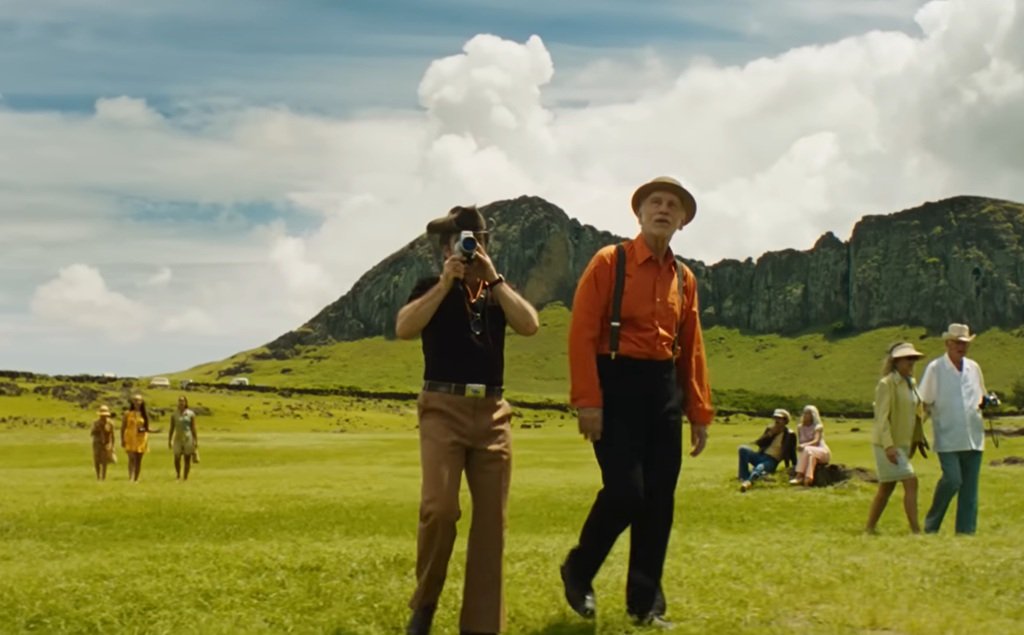
McDonagh plunges us immediately into a political powder keg: Santiago, Chile, 1973, on the eve of the bloody, CIA-backed military coup against Salvador Allende’s regime. Yet the picture swiftly dodges the conventional mechanics of political thrillevents, shifting its dramatic anchor away from cloak-and-dagger operations toward a far more isolated, mythic canvas: Easter Island (Rapa Nui). Against the backdrop of towering monolithic moai and sweeping grassy pastures, his characters undertake an existential journey cloaked in trademark dark comedy.
Through this framework, McDonagh delivers a film that vacillates between the bitterness of historical regret and the beauty of existential contemplation, dismantling the mythology of American hegemony through a portrait of two intelligence operatives.
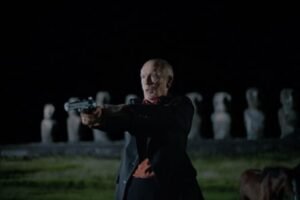
Narrative Architecture and Screenplay: Absurdity in the Shadow of Guilt
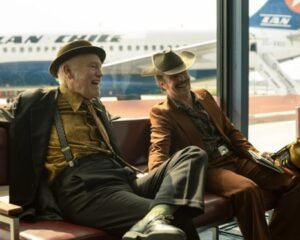
The script opens on a premise familiar within espionage lore: two CIA operatives, Chris (John Malkovich), a terminally ill veteran nearing the end of his service, and his fiercely loyal protege Lee (Sam Rockwell). The duo is dispatched on a dubious assignment to Easter Island under orders from their desk chief, MJ (Steve Buscemi), after Chris begins penning his personal memoirs—threatening to expose decades of covert operations spanning from Guatemala to historical political assassinations.
McDonagh constructs a dialogue-driven framework no less sharp or incisive than his previous milestones In Bruges and The Banshees of Inisherin. The banter crackles with relentless irony, yet it carries a heavy melancholy rooted in moral redemption.
The film treats political crime not as an ideological manifest, but as a psychological weight upon its perpetrators. Guilt manifests not through a heroic act of confession, but as a delayed existential crisis for men who once managed global affairs from the shadows, only to discover in their twilight years that they were mere pawns in a meaningless game.
Conversely, the screenplay faces minor narrative hurdles regarding its historical framework. Critics noted that McDonagh uses the tragedy of Chile primarily as a dramatic springboard for personal musings, opting not to dissect the fascist infrastructure his characters helped erect. Consequently, the political commentary occasionally feels lightweight relative to the historical gravity of the era.
Performances: A Masterclass in Character and Restraint
If the screenplay serves as the film’s thematic engine, the performances provide its beating heart.
- John Malkovich (as Chris): Malkovich delivers one of the most resonant turns of his career. As the ailing, guilt-ridden operative, he eschews the trope of the cold-blooded intelligence agent. He imbues Chris with a blend of verbal cynicism and physical decay—sunken eyes heavy with shame, delivering dark humor in hushed tones that transform every punchline into a quiet plea for absolution.
- Sam Rockwell (as Lee): Rockwell provides a formidable counterweight. Lee embodies blindly compliant American gung-ho zeal wrapped in a facade of misplaced polish. Rockwell excels at revealing the internal fractures of a man torn between unwavering allegiance to his mentor and his horrific professional duties. The chemistry between the two actors ranks among the finest pairings in McDonagh’s filmography.
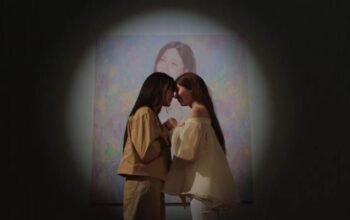
- Supporting Cast: Steve Buscemi shines as MJ, a bureaucratic superior whose icy demeanor captures the unfeeling nature of the institutional apparatus. Parker Posey, appearing as Lee’s wife through telephone exchanges, adds tragicomic texture to the dissolving personal lives of these operatives. Meanwhile, appearances by Chilean students (such as Mariana Di Girolamo and Elén Salas) offer the film’s primary direct contact with the local population, functioning effectively as catalysts for Chris’s moral transformation.

Visual Craft: Landscape as Character
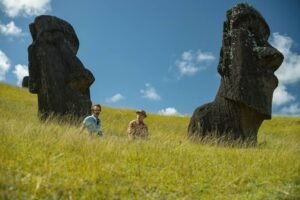
Cinematographer Ben Davis exploits the geography of Easter Island to make its landscape an active dramatic participant.
The visual language establishes a stark contrast between the opening acts set in Santiago—characterized by cold palettes, sharp angles, and rigid stone structures reflecting institutional power—and the vast natural canvas of Easter Island.
On the island, the lens expands. Davis captures vast horizons, green hillsides, and the moai statues lining the coast. Rather than serving as exotic set dressing, these ancient monoliths are framed as silent, eternal witnesses to human folly. The natural lighting and muted twilight tones grant the picture a classical 1970s aesthetic, reflecting moral decay with quiet patience.
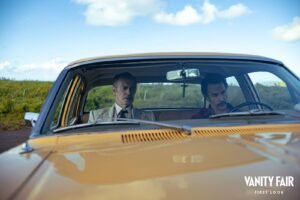
Soundscape and Score: Nostalgia and Bitterness
Carter Burwell’s score heightens the prevailing sense of melancholy. Burwell leans into late-Western motifs using mournful string arrangements paired with subtle South Pacific percussion elements.
The music never forces emotional beats; instead, it drifts through the background like an elegy for a life squandered on deception. The sound design underscores the vast solitude of the island—howling winds, crashing surf, and wild hooves—contrasting sharply with the claustrophobic conversations inside closed rooms.
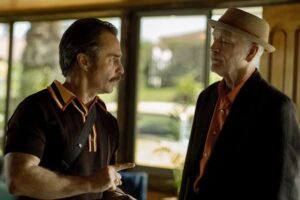
Critical Verdict and Directional Vision
In Wild Horse Nine, Martin McDonagh proves he remains a master of crafting cinema that is simultaneously entertaining and painful. Yet the film occasionally succumbs to familiar structural habits. The dynamic of two men in an isolated setting debating morality and death is a familiar playbook for McDonagh, diminishing some of the narrative unpredictability found in his earlier work.
Furthermore, the picture inhabits a delicate moral space: it approaches imperial violence with dark satire, while simultaneously seeking sympathy for the architects of that devastation by centering their personal twilight-years reckoning. Balancing catharsis with black comedy may leave some viewers wishing for a more uncompromising handling of the historical moment.
Nevertheless, the film stands as a refined artistic achievement. Anchored by a towering performance from John Malkovich, hyper-literate dialogue, and stunning visual economy, it makes effective use of one of the world’s most isolated settings.