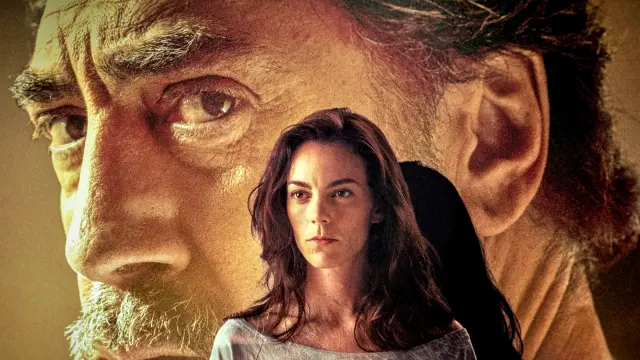
In his latest cinematic offering, El ser querido (The Beloved), Spanish auteur Rodrigo Sorogoyen ventures into the official competition of the Cannes Film Festival with a lacerating, multi-layered familial drama wrapped in a “meta-cinema” framework. The narrative revolves around Esteban Martínez (Javier Bardem), a globally acclaimed director who returns to Spain to shoot his next feature in the arid, unforgiving desert of Fuerteventura.
As a thinly veiled pretext for reconciliation, Esteban casts his estranged daughter, Emilia (Victoria Luengo)—a struggling actress whom he has abandoned for over thirteen years—in the leading role.
As the production unfolds in geographical isolation, the lines between script and reality blur, transforming the film set into a psychological battlefield where decades of unspoken resentment and fractured dynamics inevitably detonate.
Yet, Sorogoyen does not merely deliver a conventional kitchen-sink melodrama.
Instead, El ser querido functions as a brilliant, clinical thesis on the camera’s ability to dissect the human psyche.
As tectonic emotional shifts disrupt the isolated set, Sorogoyen strips away excessive dialogue, relying instead on a relentless, calculated visual syntax anchored almost entirely by the Extreme Close-Up (ECU).
Faces as Topographical Maps of Trauma
Against the barren, harsh topography of Fuerteventura, the cinematography consciously obliterates the surrounding environment.
The background dissolves into a peripheral blur, forcing the cinema screen to be entirely consumed by the physical geography of the human face.
This aggressive reliance on the ECU transcends mere aesthetic indulgence; it serves as the film’s primary narrative and emotional engine.
Subverting the Mask of Performance: Because the film deals with the inherent artificiality of filmmaking, Emilia is constantly performing under her father’s directorial gaze. However, Sorogoyen’s actual camera pierces through this meta-theatrics.
The microscopic focus on a quivering lip, a dilating pupil, or a sharp intake of breath strips the characters of their professional armor, exposing the raw, unvarnished vulnerability beneath the act.
Excavating Invisible Scars: The central conflict spans over a decade of abandonment. Rather than relying on expositional dialogue or sentimental flashbacks, Sorogoyen chooses to excavate this history through the micro-expressions of Bardem and Luengo.
The lens probes the lines of their faces like an archaeologist looking for the residue of long-standing neglect.
The Eye as a Dramatic Crucible: In the film’s crucial crescendos, the frames are occupied solely by the characters’ eyes.
A direct gaze or a sudden evasion of eye contact becomes a profound psychological confrontation, replacing pages of script with a silent, heavy vocabulary of guilt and longing.
The Paradox of Vastness and Claustrophobia
The film’s true formal brilliance lies in its visual juxtaposition.
The internal movie being shot is a Western—a genre historically synonymous with sweeping wide shots, vast horizons, and expansive desert landscapes.
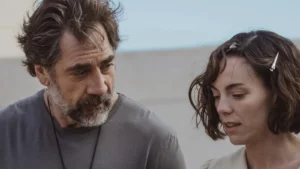
subverts this traditional grandeur by claustrophobically choking the frame with tight, suffocating close-ups.
This formal contradiction masterfully projects the internal state of the characters onto the audience.
The viewer is subjected to an claustrophobic pressure; despite being in an open desert, there is nowhere for the father or the daughter to hide from the truths they have evaded for over a decade.
The camera ceases to be a passive observer and becomes an active interrogator, forcing an emotional reckoning and a visceral offloading of repressed trauma.
A Sensory Cinematic Anatomy
Through this masterful deployment of the Extreme Close-Up, El ser querido evolves from a standard narrative of domestic rupture into a deeply sensory, microscopic anatomy of frustration, hope, and the agonizing pursuit of absolution.
Anchored by the towering, granular performances of Bardem and Luengo, Rodrigo Sorogoyen powerfully demonstrates that the smallest twitch of a human muscle can be infinitely more expansive, violent, and devastating than the loudest narrative crescendos or the widest cinematic horizons.