The birth of “Englot”—the marquee Thai screen duo comprising Engfa Waraha and Charlotte Austin—was no mere flash in the pan for Southeast Asian entertainment. It was the spark that ignited a global fandom, fundamentally reshaping the contours of Thailand’s Yuri / Girls’ Love (GL) landscape.
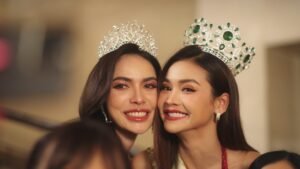
That phenomenon took root on the stage of Miss Grand Thailand 2022, where the unscripted, visceral chemistry between Waraha and Austin captured millions of social media followers before production houses could even draft a script. As their star rose exponentially, attempts to monetize that dynamic on screen began in earnest. The first effort was Show Me Love The Series (2023), produced in-house by the Miss Grand International (MGI) Organization.
However, the duo’s creative trajectory underwent a dramatic metamorphosis as they transitioned to seasoned broadcast networks and heavy-hitting production powerhouses. Their collaboration with CHANGE2561 and One31 yielded Club Friday The Series 16: Love Bully (2024), followed by the critically acclaimed crime procedural Petrichor The Series (2024–2025), and culminated in the prime-time tentpole 4 Elements: The Water (2026).
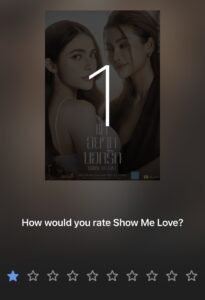
When evaluating this cumulative body of work with an analytical eye, Show Me Love emerges as an undeniable anomaly—and the weakest link in the Englot canon. While it served as the initial gateway for fans eager to see the duo’s real-world dynamic translated into fiction, it remains their most narrative-depleted, visually pedestrian, and structurally fragile outing, completely eclipsed by the high-caliber film and television projects that followed.

A Study in Metrics: Ratings, Reach, and Market Penetration
To grasp the true scale of the Englot phenomenon, one must look past fan enthusiasm and examine the hard metrics across digital and linear platforms.
Show Me Love The Series debuted in March 2023 on MGI’s proprietary GrandTV YouTube channel behind a paywall. Comprising nine episodes, its episodic clips garnered between two and three million views during initial runs. Yet its footprint remained largely confined to core Miss Grand pageantry devotees and immediate fandom circles. The series failed to make inroads into linear broadcast television, while early paywall restrictions stifled broader mainstream adoption.

The contrast was stark when the duo moved to CHANGE2561’s Love Bully under the Club Friday banner in the summer of 2024. Broadcast on One31 and streamed via Viu, the four-episode event dominated worldwide trends on X (formerly Twitter), topping charts in multiple territories during every broadcast cycle. It set viewership records on open-air Thai television while generating tens of millions of digital streams within days, proving the power of proper network backing and frictionless distribution.
Petrichor The Series further consolidated this dominance. Its uncut release on FN Series and companion digital platforms drew massive international and domestic viewership. Crucially, Petrichor expanded the audience beyond Yuri loyalists to lure fans of dark crime thrillers and police procedurals. This crossover appeal was reflected in critical ratings: Petrichor secured an enviable score above 8.5 out of 10 on MyDramaList, leaving Show Me Love trailing far behind with a modest 5.5 to 7.0 average.
By spring 2026, the duo reached another high-water mark with 4 Elements: The Water, broadcast in prime time on Channel 7HD and streamed globally on iQIYI. The series generated widespread engagement, week after week dominating global hashtags and drawing acclaim for Austin’s nuanced portrayal of Lada alongside Waraha’s commanding performance as corporate executive Apo.
This trajectory is further bolstered by their individual screen triumphs. Waraha starred in One31’s ratings hit Bangkok Blossom (2024) and led the cinematic juggernaut The Paradise of Thorns, which grossed over 150 million Thai Baht and swept festival circuit awards for Best Picture and Best Actress in 2025. These prestige victories recalibrated industry expectations for what an Englot project could achieve, casting a harsh light on the technical and narrative shortcomings of Show Me Love.

Pinpointing the Peaks: Commercial Impact vs. Critical Acclaim
The zenith of the Englot partnership rests on three distinct milestones, each representing a different facet of creative maturity:
1. Commercial Mainstream Peak: Love Bully
This series re-introduced the duo under a veteran production house skilled in socio-cultural melodrama. By channeling Waraha and Austin’s organic spark into a narrative addressing family pressure, social rejection, and public scrutiny, Love Bully achieved maximum broadcast penetration and cultural resonance.
2. Prestige Industry Peak: 4 Elements: The Water
Here, the duo proved their mettle in high-concept commercial television, seamlessly blending corporate intrigue with a classic enemies-to-lovers framework. Austin delivered a mature, emotionally grounded performance, while Waraha solidified her status as one of Thai television’s most formidable leading women.
3. Critical & Artistic Peak: Petrichor The Series
Petrichor remains the duo’s most audacious artistic statement. Stepping away from lightweight romance into the noir world of forensic investigations, Waraha (as Inspector Tul) and Austin (as forensic pathologist Dr. Ran) displayed remarkable growth in vocal control, emotional restraint, and dramatic weight—proving that given a tight script and confident direction, their talent extends far beyond romantic fluff.

Deconstructing ‘Show Me Love’: The Core Missteps
In hindsight, Show Me Love stands out as a fundamental misstep—a project hampered by a crisis of identity and execution.
First, the series suffered from narrative inertia. Marketed as a dramatization of Waraha and Austin’s real-life pageant journey, the story relied on a literal, almost cartoonish retelling. By repackaging familiar social media beats, the narrative surrendered all mystery, tension, and dramatic stakes.
Second, the production lacked the cinematic panache expected of modern Thai GL flagships. Compromised by budget constraints, the series relied on cramped interior sets and rudimentary staging that felt closer to behind-the-scenes reality footage than polished narrative television.
Third, disjointed pacing hindered audience investment. Rather than watching original, layered characters named “Meena” and “Cherene,” viewers were left watching Waraha and Austin perform awkward caricatures of their public personas, stripped of psychological depth or authentic arc progression.
Critical Breakdown: Five Structural Failures
1. Script Disarray and Tonal Confusion
The primary flaw of Show Me Love lies in its fractured script. In attempting to merge Miss Grand Thailand lore with romantic fiction, the writers delivered a hybrid that satisfied neither format. The narrative drifted through sluggish, filler-heavy episodes before making abrupt, unearned time jumps. Subplots involving agency feuds, pageant rivalries, and Cherene’s strained family dynamics competed for screen time without receiving proper dramatic development, resulting in a soap-operatic veneer.

2. Intrusive Product Placement
Unchecked commercial integration severely undermined the show’s narrative integrity. Because MGI produced the series directly, episodes frequently functioned as extended sponsor catalogs. Intimate character beats were repeatedly interrupted for unnatural sales pitches for energy drinks, facial creams, and skincare products. Characters broke scene to recite product benefits directly to the camera, shattering the suspension of disbelief and sacrificing precious runtime.

3. Pedestrian Direction and Technical Flaws
Technically, Show Me Love suffered from uninspired direction, choppy editing, and flat visual composition. Handled by a team unaccustomed to narrative drama, the series lacked visual rhythm. Stagnant single-room dialogue scenes were followed by abrupt cuts without musical transitions or thematic continuity. The harsh studio lighting and flat color grading gave the production a news-broadcast sheen, depriving romantic key sequences of warmth, depth, and atmosphere.

4. Ensemble Clutter and Marginalized Leads
Despite being built around the Englot dynamic, the script was overcrowded with peripheral figures. Extensive runtime was surrendered to agency managers (“Mama Kiki” and “Mama Queenie”), backstage sabotage plots, and manufactured contestant spats. This narrative bloat sidelined the core leads. Consequently, Meena and Cherene’s central romance felt rushed, leaving their eventual confession of feelings unearned by the narrative setup.

5. Stilted Chemistry and Forced Fan Service
The central irony of Show Me Love is that it failed to capture the very spark that made Englot a global phenomenon. Constrained by juvenile dialogue and rigid staging, Waraha and Austin appeared uncomfortable on camera. Their interactions often felt hesitant rather than romantic. To compensate, the production relied on shoehorned fan-service beats that felt calculated rather than organically derived from character motivation.

Retrospective
Evaluating Show Me Love as the weakest entry in the Englot portfolio does not erase its historical role as an early proof of concept. The series functioned as a public trial, exposing the gulf between short-term influencer monetization and sustained dramatic storytelling.
Ultimately, that early misstep provided the catalyst for Waraha and Austin’s transition toward veteran production houses, tighter scripts, and cinematic budgets. Show Me Love remains a curious artifact of their early career—a hesitant first step that highlights just how far both performers have risen.