I must admit that Apple My Love completely caught me off guard after its third episode. Initially, I felt a sluggish rhythm and a sense of monotony that led me to dismiss it prematurely. However, once romance took center stage, the series calibrated its pacing, delivering a finely balanced atmosphere of warmth, serenity, and secure affection right through to its finale.
The narrative centers on a protagonist who regains her sight after three years of blindness, yet remains haunted by an enigmatic visual imprint, retaining nothing of its owner except her eyes.
When she spots a woman on a television screen, she realizes that the eyes she has endlessly sketched and sought belong to a flesh-and-blood person in her world. Sparked by this serendipitous encounter echoing destiny, the series sets out to weave a tender emotional dynamic between Chris and Karn, skillfully blending romance, light comedy, and domestic drama.
Adapted from the novel Apple by author Chao Planoy and spanning seven episodes, the series adopts an intimate and light-toned register from the outset, refusing to burden the relationship with compounding crises or grueling psychological friction.
This stylistic choice grants the work a charming accessibility and effortless watchability, while simultaneously exposing it to a more demanding challenge: how can a modest romantic narrative sustain its dramatic momentum and render character development compelling enough that interpersonal chemistry doesn’t simply substitute for narrative progression?
The production succeeds in carving out an endearing space for its leads, visibly capitalizing on the onscreen chemistry between actresses Ormsin and Folk, though it falters in achieving uniform excellence across all its artistic components.
Between the warmth of the relationship and limited conflict, between evocative emotional beats and occasional production shortcuts, a uniquely charming viewing experience emerges, even if it ultimately leaves some of the premise’s richest cinematic potential untapped.

Structural Architecture and Narrative: A Promising Premise Underexploited
One of Apple My Love’s primary hooks lies in how it intertwines physical restoration with emotional awakening, connecting the return of sight with the recovery of the capacity to love. Chris does not encounter Karn as a mere stranger crossing her path by chance, but rather as the embodiment of an image etched into her visual memory long after its physical features faded.
Here, the eyes transcend mere aesthetic detail to become a conduit between two distinct cinematic realms: the ethereal domain of dream and memory on one hand, and the tangible reality of human connection on the other.
This conceptual framing lends the narrative an alluring poetic entry point, yet it places a heavy burden on the screenplay to manage the serendipity bringing the leads together.
When a relationship is saturated with intimations of destiny and preordained attachment, the text must offer more than initial attraction; it must compel the audience to understand why these two women are uniquely suited for one another, independent of the coincidence that sparked their meeting.
Herein lies the primary limitation of the dramatic architecture. The series leans heavily on initial misunderstandings between Chris and Karn, as well as the dissonance between Chris’s genuine feelings and her outward expression.
Chris harbors a prior infatuation, yet her nervous awkwardness projects an impression quite distinct from her inner sentiment.
While this dynamic provides fertile ground for a romantic comedy driven by misdirected intentions, over-relying on this ambiguity prevents the relationship from evolving in tandem with the plot’s forward momentum.
Furthermore, the work attempts to distribute its focus across a supporting ensemble of friends, family members, and secondary romantic subplots.
While this enriches the diegetic world, it prevents the series from anchoring itself fully within the central Chris-Karn dynamic, failing to achieve structural equilibrium.
Certain supporting characters function more as narrative devices engineered to instigate comedic beats or propel the plot than as fully realized entities with independent arcs.
The issue does not stem from having a sprawling ensemble, but from the unequal allocation of screen time across supporting roles.
The central romance remains the undisputed gravitational center, whereas peripheral lines recede into background texture without fully converting into tributaries that enrich the primary theme.
These characters could have easily been leveraged to offer contrasting philosophies on love, commitment, and familial acceptance.
Even so, the series deserves credit for refusing to sacrifice narrative levity for the sake of manufacturing artificial, unearned dramatic friction.
It understands the organic temperament of the romantic world it constructs, resisting the urge to force heavy crises into every narrative turn.

Pacing: Effortless Watchability Versus Constrained Escalation
Choosing a seven-episode format grants Apple My Love a distinct structural advantage, shielding it from the narrative bloat that frequently plagues extended romance serials. The audience is spared wading through endless filler before the core dynamic crystallizes or the primary stakes advance.
Moreover, the episode runtimes, hovering around 42 to 45 minutes, allow for a satisfying accumulation of detail without exhausting the viewer.
The series maintains a gentle, steady tempo, keeping the distance between intimate character beats and comedic relief comfortably bridged. This serves its identity as a comforting, low-stakes watch, yet it occasionally renders transitions less impactful than intended.
Furthermore, narrative progression exhibits uneven momentum.
Certain episodes lean on intimate daily vignettes that allow the characters to acclimate to one another, while the closing stages pivot sharply toward heightened dramatic urgency.
This tonal shift injects an unexpected emotional climax into the finale, while simultaneously exposing that the series possessed the capacity for a denser dramatic tapestry had those emotional beats been distributed more evenly across earlier episodes.
Nevertheless, one must acknowledge that this deliberate pacing is foundational to the work’s appeal.
Rather than aggressively chasing artificial suspense or engineering cliffhangers at every turn, the series grants the relationship breathing room to feel organic and intimate, a hallmark of its warm romantic ethos.

Performative Delivery: Ormsin and Folk at the Heart of the Experience
If there is one anchor the series relies upon with absolute confidence, it is the palpable synergy between Ormsin as Chris and Folk as Karn. The production refuses to rely solely on scripted confessions and romantic tropes, instead harnessing the mutual presence of both actresses and their ability to transform everyday banter into a wellspring of cinematic pleasure.
Ormsin leans into expressing Chris’s internal state through palpable nervousness, hesitation, and impulsive bursts she struggles to conceal. The character required a delicate naturalism to prevent her infatuation from devolving into affected shyness.
In her strongest moments, Ormsin successfully captures this duality: a young woman entirely certain of her emotional desires yet lacking the outward audacity or polish to articulate them seamlessly.
Folk endows Karn with a distinct composure, anchoring the performance in quiet self-assurance and effortless relational control.
This temperamental contrast elevates the central dynamic, proving that their chemistry relies not on mirrored symmetry, but on contrasting energies that allow each character to refract the other’s light.
Crucially, this harmony extends far beyond overt romantic set-pieces.
The true brilliance lies in micro-expressions, lingering glances, subtle smiles, and reactive body language, that render the bond convincing even when the dialogue operates on standard conventions.
It is precisely this effortless chemistry that has cemented Ormsin and Folk as the most celebrated element in audience discourse.
Yet, star power does not guarantee uniform performative consistency across the board. Certain supporting players lack the same persuasive conviction, highlighting the wisdom of casting leads capable of carrying the narrative weight of the primary romance.
When the screenplay lapses, the performers’ chemistry acts as a vital bridge, shielding the viewer from structural fissures in the text.

Characters and Relationships: The Warmth of the Supporting Ecosystem
Apple My Love refuses to isolate romance within a vacuum.
By enveloping the leads within an intricate web of familial and social ties, the series expands its thematic canvas, a core driver of its signature warmth.
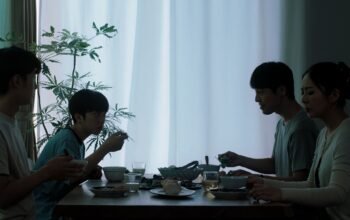
Family functions here not as a tired obstacle to be conquered before a happily-ever-after can be attained, but as an integral arena for character evolution.
Chris’s journey toward self-disclosure and parental acceptance forms a vital component of her emotional arc, reframing romance as an experience rooted in belonging, validation, and emotional transparency.
Similarly, the ensemble of friends infuses the narrative with vitality and comic timing, liberating the characters from insular dyadic isolation and placing them within dynamic social contexts.
Friendship is never treated as static set-dressing; rather, it is actively utilized to generate situational humor and soften moments of high emotional tension.
The Secondary Duo
Parallel to the central narrative, the secondary pairing of Meen and Sol, brought to life by Praifah and Peble, successfully carved out a devoted following, standing among the most magnetic romantic threads in Your Apple.
The allure of this dynamic stems from the delightful paradox of two ostensibly poised, mature women who visibly lose their composure the moment emotional intimacy enters the frame.
The actresses’ tangible chemistry infuses these hesitant moments of vulnerability and simmering romance with irresistible charm, culminating in a payoff that feels richly earned through patient narrative buildup.
Regrettably, the series fails to grant them the sprawling screen time required to fully cultivate this trajectory.
Just as the audience becomes deeply invested in their next step, their storyline is abruptly accelerated toward engagement and matrimony, as if the production realized belatedly that it possessed a powerhouse secondary couple worthy of primary billing.
Even so, their compelling presence served as a rigorous showcase of Praifah and Peble’s capacity to anchor a standalone project, making their subsequent transition to starring roles in Shadow of Love a natural evolution rather than an arbitrary casting choice.

Directing and Visual Treatment
The directorial approach aligns harmoniously with the narrative’s intimate scale, resisting the temptation to impose heavy visual or dramatic pretension upon a story designed to be accessible and tender.
The priority remains capturing the aesthetic grace of the leads and framing moments of closeness with tactile intimacy, leaning into quotidian details that ground the relationship.
However, the handling of the high-concept premise could have been visually enriched.
The motif of restored vision and the haunting visual imprint lingering in Chris’s memory offers rich directorial vistas beyond the literal recycling of eye imagery or dream sequences. Sight, memory, and imagination could have been harnessed to forge a developing visual lexicon that evolves in tandem with the emotional bond, transforming what Chris sees into a direct reflection of her internal awakening toward Karn.
This metaphorical expanse remains underutilized.
While the premise pulses with symbolic potential, the production treats it primarily as an inciting incident rather than an ongoing visual and narrative engine.
On a technical execution level, occasional production constraints prevent the work from reaching absolute cinematic polish.
This is not a matter of inflated budgets, but of whether editing, cinematography, and art direction manage to forge total aesthetic cohesion.
Certain visual details betray a need for heightened post-production care.
This critique is paramount because romance lives and breathes in the details, lighting, framing, and transitional rhythms are not mere decorative flourishes, but psychological instruments governing emotional proximity and distance.
When these elements lack uniformity, the actors are forced to shoulder an excessive burden of emotional heavy-lifting.
Dialogue and Comedy
The series excels at mining humor from everyday friction, particularly the behavioral contrast between Chris and Karn and Chris’s endearing awkwardness in front of her beloved. This dynamic injects effervescent charm into the narrative, allowing the actresses to showcase comedic timing far removed from heavy melodrama.
Conversely, the dialogue rarely scales matching heights.
Certain scenes suggest the screenplay relies too heavily on situational setups rather than sharp, revealing prose.
While functional within a romantic comedy, this reliance becomes a limitation when repetitive formulas stall character evolution.
Furthermore, certain comedic beats flirt with caricature or contrivance.
While permissible within the genre’s lighthearted sandbox, sharper tonal calibration would have preserved grounding character immersion.
The Poetics of Serendipity and Hidden Affection
The series elevates the central romance beyond conventional coincidence by revealing that Karn’s late mother was once Chris’s school teacher, inspiring a teenage Chris to donate blood due to a rare blood type.
The recipient, implicitly, was young Karn. While this plot point stretches plausibility, questioning the realism of a minor’s blood donation, it endows the relationship with a resonant, fated dimension, suggesting their lives intersected long before conscious recognition.
The mother’s parting letter introduces an additional layer of emotional resonance, having remembered the girl who saved her daughter, she registered as an organ donor so her eyes might eventually be gifted to the blind Chris. Thus, Chris, who once handed Karn the gift of life, subsequently becomes the vessel carrying her mother’s eyes, orchestrating an exquisite pre-ordained exchange of life and love before romance even takes root.
Parallel to this fateful thread runs the motif of open and masked devotion.
Chris refuses to limit her affection to daily companionship, secretly supporting Karn behind the pseudonym Apple.
This duality deepens Chris’s emotional interiority, channeling silent loyalty that demands no immediate validation.
The Apple persona transcends a mere narrative plot device for concealing identity; it becomes an extension of pure, unconditional devotion, proving that her support is tethered not to reciprocated romance, but to an altruistic desire to witness Karn’s flourishing from the shadows.
Romance and Intimate Scenes
It is impossible to analyze the success of Apple My Love without examining its handling of physical and emotional intimacy.
The series wisely capitalizes on lead magnetism, granting moments of physical closeness breathing room without reducing the relationship solely to physical chemistry.
The core triumph lies in establishing attraction through attentive care, domestic tenderness, and micro-interactions rather than relying exclusively on explicit romantic set-pieces. Emotional resonance requires audience conviction that the characters are genuinely acquiring deeper mutual literacy over time.
Nevertheless, blistering chemistry does not absolve the screenplay from its duty to architect intimacy psychologically.
A romantic tableau may stun visually, yet ring hollow dramatically if untethered from preceding character development.
This is the crucial chasm between a scene eliciting fleeting audience swoons and one permanently expanding narrative depth.
The work undeniably triumphs in rejecting gratuitous sensationalism, honoring courtship and gentle devotion.
Yet one must question whether the script supplied sufficient situational scaffolding to anchor that emotional depth, or whether it overly relied on the performers’ innate charisma to carry the frame.
The Finale: Emotional Escalation Revealing a New Dimension
One of Apple My Love’s most compelling structural choices is its refusal to coast indefinitely on lighthearted levity.
In its final stretch, the narrative elevates its dramatic stakes, plunging the relationship into a heightened emotional intensity unanticipated by viewers accustomed to its breezy rhythm.
This tonal pivot serves as one of the work’s finest narrative coups.
Having lulled the audience into a comfortable romantic haven, the series introduces vulnerable friction, forcing viewers to confront genuine emotional stakes.
The finale achieves profound resonance precisely because it reaps the rewards of the deep audience investment cultivated across preceding episodes.
Adaptation: Translating Text to Screen
Adapting Chao Planoy‘s novel Apple presents the formidable challenge of converting internal literary interiority into visual syntax without falling into the trap of over-simplification. Novels afford sprawling psychological landscapes, whereas television mandates translating introspection into kinetic action, dialogue, and framed mise-en-scène.
From this vantage point, the television adaptation prioritizes direct romantic interaction over metaphysical meditation on memory, perception, and pre-recognition.
This does not constitute an outright adaptation failure, but rather a deliberate stylistic choice, prioritizing an accessible, breezy romantic viewing experience over exhaustive literary translation.
Yet this choice remains fertile ground for critique, as adaptation demands forging a cinematic language that grants the work independent artistic autonomy.
Conclusion
Ultimately, Apple My Love defies absolute categorization through binary metrics of success and failure.
It possesses undeniable endearing qualities, foremost among them the luminous synergy between Ormsin and Folk, the warm domestic ecosystem, and a romantic ethos untethered from exhausting crises.
Conversely, it lacks the muscular dramatic architecture anchoring its primary relationship. While the premise is magnetic, its full potential remains unrealized; supporting characters add texture without achieving complete developmental arcs, and production compromises slightly blunt the overall polish.
Yet, the project wins its core gamble.
There is undeniable charm in rejecting tragic romance in favor of a narrative allowing its protagonists to discover sanctuary, acceptance, and joy.
This exact ethos explains its fervent cult following.
Apple My Love does not aspire to revolutionize romantic television or dismantle generic boundaries, rather, it succeeds as a tender, comforting confection that reflects better on its luminous leads than on the screenplay binding them together.
It is a work where chemistry eclipses structure, and character charisma reigns supreme even when the prose lags behind.