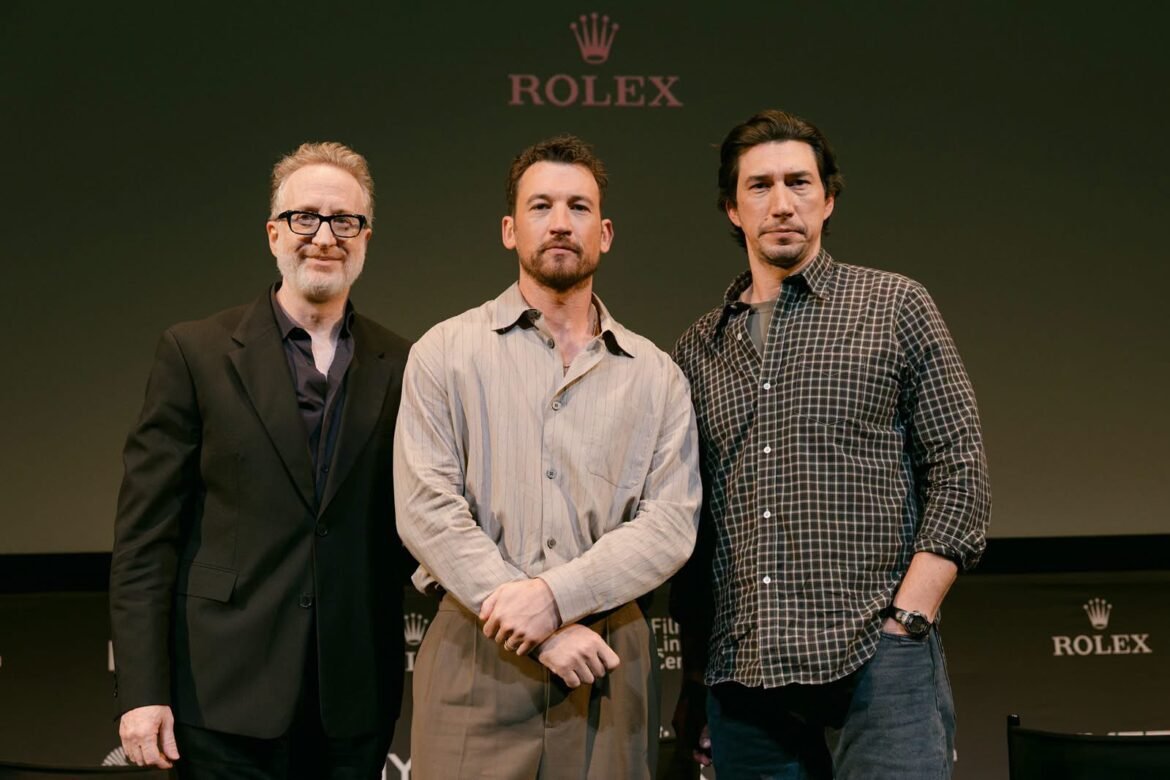
Adam Driver, Miles Teller, and Scarlett Johansson joined the filmmaker at Alice Tully Hall for the North American premiere of his 1980s crime drama.
NEW YORK — The opening night of the 64th New York Film Festival was more than just a premiere; it marked director James Gray’s return to the city that forged his cinematic vision.
On Friday evening, Sept. 25, Gray’s 1980s-set crime drama Paper Tiger kicked off the festival with its North American premiere. The helmer took the stage at Alice Tully Hall alongside stars Adam Driver, Miles Teller, and Scarlett Johansson for a post-screening Q&A.
Projected on 35mm, the film steps back into 1986 New York, following a middle-class family trapped between their aspirations for social mobility and the perilous crossfire of organized crime.
During the Q&A, Gray and his lead ensemble emphasized that the narrative views crime from inside the domestic sphere rather than from the outside looking in.
What starts as a dilemma between two brothers gradually expands into an existential threat to a wife, children, and the fragile life the family struggled to build.
Gray’s NYC from the Inside Out
With Paper Tiger, Gray returns to New York’s outer boroughs—a cinematic landscape that has defined his filmography since his 1994 feature debut Little Odessa.
Speaking ahead of the festival, the director noted that crime in his movies has never been an end in itself, but rather a mechanism to explore his personal history and family experience.
Gray explained that with the exception of Ad Astra and The Lost City of Z, most of his filmography is deeply autobiographical, framing “crime” as a vessel through which he explores intimate personal truths. In Paper Tiger, that autobiographical thread is especially poignant: the character of Hester, played by Johansson, is inspired by Gray’s late mother, who passed away shortly after being diagnosed with brain cancer.
The narrative also draws heavily on his parents’ lived experiences and his anxieties regarding economic disparity and the diminishing representation of working-class families in contemporary American cinema.
The Brother Opening the Door
Adam Driver stars as Gary Pearl, the older brother of Irwin (Teller). Gary is a former police officer turned security consultant who entices his brother into a seemingly lucrative scheme, only to drag them both into a dangerous web spun by Russian mobsters.
Driver previously reflected on collaborating with Gray, noting that the filmmaker affords actors tremendous creative leeway and fosters a set environment that gives performances time and freedom—an approach reflected in the complex dynamic between Gary and the rest of the family.
In Gray’s view, Gary is far from a conventional villain. He is a nuanced composite based on real figures from the director’s past, including his uncle and another acquaintance who met a mysterious demise.
Gray views Gary as carrying a tragic nobility, ultimately reaching a point where he chooses self-sacrifice over sinking further into a dirty game.
A Man Chasing a Better Life
Miles Teller plays Irwin, an engineer and family patriarch striving to secure a better future for his wife and children.
When his brother presents a financial opportunity, what begins as an attempt to improve their station quickly spirals into an encounter with a criminal underworld whose rules Irwin does not comprehend.
Gray treats Irwin as a character blind to the full scope of the game; he enters the illicit realm without malice, only to learn that the drive for social mobility can ensnare a person in a system far bigger than themselves.
Addressing the role, Teller previously discussed the challenge of playing a father without having children of his own, sharing that he drew heavily on memories of his own father and grandfather to anchor the character’s sense of patriarchal duty and protective instincts.
The Other Side of the Story
Scarlett Johansson takes on the role of Hester, Irwin’s wife, who refuses to remain on the sidelines of the domestic crisis despite being thrust into a male-dominated world fueled by cash and ambition.
Gray revealed that Hester was directly modeled after his late mother, with her terminal illness in the film echoing a deeply painful chapter of his own upbringing.
The director deliberately crafted Hester’s presence through sound design as well as visuals; in several sequences, her footfalls or voice herald her presence even when she is off-screen.
Praising Johansson’s “commanding and direct” performance, Gray noted that she brought an assertiveness and vocal agency to Hester that counterbalanced her husband, deliberately reflecting the real-life dynamic between his parents.
Between Crime and Contamination
Paper Tiger doesn’t merely chronicle a crime saga; it confronts the family with a dual form of contamination: the physical environmental pollution surrounding the Gowanus Canal, and the moral rot quietly infecting their business dealings and human bonds.
Gray draws an explicit line between Hester’s illness and the corruption enveloping the household. Hester’s fight for survival runs parallel to the family’s desperate bid to hold their fragile world together, even as Irwin and Gary discover that the lure of economic advancement masks a systemic web of interests far beyond their control.
Ultimately, Gray’s return to New York is more than a geographical homecoming; it is a cinematic return to the existential questions that have long haunted his filmography—family, class, ambition, wealth, and the perilously thin line between reaching for a better life and completely losing control of it.
By launching Paper Tiger on opening night, the New York Film Festival places Gray’s haunting vision at the very heart of the city he continues to immortalize on screen—a New York that remains as much a crucible of dreams as a ruthless test of survival.