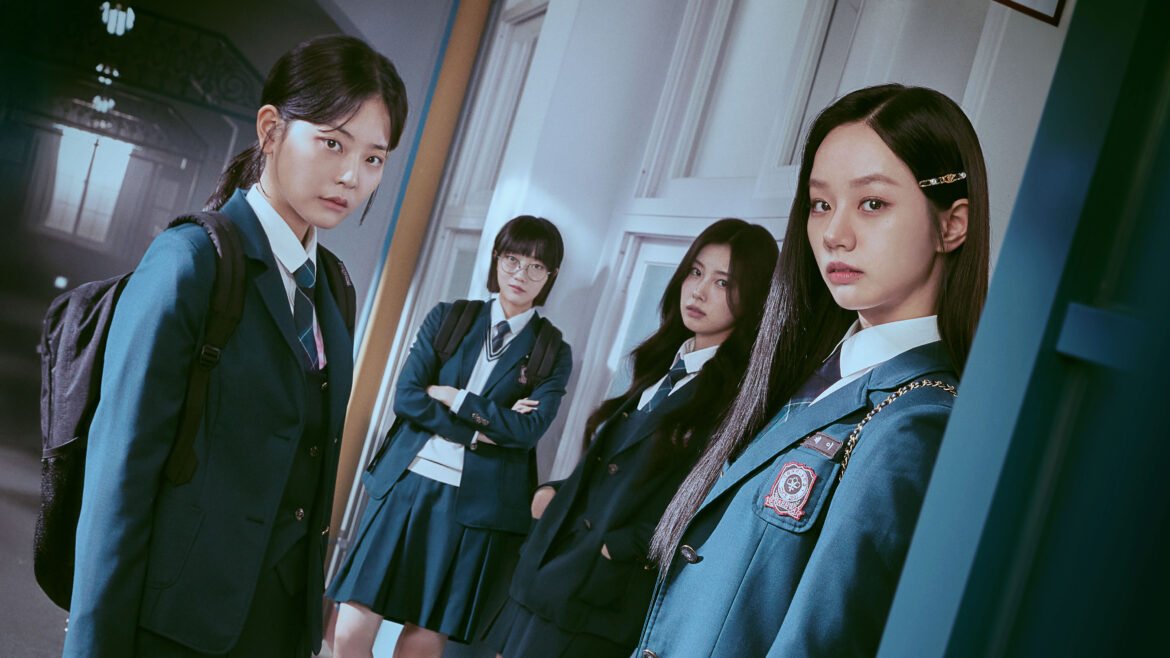
The Korean drama Seonuiui Gyeongjaeng, known globally as Friendly Rivalry and adapted from the hit webtoon of the same name, marks a sharp and defining detour in the trajectory of the Korean high school genre. After years of this dramatic category vacillating between rosy youth romances like Reply 1988 and True Beauty, or didactic social dramas, this series pushes the envelope aggressively into the territory of dark psychodrama and razor-sharp psychological thriller, replacing schoolyards with the corridors of a velvet-lined academic slaughterhouse.
From a deconstructive artistic standpoint, the series offers far more than just a tale of schoolgirls battling for top grades; it probes the psychological mutilation wrought by South Korea’s elite academic milieu, where friendship is weaponized into manipulation, excellence serves as a survival shield, and the human psyche is reduced to a commodity meant to be recycled—or destroyed.
The Script and Screenplay
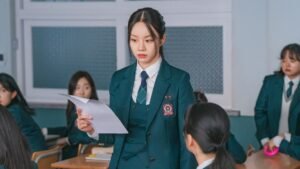
The narrative begins with its title—”Friendly Rivalry“—which carries a revealing dramatic irony at its core. The competition within Chaehwa Girls’ High School—which houses the top 1% of female students nationwide—has absolutely nothing to do with honor or innocence. Instead, it is a psychological war of attrition utilizing the latest tactics of intimidation, extortion, and pharmaceutical control.
From the opening minutes, the screenplay successfully builds its structural foundation on two parallel fronts.
The first is the criminal mystery (the whodunit), centered on uncovering the suspicious and murky circumstances surrounding the death of the newly transferred protagonist Woo Seul-gi‘s father.
The second, however, is the behavioral-psychological mystery (the why-dunit), dedicated to dismantling the pathological motives of the central character, Yoo Jae-yi, and gradually constructing the dynamics of dominance and submission among the students.
To the script’s credit, its first half maintains a taut, gripping pacing that avoids falling into on-the-nose exposition. Secrets aren’t unspooled through direct dialogue, but via micro-details: a fleeting glance, pills hidden inside a sanitary pad box, or an unexplained shift in classroom seating arrangements. However, in its later arcs, the narrative faces an increasing struggle to balance the gritty social critique of Korea’s hyper-competitive hagwon (cram school) culture with a heavy dose of psychopathic thriller elements that occasionally defy the logic of grounded reality.
Patriarchal Tyranny
At its narrative core, Friendly Rivalry conceals one of the harshest and most universal themes: “Patriarchal Tyranny” in modern Korean society. This profound drama doesn’t merely showcase the cruelty of the educational system at the prestigious Chaehwa High; it takes a surgical scalpel to reveal that this academic hellscape is merely a terrifying extension of an authoritarian structure manufactured and overseen by “fathers.”
This patriarchal throughline is not a mere B-plot; it is the “Prime Mover” behind all the psychological deformities afflicting the female leads.
To understand how the concept of “fatherhood” in this series morphed from a safe haven into a slaughterhouse for the human soul, we must deconstruct it further:
First: The Father as the Architect of Psychological Ruin
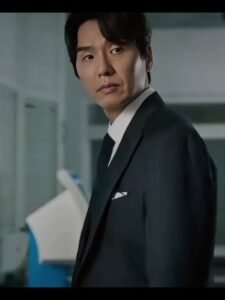
At the center of this axis stands Yoo Tae-joon (played by Kim Tae-hoon), father to the central character, Yoo Jae-yi. The script does not present him as the stereotypical physical abuser seen in classic dramas; rather, he is an elegant, icy, and calculating tyrant. He serves as the head of the PTA at Chaehwa High, and the figure pulling the strings from behind luxurious glass walls.
Second: The Dogma of “Conditional Love”
The philosophy adopted by the father, Tae-joon, boils down to the belief that everything in this world must be seized through ruthless competition and predation. He flat-out refuses to offer his daughter “unconditional love.” Instead, he manages her through a transactional system of rewards and punishments strictly tied to her academic metrics.
To him, his daughter is not an independent human being with the right to err or fail; she is an “investment project” and a narcissistic extension of his own self-image. He sees Jae-yi as a reflection of his personal perfection, and thus spares no financial expense on her—under one condition: she must always remain in first place.
The director brilliantly captures this tyranny not through screaming matches, but via a “terrifying quietness.” The father’s piercing glares, his low-register voice, and his frigid bargaining create a suffocating atmosphere, allowing the audience to viscerally feel the daily asphyxiation the daughter endures.
Third: The “Tyrant Cloning” Syndrome
The standout element of this show’s artistic execution is its exploration of “identification with the aggressor” or the cloning of tyranny. Initially, the daughter Yoo Jae-yi (played masterfully by Lee Hye-ri) appears as the quintessential perfect girl—beautiful, hyper-intelligent, and the ultimate power broker at school. But the series steadily peels back the layers to reveal that this perfection is merely a mask hiding a shattered personality, stripped of empathy by the absolute control and suffocating surveillance her father imposes on her.
Raised in an ecosystem that only respects power and dominance, Jae-yi completely lacks the capacity to forge healthy human connections. Rather than rebelling against her father’s cruelty, she “reproduces” this tyranny, inflicting it on those weaker than her—specifically, the new transfer student, Woo Seul-gi.
The pathological dynamic between Jae-yi and Seul-gi is fundamentally a chilling simulation of Jae-yi’s relationship with her father! Just as the father treats Jae-yi as private property to be controlled, Jae-yi treats Seul-gi like a pet or a bespoke doll. She offers her protection in the school’s feral environment, but in return, strips her of her autonomy, psychologically manipulates her, and pushes the relationship to a level of obsession and possessiveness that blurs the line between friendship and enmity.
From a critical standpoint, Jae-yi doesn’t “love” Seul-gi as much as she exerts the same patriarchal authority over her that she suffers at home, attempting thereby to reclaim her own stolen sense of control.
Fourth: The Educational Institution as a Patriarchal Panopticon
The patriarchal tyranny extends beyond the home walls to encompass an entire institution. Chaehwa Girls’ High School is not just a place of learning; it is a microcosm of South Korea’s rigid capitalist and patriarchal system.
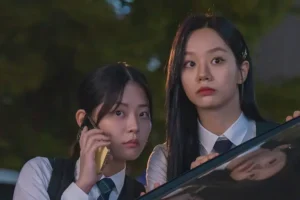
In a pivotal episode, it is revealed that Jae-yi uses her father’s office to access sensitive data regarding Seul-gi. This narrative detail symbolizes how “patriarchal power” acts as an all-seeing eye—monitoring everything, harvesting data, and weaponizing it to dictate others’ fates.
Conversely, we are subtly shown that the mothers in this world are essentially “undercover prison guards.” Artistically fascinating is the absence of active male fathers for the rest of the students, replaced instead by mothers who wield the exact same patriarchal tyranny.
For instance, Joo Ye-ri’s mother (a former actress) pressures her daughter, instilling in her a clinical obsession with appearances, luxury brands, and the perfect body. Meanwhile, Choi Kyung’s mother (who works in the judiciary) pressures her not to settle for being “perpetually second” to Jae-yi. The mothers here do not offer safe harbors; they function as “brokers” for the patriarchal system, enforcing its draconian standards on their daughters to secure their survival in the upper crust. This makes the oppression in this series a “structural” phenomenon—it’s not limited to one gender, but operates as an integrated meat grinder for these girls.
Fifth: The Scenography of Authoritarianism
The creators didn’t stop at writing brutal dialogue to express this oppression; they slyly and intelligently employed visual language to reinforce the concept.
We see this visually manifested first through the reliance on cold color palettes and sterile environments. Jae-yi’s home, much like her father, is framed to look like a high-tech hospital or laboratory. The dominant hues are white and gray, awash in harsh, warmth-free fluorescent lighting. This emotional void is expressed architecturally; Jae-yi often looks small, insignificant, and cornered between the walls of this freezing mansion that is utterly devoid of any signs of life or spontaneity.
Furthermore, the use of high-angle shots is highly deliberate. Tae-joon is frequently framed from a low angle to make him appear larger and more menacing, while Jae-yi is shot in front of him from high angles that emphasize her smallness and helplessness, visually communicating the glaring power imbalance between them.
The cinematography also physically manifests the traps of isolation. Patriarchal tyranny operates on the principle of isolating the victim. The father ensures Jae-yi has no real friends so she remains exclusively dependent on him. The director reflects this visually through framing that constantly places Jae-yi in the center of the shot but against completely empty backgrounds, underscoring her desolate loneliness inside her gilded cage.
Sixth: Shattering the Myth of “Friendly Rivalry”
There is zero honor in the battle fought within the school walls, because these girls are not free competitors; they are “fighting cocks” thrown into an arena built by their fathers.
The patriarchal pressure here does not push the girls to succeed; it pushes them to obliterate one another.
Mutual manipulation, forced drugging, stealing diaries, and emotional blackmail are tools the girls employ not out of their inherent nature, but because the patriarchal system taught them that “hell is other people,” and that one’s survival mandates the erasure of the other.
This twisted Darwinian philosophy (survival of the fittest) is the true crime the series puts on trial.
This dangerous narrative arc elevates the show from a mere drama into a horrifying case study on the mutation of human nature under the guillotine of patriarchal oppression.
Through the father, Tae-joon, who executes his tyranny in a tailored suit with a polite smile, and the daughter, Jae-yi, who inherits this toxicity and turns it into a tool to possess her classmate Seul-gi, the show poses a terrifying question: Are these girls born monsters, or are they simply defective products rolling off the assembly lines of fathers who know nothing of parenthood beyond the desire to control and possess?
The artwork does not merely condemn individuals; it indicts the structural system that treats the destruction of a generation’s mental health as an acceptable, justified tax to maintain social standing, delivering one of the darkest and most honest dramatic portraits of the backstage of the Korean elite.
The Dynamics of Submission
The artistic success of the work rested squarely on the acting performances of the central duo, which catalyzed a genuine rediscovery of the actresses’ capabilities.
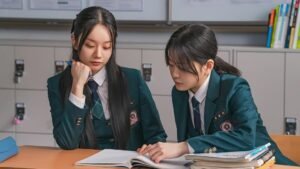
Together, they played a magnetic onscreen game embodying a dynamic of control and dark allure. First is “Yoo Jae-yi,” a character projecting a facade of perfection, a complete lack of empathy, authority, and classism. The second is “Woo Seul-gi,” a character revealing profound vulnerability, trauma, a desperate search for protection, and a primal struggle for survival.
The submissive dynamic between Jae-yi and Seul-gi transcends the idea of simple academic rivalry or suppressed romantic love, settling instead into an intensely complex psychological territory where the desire for absolute control tangles with a twisted emotional obsession.
From a psychological relationship-assessment standpoint, Jae-yi doesn’t merely seek to subjugate her classmate to guarantee academic supremacy—she already holds that crown. Rather, she seeks to test her ability to dismantle another human being’s will and remold it as an extension of herself.
This possessiveness is shrouded in a clinical obsession harboring emotional undertones and implicit attraction, where body language, calculated physical proximity, lingering stares, and seemingly tender touches translate into a form of “toxic caregiving.”
Jae-yi does not love Seul-gi in a healthy, familiar sense; she is infatuated with her broken, dependent reflection, utilizing mind games and control as a mechanism to enforce this subjugation. For Jae-yi, who internally suffers from emotional bankruptcy and a detachment from her own identity due to paternal pressures, Seul-gi represents a project for psychological projection. Controlling and breaking her is not just an intellectual game; it is the psychological armor that makes her feel complete and secure, transforming their relationship into an asphyxiating cocktail of repressed attraction, a need for dominance, and a battle for academic survival.
Acting Performances
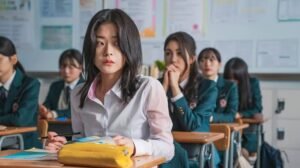
The character of Yoo Jae-yi was brought to life by actress Hyeri, delivering the biggest surprise to K-drama aficionados. After years of being typecast as the bubbly, spontaneous girl—cemented by her iconic turn in Reply 1988—Hyeri executes a radical pivot here by heavily employing micro-expressions and relying on severe kinetic discipline. Her smile is serene and calculated, and her eyes remain devoid of genuine emotion even during moments of alleged “kindness.”
Jae-yi is not just a traditional villain; she is the byproduct of an authoritarian patriarchal system represented by her influential doctor father. She is a high-functioning sociopath who views human relationships as a chessboard, treating Seul-gi as personal property or a project to validate her own power.
Hyeri deliberately lowered and stabilized her usual vocal register, giving the character an aura of frigid command that instantly raises red flags the moment she steps into a scene.
Opposite her is the second lead, actress Chung Su-bin as Woo Seul-gi, the provincial transfer student burdened by the trauma of her father’s death.
The absolute peak of Su-bin’s performance was her refusal to slip into the trope of the “passive, surrendered victim.” She masterfully broadcasted the grueling psychological paradox of Seul-gi on screen; on one hand, she desperately needs Jae-yi’s protection and influence to survive this lethal school, but on the other, she is terrified by the sheer volume of manipulation she constantly endures.
What also credits her as an actress is her skill in manifesting psychological tension physically—through hunched shoulders, hesitant glances, and rapid breathing during confrontation scenes, creating a stark visual and psychological contrast to the chilling emotional flatline of her co-star Hyeri.
Supporting Roles
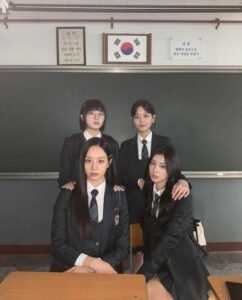
Supporting players like Joo Ye-ri (Kang Hye-won) and Choi Kyung (Oh Woo-ri) played vital roles in completing the school’s psychological mosaic. Every supporting character represents a different stress-response to the academic pressure. One resorts to addiction and plastic surgery to escape the anxiety of failure. The other is fueled by class resentment and envy as an engine to keep going.
These characters weren’t mere “extras” serving the leads; they exposed how this system mutates everyone who steps foot into it, to varying degrees.
Direction and Visual Language… The Architecture of Suffocation
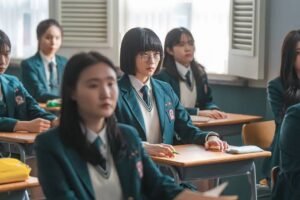
The directorial vision of the series stands as one of its most potent artistic elements, treating the setting (Chaehwa High School) as a standalone dramatic character.
The director leaned heavily into the Panopticon aesthetic—the concept of a prison where everyone can be observed at all times. Starting with the glass walls and open floor plans, the school is teeming with massive windows and cavernous halls, yet this opulence doesn’t scream freedom; it screams exposure and perpetual surveillance. The characters are always “visible” to others, effectively annihilating any sense of psychological safety.
Moving on to the sharp angles and straight lines, the framing frequently traps characters between the building’s stone pillars or along the sightlines of endless corridors, reinforcing the sensation that they are housed in a luxurious geometric cage.
Down to the color palette and lighting choices, the DP deliberately opted for cold, aquatic tones. The visual identity of the show is dominated by icy blues, metallic grays, and a sickly green. This grading strips the school environment of any warmth, morphing it into something resembling a psychiatric ward or a laboratory.
It is also worth noting here that the DP heavily utilized Chiaroscuro (intense light/shadow contrast) with heavy symbolic intent. In many scenes, Yoo Jae-yi’s face is only half-lit, while the other half dissolves into shadow—a direct visual cue to her dual nature and the darkness lurking within her.
Symbolism of Mirrors and Reflections
Scenes featuring characters staring into mirrors or blank, dark screens are strikingly recurrent. These reflections weren’t utilized merely for visual aesthetics, but to deepen the concept of the “fractured identity” or the disintegrated self of the students, who are forced to wear masks of success and perfection for society while being hollowed out by internal collapse.
Diving and Brilliant Visual Metaphors
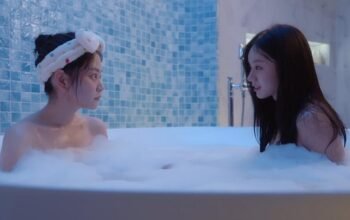
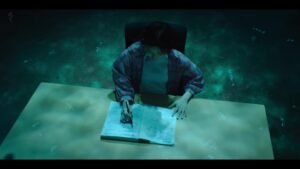
The recurring underwater diving sequences following the consumption of “focus” pills stand out as one of the most powerful visual metaphors in the series. The director uses the aquatic environment as an objective correlative for the state of psychological dissociation and chemical transformation the student experiences.
These scenes are artistically and psychologically deconstructed through several key motifs.
The most prominent is the idea of Sensory Muting. Physically, water acts to muffle external sounds and isolate a person from their surroundings. Consuming the drug performs the exact same function within the student’s mind; it silences the deafening roar of parental expectations, the cacophony of school competition, and the perpetual state of anxiety, leaving her in a bubble of forced focus and artificial calm where she hears nothing but her own heartbeat.
The second motif is The Drowning Paradox. Diving is used to express a terrifying contradiction; the student swallows the pills to survive and stay afloat in the swamp of academic rankings, but in reality, she is plunging herself into an asphyxiating environment where a human cannot breathe for long. Water here symbolizes addiction—a space offering a comfortable, temporary isolation, but where lingering means death and slow suffocation.
The third motif of the diving scenes is the concept of Weightlessness and escaping gravity.
The educational system at Chaehwa High imposes a psychological pressure that equates to a crushing physical weight grinding the students down. The moment of diving underwater is the only instance the student experiences “zero gravity.” Naturally, the drug grants her an illusory lightness, temporarily liberating her from the material and mental burdens dragging her back to earth.
The fourth motif is the Distortion of Reality and the moral compass. Beneath the water’s surface, light rays refract, vision blurs, and objects lose their true dimensions. This visually aligns with the effects of psychoactive drugs that hijack brain chemistry, as the student begins to lose her grip on objective reality. The boundaries between right and wrong dissolve, rendering her increasingly fragile and susceptible to manipulation by characters like Yoo Jae-yi.
The final, and perhaps most unexpectedly profound motif..
is the idea of Womb Regression. The curled or floating body posture underwater subconsciously evokes the image of a fetus in the womb. It is a psychological manifestation of a deep-seated desire to regress and flee the cruelty of a demanding external world, seeking an absolute, primal safety found only in the drug’s embrace.
All these profound, interwoven motifs are brilliantly executed by the director through the use of slow motion, coupled with amplified sound design highlighting the student’s muffled breathing and the sound of ascending bubbles. This technique doesn’t just aim for visual poetry; it violently pulls the audience into the character’s claustrophobic sensory experience, underscoring the show’s brutal thesis: in this system, academic excellence isn’t a climb to the summit—it’s a slow, deep dive to the dark abyss.
The Soundtrack: The Tones of Resident Anxiety
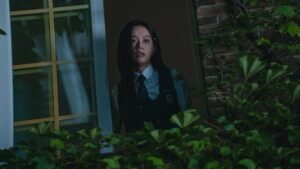
The sound engineering in the series didn’t treat the Original Soundtrack (OST) as an illustrative background for emotions, but as a weapon to induce discomfort.
The showrunner opted for Minimalist Synth over the grandiose classical orchestrations typically found in revenge dramas. The sonic landscape heavily relies on low-frequency drones and abrupt pizzicato strings that aggressively swell to generate an almost arterial tension.
Furthermore, one of the smartest artistic tactics in the show is the complete cutting of audio during moments of emotional climax—what we call “directorial silence.” This sudden muting abruptly dumps the viewer right into Seul-gi’s sensory isolation during her panic attacks or moments of extreme psychological duress, vastly elevating the realism and internal resonance of the experience.
The Psychological Anatomy of “Education Hell”
The artistic merit of the show transcends superficial thriller tropes to tackle deep-rooted structural issues in modern Korean society. If we look at the macro-themes of the series, we find it juggling four major axes simultaneously—a density of execution that heightened the director’s narrative burden and placed him against a challenge that exceeds the bandwidth of most global showrunners.
These themes were, firstly, the hellscape of Korean academia; secondly, Toxic Intimacy & Sapphic Code; thirdly, the commodification of children and the projection of parental complexes; and fourthly, behavioral control and Substance Exploitation.
First: The Obsession with Excellence and the Deconstruction of the Elite Class
The series is a continuation of the tradition sparked by hits like SKY Castle and Extracurricular, but it journeys into a much darker abyss. The fear of academic failure is no longer just tied to future career prospects; it is now tied to the fundamental “right to exist.”
Grades at Chaehwa High sort human beings and dictate their inherent value, transforming the educational system into a fertile breeding ground for behavioral disorders and psychopathy.
Second: Toxic Intimacy and Emotional Coding (Sapphic Undertones)
The series delivers one of the most complex female dynamics in modern K-drama. The relationship between Jae-yi and Seul-gi teeters on a razor-sharp, disorienting line between three emotions: first, a desire to protect and contain; second, a pathological possessiveness and a lust for total control; and third, an implicit romantic tension (Queer Coding / Sapphic Undertones).
This attraction wasn’t romantic in the conventional sense; it was a gravitational pull of power and vulnerability. Jae-yi sees Seul-gi as a blank canvas she can paint on at will, and Seul-gi sees Jae-yi as the only sanctuary from her own ruin, making her separation from her virtually impossible and lacing her blood with fear.
Third: Pharmaceuticals and Escaping Reality
One of the most audacious points the show tackles is the phenomenon of high schoolers exploiting tranquilizers and psychotropic drugs to boost focus or escape pressure. Here, the show doesn’t treat the issue with a superficial moralizing lecture; rather, it showcases how the human body becomes collateral damage in an unforgiving, grinding machine.
Fatal Artistic Flaws
Despite its myriad strengths, the series is not immune to several artistic stumbles that prevent its ascension into the pantheon of timeless masterpieces:
First: Sensationalism and Melodrama:
In certain episodes, the script careens into hyperbole when portraying psychological abuse and substance exploitation, pushing the show perilously close to the trap of cheap melodrama that leans on pure shock value over meticulous psychological pacing.
Second: The Weakness of the Crime Investigation Arc Compared to the Psychological One:
While the psychological warfare between Jae-yi and Seul-gi was impeccably penned, the investigation arc surrounding Seul-gi’s father’s death felt cobbled together with repetitive beats and plot holes, relying heavily on unjustified coincidences to preserve the mystery.
Third: Pacing Issues:
The middle third of the series suffered from narrative looping in the classroom confrontations, resulting in a drag on the overall pacing before aggressively reigniting in the final episodes.
The Shock of the Endings
The finale of Friendly Rivalry wasn’t merely a curtain call on a thriller; it was akin to dropping a heavy boulder into a stagnant pond, stirring up feelings of betrayal and frustration, particularly when examining the chasm between “what the audience expects” and “what the show’s psychological logic dictates.”
Usually, K-dramas lean towards delivering a comforting “catharsis” in their finales, where the villain is punished, the victim heals, and justice prevails. But the creators of this series opted for a much rockier and more realistic path. What serviced the ending well was the script’s refusal to spoon-feed a clichéd redemption arc to Yoo Jae-yi. She didn’t magically pivot into a do-gooder fueled by the “power of friendship”; she remained utterly anchored to her complex, warped psychological makeup. This steadfast commitment to the character’s psychological architecture is commendable—the scars inflicted by patriarchal tyranny cannot be wiped away by a simple apology.
Simultaneously, the finale refused to offer a utopian collapse of Chaehwa High or its draconian educational matrix. The wheel kept turning, and the patriarchal and academic institutions remained standing, reinforcing a terrifying critical thesis: “Individuals may fall or survive, but the slaughterhouse stays open for business.”
On the flip side, we felt let down by the rushed resolution of the criminal mystery. While the psychological warfare between the two students took its sweet time to simmer on low heat, the resolution of the core mystery (the circumstances of Seul-gi’s father’s death) felt heavily accelerated. The big reveal relied heavily on clunky exposition and melodramatic confessions that felt wildly out of sync with the razor-sharp brilliance that characterized the earlier episodes.
Furthermore,
the average viewer was bracing for a moment of complete emancipation for Seul-gi; a moment where she severs all the puppet strings Jae-yi spun around her and marches toward healing.
Yet, the open—or rather, “circular”—ending left the door cracked open for the continuation of this deformed bond in one way or another. This emotional “non-resolution” left the audience gasping for air, as if they had dived underwater with the protagonist, only for the director to end the series before letting them surface for a breath.
Ultimately, the ending of Friendly Rivalry may have betrayed the viewer hunting for a clear-cut, triumphant victory for justice, but it deeply satisfied the critic who understands that in the real world—specifically within highly toxic elite ecosystems—there are no clean-cut happy endings. There are only brutal compromises, unhealing scars, and complex entanglements too messy to sever with a single decision.
It was a bitter finale, but—ironically—the most honest one regarding the true nature of the work.
Read Also ..
Stop Calling ‘Friendly Rivalry’ a GL Series: The Anatomy of a Queerbaiting Masterclass
Conclusion…
Friendly Rivalry stands as a highly advanced, courageous, and exemplary piece of drama within its tier. It is televisual cinema that weaponizes thriller tropes and dark aesthetics to compose a savage elegy for a youth pulverized under the wheels of academic and societal competition.
The true currency of the series lies in its exceptional acting ensemble—spearheaded by Hyeri—who proved that the Korean actor is capable of shattering all classic molds if provided with a rigorous script and a directorial vision that knows how to invest in the shadows before the highlights. It is a work that refuses to hand out rosy solutions or tie its finale with a decorative ribbon; instead, it leaves the audience staring into a heavy mirror, questioning the true price we all pay when we rebrand psychological butchery as a “friendly rivalry.”