
Khom Khlang does more than break a number of established artistic conventions, carving out a distinctive place for itself among Thailand’s most promising television productions.
A closer examination of the romantic relationship at the heart of the series reveals an attempt to establish entirely new ideas and forms of intimacy on television, particularly for audiences accustomed to the conventions of GL drama.
While the series has drawn criticism for its limited directorial approach to love scenes, many of which feel unfinished or occasionally repetitive, it counterbalances these shortcomings with bold and unconventional ideas.
The execution may sometimes fall short of the concepts themselves, particularly in visual terms, but the ambition behind them remains difficult to overlook.

That boldness extends to the way the series approaches the body as a site of desire, power, submission and initiative.
Rather than relying on conventional romantic kisses or physical closeness as a reward audiences are expected to receive after a succession of emotional confessions, Khom Khlang attempts to expand the vocabulary of intimacy.
It does so through gestures, movements and physical details that rarely receive comparable attention in Thai television aimed at GL audiences.
More interestingly, not all these choices take the form of explicit scenes.
Some rely instead on visual suggestion, physical movement and the shifting distribution of roles between the two characters.
The desire between Master Bulan and Pheem is not governed by fixed romantic hierarchies, nor does either woman consistently occupy the position of initiator while the other remains merely responsive.
They explore different ways of expressing attraction together, making their relationship considerably richer than a conventional love story between two women.
This experiment takes on added significance within GL drama, a genre that has often treated intimate scenes as tender emotional milestones, or limited their physical vocabulary to kissing and embracing before quickly moving on.
Khom Khlang, by contrast, makes a clear attempt to broaden the language of intimacy by introducing elements of individual desire and sexual dynamics that are rarely represented in this particular genre.

Silent Attraction
One of the most distinctive features of Bulan and Pheem’s relationship is that neither character consistently relies on dialogue to communicate what she wants from the other. Their glances, body language, physical distance, and patterns of approach and withdrawal become a language of their own, offering an unusually nuanced example of nonverbal romantic communication.
Bulan makes particularly effective use of this space.
She is more conscious of her influence over the other woman and does not need to verbalize her desire every time.
A particular gesture or a carefully measured look can be enough to make Pheem understand exactly what she wants.
Pheem, by contrast, is more emotionally expressive and transparent in her reactions. She does not always conceal what she feels, but her gradual movement from hesitation to confidence becomes an essential part of her emotional and sexual development.
Here, the series succeeds in turning the body into a vehicle for character development rather than merely an instrument of visual titillation. As Pheem becomes increasingly comfortable with her attraction to Bulan, the way she responds to touch, physical proximity and initiative begins to change.
That transformation matters because desire is not always a fully formed emotion that announces itself with absolute clarity from the outset.
Sometimes people need to explore their feelings and discover what they actually want before they can express those desires with confidence.

From Arousal to the Discovery of Desire: How the Series Reframes Intimacy
In the third episode, the series delivers a scene that sparked considerable discussion among viewers.
It becomes clear that the physical relationship between Bulan and Pheem serves a purpose beyond satisfying romantic expectations.
It is also part of the process through which the two women begin to dismantle their psychological barriers.

Bulan, a self-assured woman who knows what she wants and feels no embarrassment about expressing her desire, uses her foot to flirt with Pheem and draw her into a more intimate encounter.
At first glance, this might seem like nothing more than an unusually daring piece of physical choreography.
Yet it opens the door to a broader reading of the relationship through the lens of unconventional forms of sensual expression.
The foot is no longer simply another part of the body within the visual composition of the scene; it becomes an instrument of flirtation, initiative and seduction.
More importantly, Bulan’s reclining position and the deliberate way she raises her foot toward Pheem communicate confidence and control, even though she is already the more assertive partner at this early stage of their relationship. This becomes even clearer when Pheem responds by exploring Bulan’s leg with her hand, creating a sequence of reciprocal gestures rather than a one-sided display of desire.
The scene can be read as approaching what sexual psychology and sexuality studies refer to as fetishism, or specific sensory preferences associated with particular body parts.
However, an important distinction must be made: using the foot as an instrument of seduction does not necessarily establish that the character has a sexual foot fetish.

Nor does the series offer an explicit confession or diagnosis from Bulan to that effect.
What it provides is a gesture that invites such an interpretation, leaving viewers room to consider the nature of the pleasure this interaction might hold for both women.
The significance of this moment extends beyond its relative rarity in GL drama.
It also disrupts the monotony that often surrounds romantic scenes when they rely almost exclusively on variations of the same kisses and conventional touches.

Mutual Masturbation
One of the series’ boldest choices arrives in the seventh episode, in a scene where Pheem explores her own pleasure while kissing her partner, before the other woman takes the initiative as their desire intensifies.
The importance of this detail lies in its affirmation of bodily autonomy and individual pleasure.
It presents a model that acknowledges every woman’s independent relationship with her body and her own sources of gratification.
The scene does not portray a woman as a passive recipient of her partner’s advances, nor does it reduce the expression of desire to a physical response to what the other woman initiates.
Instead, it places self-pleasure within the intimacy of a relationship without treating it as the opposite of emotional closeness or a substitute for it.
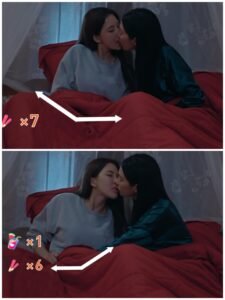
The interplay between kissing and self-exploration gives the scene a more complex meaning: a woman can be immersed in her own desire while remaining emotionally and physically connected to her partner.
Sexual psychology has devoted considerable attention to the relationship between bodily awareness and sexual satisfaction, including the ways in which understanding one’s own sources of pleasure and personal preferences can influence the ability to communicate with a partner.
From this perspective, the scene can be read as an acknowledgment of female sexual autonomy, rejecting the idea that a woman enters an intimate relationship as a blank slate upon which someone else is expected to write her sexual experience.
She brings her own body, experience, preferences and curiosity into the relationship. She can participate in discovering and creating pleasure rather than simply receiving it.
And acknowledging this dimension of female sexuality does not diminish the poetry or emotional depth of love.

The Conventional Dynamic
One of the most revealing aspects of Bulan and Pheem’s relationship is the constant shifting of initiative and control between them.
Love scenes often reflect a familiar dynamic in which one partner takes charge and directs the encounter, while the other occupies a more submissive position, deriving pleasure from surrender and receptivity.
Based on their initial characterization, viewers might assume that Bulan would be the more receptive partner, while Pheem would take on the role of initiator or dominant figure.
Yet the series disrupts this seemingly established arrangement by introducing a relatively unusual alternative.
In a scene in the fifth episode, Pheem emerges as someone capable of taking the initiative with confidence.
Her facial expressions, smile and physical presence suggest that she has no difficulty assuming control of the encounter or accommodating Bulan’s desires.
At the same time, however, Bulan behaves as though she remains in control, albeit indirectly.

The series thus introduces a different sexual dynamic, one that can be understood through the distinction between a Top and a Power Bottom.
In sexual terminology, a Power Bottom is the receptive partner who does not necessarily occupy a position of lesser authority or influence.
Instead, she can retain psychological control and help determine the pace, boundaries and nature of the encounter.
This distinction is particularly important because television drama frequently falls into the trap of directly associating a character’s outward personality with her sexual role.
The more assertive, powerful or authoritative character in everyday life is automatically positioned as the initiator, while the softer or more emotionally expressive character is assigned the role of the responder.
Bulan, however, allows for a more nuanced reading.
Even when she chooses the receptive position, she can remain the one directing Pheem, stimulating her desire and controlling the rhythm of the moment.
This interpretation becomes even more intriguing when considering the scene in which Bulan grips Pheem by the neck.
Viewed within the context of their intimate relationship rather than as an act of aggression or violence, the gesture can suggest physical dominance and mutual confidence.
It also presents a character whose emotional tenderness does not necessarily conflict with her desire to express physical authority within the relationship.
In any case, one partner gripping the other’s neck during physical intimacy can carry several psychological and sexual meanings.

The gesture can be examined through four distinct dimensions:
1. Power and the Exchange of Control
The neck is an especially sensitive area with strong symbolic associations. It is connected to movement, breathing and voice, while also being relatively exposed.
Placing a hand around it during intimacy can therefore create a visible shift in the balance of power: one partner holds and directs, while the other allows access to an exceptionally sensitive part of her body.
Psychologically, this may be associated with the excitement of exercising control or temporarily surrendering it.
However, it does not automatically mean that the person gripping her partner’s neck is dominant in everyday life, or that the other partner is permanently submissive.
2. Trust and Surrender
In certain intimate relationships, allowing a partner access to highly sensitive areas of the body can be an expression of trust.
Physical closeness here involves more than touch; it also entails accepting a degree of vulnerability in front of another person.
From the perspective of relational psychology, this can be understood through the concept of mutual vulnerability: the willingness to become emotionally and physically exposed to a partner, with the expectation that this vulnerability will not be exploited or used to cause harm.
It is important, however, not to infer trust from the gesture alone. Its meaning depends on mutual consent, context and the nature of the relationship.

3. Arousal Through Dominance and Submission
In certain sexual practices, neck-gripping can fall within the broader framework of Dominance and Submission (D/s), forming part of a consensual dynamic in which partners agree to particular roles.
One partner may find excitement in exercising physical control, while the other may derive pleasure from temporarily relinquishing it.
This does not necessarily indicate an unequal relationship outside the intimate encounter.
The roles established in private may be entirely different from the dynamic that governs their everyday lives.
4. Why the Neck?
The neck is not a neutral area in the language of body movement.
It is associated with sensitivity and exposure in human perception, and touching it may feel more intimate or stimulating than touching other areas, depending on the individual and the context.
This makes it a particularly effective visual device for television drama.
A hand placed on the neck can simultaneously suggest boldness, control, tension and desire, without requiring dialogue to explain what is unfolding between the characters.

The Belt: a tease of BDSM Without going all the way
The belt scene in the third episode may be one of the moments that most successfully stimulates the audience’s imagination, precisely because it builds a sexual expectation before deliberately withholding its direct fulfillment.
The moment begins when Pheem removes her belt, immediately creating an expectation among viewers about what she might do with it.
Yet she simply takes it off, wraps it around her hand and approaches Bulan without actually using it during the encounter.
Despite the boldness of the idea, this is also one of the directorial opportunities the series fails to capitalize on.
It could have been developed into a more substantial exploration of the evolving power dynamic between the two women, but the execution stops short of fully exploiting its potential.
The belt carries unmistakable cultural and visual associations with BDSM, an umbrella term for practices involving forms of bondage, discipline, dominance and submission.
What the series does here is invoke those associations without explicitly committing to them.
An ordinary everyday object is placed within an intimate context, where it suddenly becomes charged with a range of possible meanings.
In this sense, suggestion itself becomes part of the construction of erotic tension.

Foot Kissing
If Bulan’s use of her foot to seduce Pheem represents one form of initiative and control, the transition to foot kissing introduces another dimension of desire.
This is not merely an incidental gesture within a romantic scene.
It is a detail that invites discussion of sensory preferences and foot-related fetishism, a subject rarely addressed with comparable clarity in GL drama, even when a series is willing to venture into relatively daring intimate territory.
In the fifth episode, we see Pheem begin by kissing the outer part of Bulan’s leg before moving closer.
The moment also echoes the recurring use of Bulan’s foot to flirt with Pheem and draw her closer.
These details help establish a distinctive physical vocabulary for the couple.
More importantly, the series refuses to treat the body as a collection of areas that can only be approached through familiar romantic conventions.
Instead, it opens the door to discovering pleasure through less conventional forms of physical expression, giving them a place within an emotional relationship that does not lose its romantic character as a result.

Sex During Menstruation
Another choice involving the series’ intimate scenes deserves particular attention.
It may, in fact, be one of its most significant decisions in terms of representation: the portrayal of physical intimacy between Bulan and Pheem during menstruation.
In the eighth episode, this moment stands out as a bold choice because the series does not treat menstruation as an obstacle to desire or as a reason for the two women to suspend their intimate life.
It also challenges one of the most persistent taboos surrounding sex and the female body.
More importantly, the scene does not present the experience as a shock tactic or an exceptional situation requiring justification.
Instead, it incorporates it naturally into the relationship, even allowing room for playfulness and teasing.
Pheem jokes with Bulan about the different sides of her personality and expresses her delight at discovering these previously unseen dimensions of her partner.
The significance of this detail extends well beyond its provocative nature. It challenges a familiar representation of the female body on screen: one that consistently associates femininity and desirability with an idealized, pristine body, seemingly untouched by ordinary biological functions.
Bringing menstruation into an intimate context restores the female body to its human reality.
It presents a relationship in which a woman does not have to conceal her body’s natural functions or pretend that desire exists independently of the everyday realities of life.
This is particularly meaningful within GL drama, where many productions tend to idealize same-sex relationships, presenting them through an exceptionally soft and polished romantic lens. Khom Khlang moves closer to a more grounded and realistic understanding of the body.

On-Screen Chemistry: How Bint and Boonon Created This Language
These unconventional choices cannot be separated from the performances of Bint Sireethorn Leearamwat and Boonon Warangsiri Tanajarosavat.
Much of the success of these scenes depends on the actresses’ ability to communicate desire without relying on dialogue.
This is particularly evident in Bulan, whose appeal rests on the contrast between authority and composure, outward confidence and the emotional vulnerability that gradually emerges beneath the surface.
Pheem, meanwhile, is more emotionally expressive and transparent in communicating her desires.
Boonon gives the character a remarkable ability to convey anticipation, hesitation and the gradual transition from shyness to confidence.
By the tenth episode, glances, subtle changes in facial expression and the way each woman monitors the other’s reactions have become an independent language of flirtation between them.


Another moment worth noting comes when Bulan pulls Pheem by the hair and guides her downward.
It is an undeniably daring gesture, one that feels like an improvised choice by the actresses and fits the personalities they have established for their characters.
Intimate scenes do not succeed simply because they include daring physical gestures.
They require performers capable of making every movement feel like a natural extension of the character.
Without that connection, such moments risk becoming mechanical displays that strip the relationship of its emotional credibility.

Has Khom Khlang Really Invented a New Language for GL Drama?
Western and Asian productions have already explored diverse forms of sexual relationships and power dynamics involving dominance and submission.
What can reasonably be argued, however, is that Khom Khlang brings together a striking range of these choices within a single Thai GL production, placing them alongside a romantic relationship that has its own independent dramatic trajectory.
The series does not position boldness in opposition to romance, nor does it assume that portraying unconventional sexual desires requires sacrificing emotional depth.
Instead, it attempts to make both dimensions part of the same experience.
More importantly, these scenes raise broader questions about the way female characters are written for television.
Why must a strong woman always be the one who takes the initiative? Why is the receptive partner automatically assumed to have less control?
And why do a woman’s self-pleasure, sensory preferences and relationship with different parts of her own body remain marginal subjects in stories about love between women?

Khom Khlang does not offer theoretical answers to these questions.
Instead, it puts them on screen through Bulan and Pheem, allowing their relationship to become more complex than the conventional division between a dominant character and a submissive one.
The series may not always succeed in exploring these ideas with the dramatic depth they deserve, and it occasionally wastes opportunities that could have given certain scenes greater weight.
Yet it achieves something equally significant: it gives the female body a more prominent and diverse presence within the language of romance, opening up new possibilities for GL storytelling and allowing desire to move beyond repetition and familiar conventions.