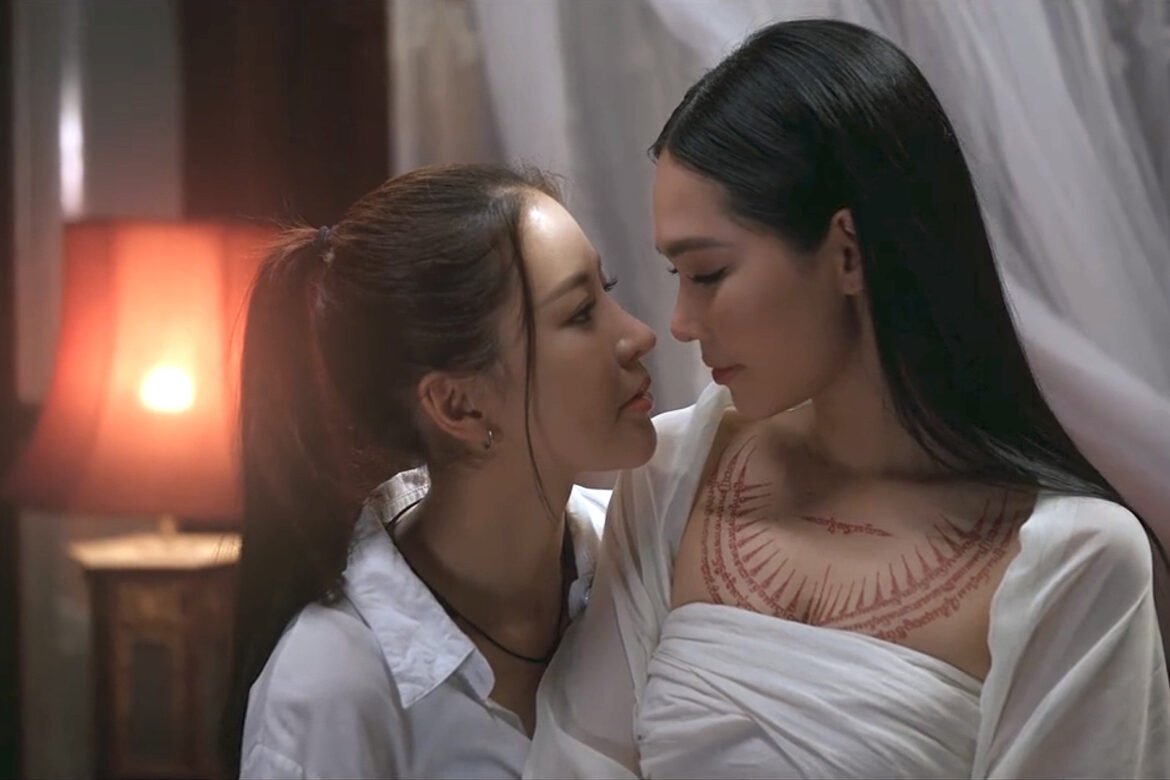
It is not often that a Thai GL series dares to venture beyond the familiar territory in which the genre has traditionally operated. Rather than settling for a conventional romance revolving around the attraction between two women and the obstacles threatening their relationship, Khom Khlang places love within a far broader and more intricate universe, where crime intersects with magic, sorcery, spiritual beliefs, folk traditions, and family conflicts.
It is an ambitious undertaking that seeks to give its characters lives extending beyond their romantic involvement, making love an integral part of a dramatic world governed by its own rules, dangers, and secrets.
This willingness to take risks is, first and foremost, the series’ greatest asset. Paradoxically, it is also the most appropriate starting point for understanding its shortcomings. Khom Khlang clearly aspires to offer something different within Thai GL drama, yet it does not always succeed in bringing its various elements under a cohesive artistic framework.
It has compelling ideas, strongly defined characters, and emotionally resonant sequences, but these coexist with narrative and directorial choices that make certain developments less convincing than they could have been.
At times, the series seems to know exactly what it wants to achieve without possessing all the necessary tools to bring that vision to fruition.

From Romance to the Supernatural
The story begins with a personal tragedy that sends police officer Pheem on a mission to hunt down Kratin, a human-trafficking kingpin endowed with supernatural abilities that render him impervious to bullets.
During one confrontation, Pheem’s brother is seriously injured and falls into a coma, while her pursuit of justice gradually becomes consumed by a desire for revenge.
When she realizes that conventional law-enforcement methods are insufficient against an adversary possessing supernatural powers, she is forced to seek the help of Master Bulan, the daughter of a spiritual master who possesses extraordinary abilities rooted in ancient magic and rituals.
From this point onward, the series begins constructing its own distinctive universe. Pheem is a woman who believes in physical evidence, the law, and rational thinking, whereas Bulan belongs to a world governed by beliefs that Pheem cannot explain.
This contrast is not merely a convenient device for creating amusing differences between the two leads; it constitutes the central engine of the narrative.
Each woman possesses knowledge that the other cannot access, and neither can confront the looming threat alone.
More importantly, their differences extend well beyond their professional lives.
They gradually become embedded in their romantic relationship as well.
Pheem, accustomed to controlling situations and confronting danger head-on, finds herself dealing with a woman whose thoughts are difficult to decipher and whose reactions are rarely predictable.
Bulan, in turn, must contend with someone who does not readily accept what she considers established truths within her spiritual world.
Here, the screenplay succeeds in establishing a convincing dramatic foundation for the two women’s growing intimacy.
Their relationship does not emerge simply because the series requires a romantic pairing. Instead, it develops through mutual dependence, dangerous encounters, and the necessity of sharing secrets.
Pheem’s attempts to persuade Bulan to help her, followed by their search for the seven ingredients required to create enchanted bullets, provide a narrative framework that keeps the two women together while allowing the investigation and their growing attraction to progress simultaneously.
This is a genuine strength.
Rather than separating romance from the central storyline, the series makes each one influence the other.
The more dangerous their mission becomes, the more dependent the women are on one another. And as their emotional connection deepens, the threats facing either woman become an immediate danger to the other.
Nevertheless, having a compelling premise does not automatically guarantee an equally accomplished execution.

Rich Ideas, Weak Structure
One of the most significant weaknesses of Khom Khlang lies in the way it organizes its information and narrative developments.
The series constructs a universe filled with intricate details, but it sometimes treats them as pieces of information that can be distributed across episodes in almost any order, without sufficient consideration for how viewers are expected to process them.
This problem becomes particularly apparent in the fifth episode, arguably one of the season’s most disjointed installments in terms of narrative construction.
The screenplay relies heavily on repeated flashbacks, returning to earlier scenes to explain events and relationships that should have been established at their natural points in the story. Rather than using this technique to deepen the mystery, the episode forces viewers to concentrate on reconstructing the chronology and determining when each moment actually takes place.
Some transitions feel disconnected from the scenes preceding them, while other sequences appear considerably later than their logical narrative position.
Certain details concerning Pheem’s awareness of the existence of the little ghost Thong, for instance, are only revealed after the events in question have already occurred.
The transitions between scenes taking place the following day and earlier ritual sequences also lack sufficiently clear temporal markers.
The problem is not the use of flashbacks itself, but the absence of a compelling dramatic necessity behind some of these decisions.
An effective flashback should reinterpret a previous event or disclose information that fundamentally alters our understanding of a character.
When it instead becomes a device for patching narrative gaps left elsewhere in the screenplay, it turns into a burden on the pacing.
The compression of the original novel into a ten-episode television adaptation appears to have contributed to this problem.
The novel could naturally devote more space to character backstories, family histories, and spiritual traditions, whereas the television adaptation must reorganize and condense this material.
Yet compression should not come at the expense of the essential connective tissue between scenes.
The problem becomes even more pronounced when the information in question is indispensable to understanding the rules of the dramatic universe itself.
The series introduces characters with different supernatural abilities and alludes to a system governing magic, incantations, amulets, and karmic connections.
However, it does not always establish clear boundaries between these powers.
For instance, Suwa’s father appears to possess considerable knowledge of spiritual rituals.
Yet when his son falls under the influence of black magic, he seems incapable of understanding what is happening or confronting it.
A simple line of dialogue could have resolved this ambiguity by clarifying that Kratin’s magic operates differently from the powers he understands, or that certain supernatural forces lie beyond his abilities.

The same issue recurs in the relationship between Bulan’s powers and the golden light associated with Pheem.
The series presents this connection as an important component of the fated bond between the two women, but it does not always provide a sufficiently clear explanation of how it operates or what conditions make it stronger or weaker.
Consequently, the very mystery intended to make this world fascinating also becomes a source of confusion.
Pheem: When the Investigator’s Competence Gives Way to the Lover’s Impulsiveness
One weakness the screenplay could have easily avoided is its failure to maintain consistency in Pheem’s characterization.
The early episodes introduce her as a courageous and intelligent police officer, experienced in confrontations and capable of making decisions under pressure.
As the story progresses, however, several situations repeatedly undermine this characterization, making her appear considerably less competent than she should be.

In the fifth episode, for example, Pheem knows that her supply of enchanted bullets is limited. Nevertheless, she fires seven of her nine remaining rounds during a confrontation that produces no meaningful injuries, despite already understanding the nature of the threat she is facing.
She also enters the location without convincing tactical coordination with her colleague, remaining exposed to danger even when there are clear indications that supernatural forces are controlling her opponents.
The same contradiction resurfaces in the seventh episode.
Pheem enters an abandoned building and encounters a series of unnatural events, yet at certain moments behaves as though she has never witnessed anything supernatural before, despite having already become emotionally involved with a woman whose life is deeply rooted in this world and who possesses extraordinary abilities.
Such moments weaken the character’s credibility because her decisions seem dictated more by the immediate requirements of individual scenes than by her established personality.
To the series’ credit, it occasionally manages to correct this inconsistency.
In the eighth episode, when Pheem goes to rescue Bulan from her brother Zai, she demonstrates intelligence and an impressive ability to assess the situation.
Knowing that she has only one bullet left, she confronts the threat with composure and resorts to another weapon when she realizes that conventional ammunition is no longer sufficient.
At this moment, we recognize the character introduced in the opening episodes.
Bulan’s rescue becomes the natural outcome of Pheem’s competence rather than a convenient act of heroism imposed by the screenplay.
This inconsistency suggests that the problem does not lie in the actress’s ability to embody the character, but rather in the screenplay’s failure to maintain a clearly defined characterization.

Direction and Editing: Between Visual beauty and Haste
The series demonstrates a distinct visual sensibility, but it does not maintain the same level of control over its scenes throughout.
Some sequences display beautiful composition, restraint, and a well-balanced relationship between movement and performance.
Others feel as though the editing is rushing toward a conclusion before allowing the scene to develop naturally.
This becomes evident in the abrupt transitions between scenes and in several confrontations that are not given enough time to establish the characters’ movements and spatial positions within the setting.
Certain action sequences also lose credibility because of insufficiently choreographed physical movement or a lack of coordination between the performances and sound effects.
The hospital confrontation offers a particularly telling example.
The actress portraying the woman under spiritual possession delivers convincing physical work, but the sound effects accompanying her attempt to strangle Pheem do not entirely correspond to what we see on screen.
The sound suggests a level of suffocation and physical pressure that is not fully reflected in the actress’s performance.
This is fundamentally a sound-design issue. Sound effects should not merely amplify the sensation of danger; they should reinforce what is happening visually and physically.
When these elements contradict one another, the scene loses part of its credibility.

Another sequence reveals difficulties in coordinating the characters’ movements as they attempt to restrain the possessed woman.
The physical resistance does not feel entirely convincing, while hesitation in executing certain movements makes viewers conscious of the mechanics of the performance rather than immersed in the confrontation.
A further continuity problem occurs when Pheem shoots Kratin.
Although the bullet strikes him directly in the chest, seemingly close to his heart, we later see him standing almost normally while a police officer handcuffs him and prepares to escort him away.
On the other hand, the series delivers several action sequences that deserve genuine praise. Pheem’s first confrontation is among the strongest action moments of the entire production.
The fight choreography is clear and forceful, while Puinoon lends the physical action considerable credibility through her commitment, executing punches, falls, and reactions to pain with impressive conviction.
More importantly, the series does not treat injuries as cosmetic details that can conveniently disappear between scenes.
Wounds, bruises, and blood remain visible, giving the confrontations a tangible physical weight and reminding viewers that violence has consequences.
This continuity in the makeup work is particularly important because it strengthens the credibility of the dramatic world.
When a character sustains a serious blow and appears completely unharmed in the following scene, the audience loses its sense of the severity of the incident.
Here, however, some injuries remain visible on the characters’ bodies, functioning almost as physical memories of previous confrontations.
That said, the makeup work is not entirely free of inconsistencies.
In the eighth episode, for instance, after Zai attempts to strangle Bulan, the severe marks of the assault are no longer visible on her neck once she regains consciousness.
The series also fails to maintain a consistent standard in its action choreography.
The confrontation inside the abandoned building in the seventh episode begins impressively, giving Puinoon another opportunity to demonstrate her physical capabilities.
Yet certain subsequent developments raise questions about Pheem’s reactions and her ability to assess the danger.
Her appearance after falling into a pool filled with liquid, without any obvious physical traces of what she has endured, also creates a disconnect between the incident and its consequences.
Ultimately, these are problems of continuity and detail rather than deficiencies in the performances themselves.

Pheem’s Amulet: An Unanswered Question
The series leaves another important detail unexplained: the protective amulet Pheem has been wearing around her neck since the beginning.
In the school sequence in the second episode, when she intervenes to rescue a possessed girl, Pheem removes the amulet and places it around the girl’s neck to ward off the evil spirit. The gesture clearly suggests that she already knows its purpose and protective capabilities.
But where did Pheem get this amulet? Who gave it to her? Why did she keep it and wear it, and how did she know about its power before even meeting Bulan, let alone beginning her journey into the world of magic and incantations?
The series provides no backstory to explain this detail, nor does it return to the subject later, despite its significance in establishing Pheem’s relationship with the supernatural world.
It is a narrative gap that leaves a fundamental question unanswered: how did Pheem acquire prior knowledge of something that should have been entirely foreign to her world?

Visual Identity : strong but Uneven
One of the series’ undeniable strengths is the visual identity it attempts to establish.
The supernatural world is not merely a neutral backdrop for the events; it is an integral part of the characters’ identities and their relationship with place and folk traditions.
Bulan’s wardrobe gives her a distinctive presence, combining traditional local clothing with contemporary fashion choices.
She is a character who does not need to constantly announce her authority.
Her appearance, movements, and carefully considered details communicate her standing within the world to which she belongs.
This is particularly evident in the shrine and ritual sequences, where costumes, makeup, posture, and hand movements become essential components in constructing her authority.
Some of the series’ most striking visual compositions emerge in these moments, especially when Bulan regains control of a situation and begins performing her rituals.
The costume design also succeeds in the eighth episode, when Bulan appears in an elegant suit during her visit to Pheem’s family in the capital, away from the atmosphere of the village. Her clothing serves more than an aesthetic purpose; it reinforces her self-confidence and her ability to enter a different social environment, even if it is not necessarily one in which she feels entirely comfortable.
Nevertheless, certain visual details deserved greater attention.
Among the most notable are the birthmarks that carry symbolic significance in the novel and, when brought together, form the shape of a heart connecting Pheem and Bulan.
It is a beautiful concept that fits naturally within the idea of a fated bond between the two women. However, its execution through makeup is not entirely convincing.
At times, the marks look like recently applied patches of color rather than natural birthmarks.
This is not an insignificant observation, since the symbol carries considerable dramatic weight and should have received visual treatment commensurate with its importance.
The visual effects also deliver mixed results. There are moments when Bint’s physical performance gives magic a tangible presence, particularly through her controlled hand movements, which suggest that she is manipulating invisible forces.
This is an essential aspect of productions relying on visual effects: the actress must first convince us that the supernatural power exists before the visual effects can complete the illusion.
However, certain sequences would have benefited from faster effects execution and more carefully coordinated movement within the frame. Some sound effects also fail to synchronize convincingly with the actors’ movements.
The issue, then, is not the absence of a visual vision, but the inconsistency of its execution.

Bint and Puinoon: Performances That Surpass the Material They Are Given
If there is one element that deserves the highest praise without reservation, it is the performances of the two leads.
Bint approaches Bulan with remarkable restraint and composure.
Rather than relying on exaggerated expressions or raised voices to establish the character’s presence, she uses her gaze, subtle facial shifts, and body language to communicate what is happening beneath the surface.
Bulan is a woman who knows more than she reveals, possessing a spiritual authority that makes others approach her with a mixture of respect and caution.
Such qualities could easily have turned her into an artificially mysterious or emotionally detached character.
Yet Bint succeeds in giving her enough human complexity to reveal what lies beneath that composed exterior.
Perhaps the most impressive aspect of her performance is her ability to move from absolute confidence to embarrassment and vulnerability without compromising the character’s identity. Bulan is not emotionally rigid; she is simply a woman accustomed to keeping her feelings under control.
Consequently, the moments in which she allows herself to become vulnerable carry greater emotional weight.
This is particularly evident when Pheem attempts to flirt with her or when Bulan finds herself in situations that provoke jealousy.
Bint does not need exaggerated reactions to communicate these emotions.
Sometimes a subtle movement of the eyes or the slightest change in facial expression is enough to reveal that the woman who appears entirely composed is struggling with an internal conflict.
Puinoon faces a different challenge. Pheem is a more emotionally volatile character who requires a wider expressive range, both physically and emotionally.
She moves between the tough police officer, the grieving sister, the woman struggling to resist her feelings, and finally the lover who can no longer conceal her attachment to Bulan.
Although this is among her first leading roles, Puinoon delivers a convincing screen presence in both action sequences and emotional breakdowns.
Her ability to convey grief, anger, jealousy, and desire gives the character considerable vitality.
Her performance is particularly effective in the ninth episode, which contains one of the season’s most emotionally demanding developments.
When Pheem and Bulan are forced to separate, the series does not simply present their farewell; it follows the emotional consequences for both women in parallel.
Each becomes unable to maintain her normal routine, loses her appetite, and exhibits visible signs of physical and psychological deterioration.

Puinoon delivers some deeply affecting moments, particularly when she tries to save the perfume pouch that represents her last tangible connection to Bulan after her mother sets it on fire.
Her desperate rush toward the water, her attempt to extinguish the flames, and her subsequent search through the ashes with her bare hands for any surviving remnants give the sequence an emotional intensity that transcends direct dialogue.
Bint, meanwhile, delivers an equally moving performance in the separation scenes.
The composure that has defined Bulan throughout the series gradually becomes another expression of suffering.
She does not need to constantly announce her pain; simply watching her struggle to continue her life is enough to reveal the magnitude of her loss.
What makes their performances particularly effective is that each actress understands the emotional nature of the character opposite her. They do not attempt to express feelings in identical ways.
Pheem communicates love more directly and impulsively, whereas Bulan requires more time before allowing her emotions to surface.
This contrast is one of the most important reasons the relationship works.

Chemistry: The Language of Glances
The chemistry between Bint and Puinoon is not merely a matter of visual compatibility or attractiveness enhanced by close-ups.
There is a gradually developing physical language between them, in which prolonged gazes, subtle facial expressions, and the way they approach or withdraw from each other become integral components of the relationship’s construction.
Initially, Pheem appears more willing to express her attraction, while Bulan maintains an emotional distance consistent with her disciplined personality.
But this distance does not remain static.
As the story progresses, Bulan begins expressing her interest through small gestures, her movements become more spontaneous, and she gradually allows herself to display jealousy and desire.
One of the finest moments illustrating this evolution occurs during the river sequence in the fourth episode, when the immediate threat temporarily recedes and gives way to a quiet conversation revealing how much the two women value one another.
The scene in which they exchange vows in front of the Buddha statue in the sixth episode is equally significant, giving their relationship an emotional and spiritual dimension that goes beyond immediate attraction.
These moments are important because they remind us that romance is not built on kisses alone.
Sometimes an expression of trust, a small gift, or encouraging a partner to meditate and reconsider her thoughts can be more affecting than an elaborate romantic sequence.
This idea also emerges when Bulan gives Pheem the small sword and encourages her to meditate so she can organize her thoughts and recover some of the investigative threads she has lost along the way.
Their relationship is therefore built on mutual support, rather than physical protection alone.
Another noteworthy development occurs in the eighth episode, when Pheem refers to Bulan as part of her family before explicitly introducing her to her relatives as her girlfriend.
It is a relatively simple exchange, yet it marks a clear shift in Bulan’s place within Pheem’s life.
Even small details, such as holding hands inside the family home, become meaningful, particularly because Bulan is not accustomed to expressing her feelings publicly.
Her decision to remain close to Pheem in an environment where she does not necessarily feel comfortable demonstrates a genuine evolution in her willingness to express love.

Intimate Scenes
There is no denying that Khom Khlang delivers some remarkably steamy scenes.
Even when isolated from their surrounding narrative context, they possess enough passion and relational dynamism to attract viewers to the series.
Yet the fifth episode also brings a certain degree of disappointment.
After the romantic tension carefully established over the preceding episodes finally reaches the point where declared attraction develops into physical intimacy, Bint and Puinoon deliver highly convincing performances, relying on their gazes, subtle expressions, and the physical choreography of the scene.
Bulan appears more confident in expressing her desire, while Pheem brings a physical presence consistent with her more direct personality.
The problem is that the scene does not receive the screen time it deserves.
After five episodes of anticipation and gradual buildup, the direction should have allowed more room for the emotional transition to unfold into a physical experience.
Another kiss, a quiet moment following their intimacy, or even a small interaction allowing viewers to absorb the significance of this new stage in their relationship could have made the sequence considerably more satisfying.

The early cut away from the scene, followed by a return from a different angle, also disrupts its natural flow.
A different version of the same problem emerges in the seventh episode.
The visual treatment of certain intimate moments feels overly familiar, relying on similar camera angles and physical gestures that have already appeared in previous scenes.
Some touches that should communicate unmistakable desire also appear hesitant or too restrained to reflect the evolution of the relationship.
Here, a gap emerges between the actresses’ performances and the directorial choices.
Bint and Puinoon possess the chemistry and the expressive ability to communicate desire, but the visual approach does not always capitalize on these strengths.
Indeed, the repetition of certain gestures, such as similar kisses around the neck, makes it possible for viewers to anticipate what will happen before it occurs.
This is not about demanding greater explicitness or more revealing scenes.
Rather, it is about renewing the visual language through which intimacy is expressed.
A relationship that begins with hesitation and gradually develops into trust, comfort, and desire should also evolve in the language of touch, the manner of physical approach, and the rhythm of the camera.
Nevertheless, it would be unfair to overlook the genuinely bold choices the series makes in portraying the relationship between the two women.
It does not treat their bodies as forbidden subjects, nor does it suggest that female desire requires justification or apology.
Instead, it gives their relationship room to express mutual pleasure and intimate experiences that remain relatively uncommon in Thai GL drama.
One particularly notable choice is the portrayal of physical intimacy during Bulan’s menstrual period, without treating menstruation as an obstacle to desire or a reason for physical distance.
Instead, it becomes a natural detail within a relationship that has grown more comfortable and accepting.
The series subsequently explores other aspects of female pleasure and mutual initiation, giving both characters greater autonomy in expressing their desires.
This conceptual boldness deserves recognition, but boldness alone is not enough.
The success of an intimate scene should not be measured by how much of the body it reveals, but by what it discloses about the character and the relationship.
The direction could have explored these moments with considerably greater variety and depth.

In this respect, the series succeeds in presenting a relationship defined not only by what Bulan and Pheem feel for each other, but also by how they discover each other’s bodies and learn to communicate with one another.
From the exploration of self-pleasure to the use of the foot as an instrument of seduction and kissing, from the suggestion of physical dominance through gripping the neck and hair to the incorporation of BDSM imagery through the belt, and finally to the portrayal of intimacy during menstruation, the most important element connecting these details is their refusal to reduce women to a single representation of desire.
They also challenge the assumption that strength and tenderness, initiation and receptiveness, or independence and shared pleasure are mutually exclusive elements that cannot coexist within the same relationship.
Love does not cancel out desire, desire does not diminish emotional intimacy, and physical closeness does not necessarily require surrendering strength or independence.
Between Bulan and Pheem, these ideas become part of a relationship that aspires to be more complex than a straightforward story of attraction between two women.

Family Conflict: When Superstition Becomes an Instrument of Oppression
One of the elements that gives the series a significant social dimension is the conflict between Pheem and her family, particularly her relationship with her mother, who regards her daughter’s love for Bulan as a deviation that must be corrected.
Initially, the family appears to be caught up in a larger conflict governed by supernatural forces. As the episodes progress, however, it becomes increasingly clear that the problem is not simply about magic.
Social prejudices and deeply rooted beliefs are being used to justify control over Pheem’s life and interference in her personal choices.
Pheem’s mother becomes one of the series’ most frustrating characters, particularly when she interprets Bulan’s tattoos as evidence of questionable morality and resorts to degrading judgments that undermine her dignity.
Yet the character does not remain a conventional obstacle in a romantic storyline.
The series connects her behavior to the influence of spiritual forces controlling members of the family, subsequently providing a clearer understanding of the reasons behind their hostility.
One of the television adaptation’s strengths is its occasional ability to clarify the family’s motivations more effectively than the novel does at this stage, particularly through Zai’s role and his influence over the other family members.
The confrontation reaches its climax in the final episode, when Pheem’s mother takes her daughter to someone who performs rituals intended to expel what she perceives as evil from within her.
The scene transcends the boundaries of fantasy and approaches a painful reality experienced by some members of the queer community, in which religious or spiritual beliefs become instruments of coercion and attempts to change a person’s sexual identity.
The scene’s real significance lies in the fact that Pheem does not merely resist the ritual; she confronts the ideology behind it.
She implicitly asks her mother whether she must endure pain in order to finally earn her acceptance and love.

It is a devastating question because a daughter’s need for love should never be conditional upon abandoning her identity or denying her feelings.
The series deserves credit for not placing spirituality itself under accusation.
Instead, it distinguishes between faith as a path toward discipline and tolerance, and the manipulation of belief systems to justify hatred and control over others.
This distinction is particularly important in a series that makes spiritual heritage one of its central pillars.
The eventual reconciliation becomes more affecting when Pheem’s mother apologizes to Bolan and acknowledges her mistakes.
Pheem’s brother subsequently regains consciousness, allowing the family to reunite in a celebratory moment that restores some of what they have lost.

Bulan and Zai: A Confrontation That Exposes the Limitations of the Supernatural World’s Rules
While the series succeeds in making magic an integral part of its identity, the final confrontation between Bulan and her brother Zai exposes just how insufficiently developed the explanatory framework of this supernatural universe remains.
The anticipated confrontation could have served as a major visual and dramatic climax, particularly given the family and spiritual history underlying the conflict between the siblings, and Zai’s determination to acquire power and exploit it for selfish purposes.
Yet the confrontation does not always follow a clearly established logic.
When Bulan summons the power of the tiger to confront her brother, it becomes apparent that the family’s emblem cannot be used against members of the family itself.
This is information Bulan should presumably have known from the beginning, especially since her father was aware of Zai’s ambitions and had passed his teachings on to her so she could protect herself and safeguard the family’s legacy in the future.
The series also fails to clarify whether Bulan is acting according to a calculated plan or genuinely suffering defeat because of the limitations of her abilities.
One possible interpretation is that she realizes her brother will ultimately destroy himself if he obtains a power whose responsibilities he cannot bear, and deliberately allows him to approach his goal until his own greed becomes the cause of his downfall.
Another possibility is that she chooses to place her faith in karma, trusting it to punish those who use magic for malicious purposes.
Both interpretations carry compelling symbolic weight, but the problem is that the narrative never sufficiently establishes which one it intends to pursue.
Nevertheless, the transfer of Bulan’s power to Zai carries one of the series’ most significant thematic implications.
Bulan acquired her abilities through years of training, faith, discipline, and sacrifice, whereas Zai wants power simply as an instrument of domination and revenge.
When he acquires it without possessing the wisdom or discipline necessary to bear its responsibilities, it becomes a burden that ultimately destroys him from within.
Here, supernatural power becomes an unmistakable metaphor for authority when it falls into the hands of someone lacking the wisdom required to wield it.
This idea gives the confrontation a thematic dimension that goes beyond an exchange of blows and incantations.
Bulan’s use of a piece of her mother’s clothing to restrain Zai also introduces a familial and symbolic dimension, connecting the confrontation to the family’s history rather than limiting it to the characters’ supernatural abilities.
However, the scene in which Bulan throws her mother’s garment over her brother exposes a dramatic problem the series never resolves.
The screenplay does not explain why this particular garment possesses such power.
Does it carry a special incantation or blessing? Does its power originate from the mother herself, or from the family’s spiritual traditions?
Nor does the series sufficiently foreshadow its use in the confrontation, making its sudden appearance feel rather convenient.
The series also leaves viewers with several other unanswered questions.
Why was the golden light associated with Pheem not more effective in restoring Bulan’s power? Why did certain abilities fail to manifest more clearly when the two leads needed them most? And was Bulan’s apparent surrender to her brother’s power a deliberate strategy or a desperate decision intended to save Pheem?
These questions do not undermine the emotional outcome, but they reveal that the series’ structural construction required considerably greater refinement.
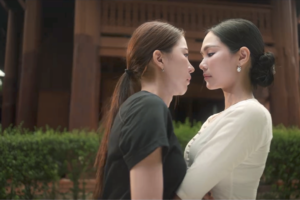
The Final Plot Hole: When the World’s Rules Are Suspended to Serve the Narrative
One of the clearest indications of the series’ structural inconsistency lies in the way the screenplay handles the spell placed on Pheem’s mother, particularly when compared with what happened to her father.
From the beginning, the series establishes Bulan as the heir to a body of spiritual knowledge that enables her to detect the traces of black magic, resist it, and deal with its consequences.
This ability is presented as a fundamental part of her identity and the role she plays within the narrative.
It is therefore entirely reasonable to expect her to intervene when she discovers that Pheem’s mother is also under the influence of an evil force.
What follows, however, reveals a contradiction that is difficult to overlook.
When Pheem’s father falls victim to magic, Bulan successfully identifies its source and neutralizes it through a clearly established ritual. With the mother, however, despite sensing the presence of danger surrounding her as early as the eighth episode, Bulan does not demonstrate the same degree of effectiveness.
She initially hesitates to tell Pheem what she knows, then eventually limits her intervention to giving her an incantation intended to protect her against the threat.
When Pheem’s mother tears up the incantation, we do not see Bulan make any serious attempt to find an alternative solution, nor does the series provide a convincing explanation for why she cannot intervene directly.
This is a substantial narrative gap.
The entire development feels like a plot device inserted to separate the lovers and manufacture additional drama.
The problem is not Bulan’s failure to remove the spell.
Failure itself could have provided compelling dramatic material if it had resulted from clearly established rules or a supernatural force beyond her abilities.
The problem is that the series never gives us a convincing reason for this discrepancy.
Was the magic affecting the mother fundamentally different from the spell placed on the father? Was the mother’s rejection of assistance so absolute that spiritual intervention became impossible? Did Bulan know more than she was telling Pheem? Or were there limitations to her abilities that the screenplay had simply never established?
Any of these possibilities could have added another layer of complexity to the narrative, but the series never clearly commits to any of them.
The gap becomes even more pronounced in the final episode, when the crisis turns into a confrontation between mother and daughter, and the mother gradually realizes that the problem was never her daughter or her relationship with Bulan, but rather her own prejudices and refusal to accept them.

The series chooses to resolve the conflict on emotional and moral grounds through the mother’s change of heart and eventual apology. This is not inherently a wrong decision. Indeed, the mother’s abandonment of her preconceived judgments and acceptance of her daughter constitute an important emotional destination.
However, reaching that destination should not require the narrative to suddenly abandon the rules it previously established.
The screenplay could have revealed that the magic was connected to the mother’s own resistance or to a deception orchestrated by Zai. Alternatively, it could have established genuine limitations to Bulan’s abilities, making her unable to intervene in the usual way.
It could also have given the mother’s rejection of the protective incantation dramatic consequences that would naturally lead to the eventual outcome.
Any of these approaches would have made the ending more cohesive because Bulan’s inability to intervene would then have become an integral part of the conflict rather than an unexplained narrative void.
The result is a finale that succeeds in generating sympathy and achieving reconciliation, but does not equally succeed in resolving the story according to its own internal logic.
This is a more fundamental flaw than certain directorial missteps or visual-effects shortcomings because it undermines the very foundation that should make the dramatic universe believable.

The Finale: Love Triumphs Over Hatred More Than Power Triumphs Over Evil
The series chooses to prioritize family reconciliation and emotional resolution in its finale rather than delivering the prolonged supernatural confrontation viewers might have anticipated.
This decision has both advantages and disadvantages.
On one hand, the conflict between Pheem and her family deserved a conclusion that acknowledged everything she had endured, and Bulan finally needed to receive the acceptance that had been denied to her.
Pheem’s brother regaining consciousness, along with the appearance of her deceased sister during the celebratory sequence, also provides an emotionally satisfying closure to the family storyline.
On the other hand, the conflict between Bulan and Zai deserved a considerably more spectacular confrontation, one proportionate to the magnitude of the threat the series had spent the preceding episodes establishing.
It would have been possible to combine supernatural resolution with emotional triumph. Instead, the finale seems more concerned with achieving inner peace than fully exploiting the action and visual potential of the confrontation.
Nevertheless, the sequence in which Pheem returns to Bulan after freeing herself from her restraints, using her amulet to protect her and ease her suffering, represents one of the moments when the supernatural and emotional elements successfully converge.
Here, love is no longer merely an emotion accompanying the events; it becomes a tangible force within the world the series has constructed.
Pheem’s decision to transfer to the town where Bulan lives also gives their relationship a future beyond the resolution of the conflict.
What was initially a place she had been forced to visit because of the investigation now becomes the place she actively chooses as the setting for a new life alongside the woman she loves.
The final scene offers an intimate and understated moment that suits the nature of the couple.
Bulan’s wardrobe shifts from its traditional burgundy tones to white, a visual transition that can be interpreted as a sign of a new beginning, although the series never explicitly explains its symbolism.
Bint and Puinoon successfully carry these moments through their gazes and physical interactions, while the cinematography and musical score establish a calmer and more balanced rhythm than some of the earlier intimate sequences.
Yet even the finale does not entirely escape smaller narrative problems.
Certain details concerning Pheem’s grandmother and her previous relationship with Bulan deserved a moment of acknowledgment or clarification.
Earlier, Bulan had approached her under the pretext of seeking help with matters related to prosperity, and subsequently asked her to teach her how to cook, without revealing her true identity.
When the family reunites in the finale, this relationship receives no moment of confrontation, apology, or even mutual acknowledgment of the deception.
A brief scene could have provided a much more complete resolution to these details.
There are also unanswered questions concerning the objects and rituals used to expel black magic, alongside continuity issues involving the papers and pieces of fabric appearing in the final sequences.
These are relatively minor gaps compared with the emotional scale of the finale, but they reinforce the impression that the series did not manage to tie up every narrative thread before the curtain fell.

Expanding GL, Outgrowing its story
The real value of Khom Khlang lies in its refusal to treat stories of love between women as a genre confined to everyday relationships and conventional romantic misunderstandings.
It presents two women with careers, responsibilities, family histories, personal beliefs, and dangers that extend far beyond their romantic involvement.
They are placed at the center of a narrative involving crime, magic, power, karma, and social prejudice.
This diversity is important to the evolution of the Thai GL industry, which needs more productions willing to open up broader dramatic possibilities for their female characters.
There is no reason for these stories to remain confined to romance alone, nor should a character’s sexual identity be the only element determining the kinds of narratives that can be told about her.
From this perspective, the series represents a step worth recognizing.
The decision to cast two mature actresses as Pheem and Bolan also gives their relationship a distinctive presence.
Bulan is a woman with a firm sense of self and an established position within her world, while Pheem is a woman with a profession, responsibilities, and difficult decisions to make. Neither character appears to be waiting for love before beginning to live.
This becomes even more significant through Bint’s performance, which gives Bulan a presence rarely encountered in certain GL productions.
She is not simply a young woman at the beginning of discovering her feelings; she is someone who already knows who she is and what she wants, and must learn how to allow love into a life whose rules she has already established.
The preparation undertaken by the two actresses is also evident in the natural chemistry they share.
Their relationship required workshops and joint rehearsals to develop their on-screen connection, while their mutual support during emotionally demanding and physically challenging scenes became an important part of their filming experience.
Yet this strength also places greater responsibility on the writing and direction. When a production has two actresses capable of generating such a compelling level of interaction, it becomes particularly frustrating when the screenplay does not consistently provide them with material written with the same degree of care.

Final Thoughts
Khom Khlang is not a flawless production, but it is certainly not an ordinary series that can be reduced to the success of a romantic pairing or a collection of visually appealing scenes.
It is a series that attempts to give love a place within a more complex universe, where folk mythology intersects with crime, family conflicts, and social prejudice.
It succeeds in establishing a distinctive identity, introducing a central couple with genuine chemistry, and making effective use of Bint and Puinoon’s performances to portray a relationship that develops through gazes, touches, emotional support, and difficult circumstances.
>It also delivers several strong action sequences and demonstrates considerable boldness in its treatment of intimacy and female desire.
However, it also struggles with narrative organization, temporal transitions, and the rules governing its supernatural universe.
Some character decisions are not entirely consistent with what we have previously learned about them, while the direction does not always give emotional and intimate scenes the time and space they require.
Perhaps the series’ greatest paradox is that it possesses all these compelling ingredients but fails to make them work together with the same degree of effectiveness.
There are moments when the two actresses surpass the screenplay, and others when their chemistry rescues scenes that could have been considerably more affecting with stronger directorial choices.
Khom Khlang gives us a relationship worth becoming emotionally invested in, a world worth revisiting, and two characters capable of carrying stories beyond this particular experience.
Yet it also leaves us with the impression that a far more accomplished production was within reach, only to be compromised by the gap between the screenplay’s ambitions, the limitations of its running time, and the shortcomings of certain executional choices.
It is a series in which chemistry triumphs over the screenplay, and performance gives us what the narrative cannot always deliver.
That does not diminish the importance of its ambition. If anything, it makes us wish its artistic tools had been worthy of the world it set out to create.