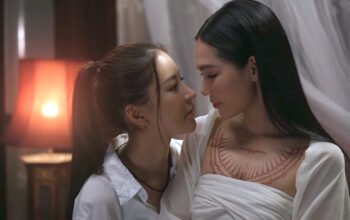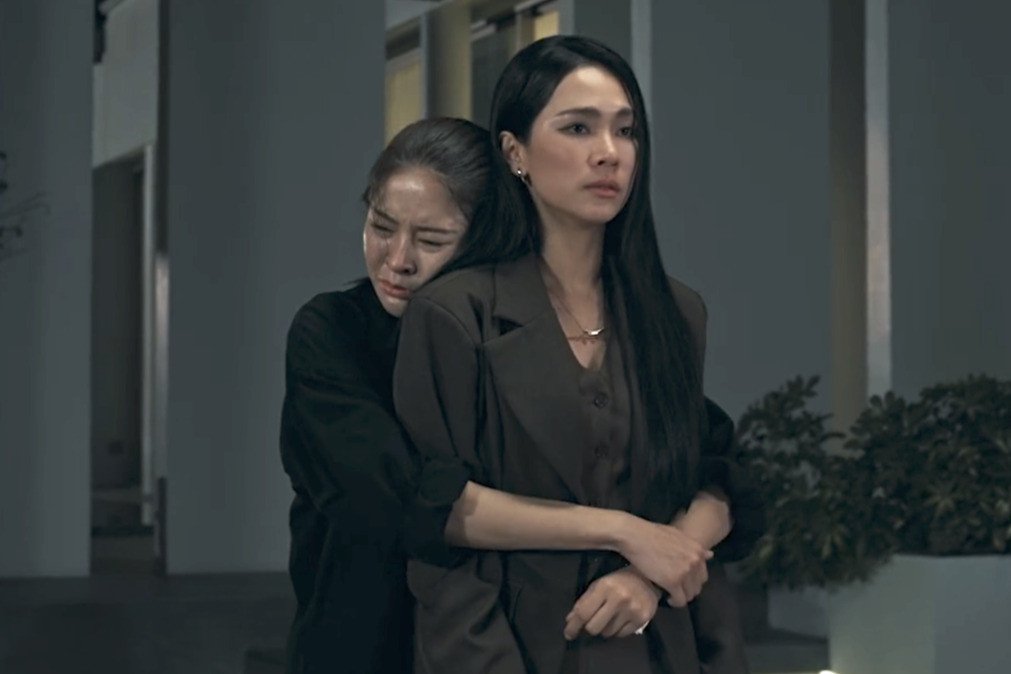
Khom Khlang is an ambitious attempt to push the Thai GL genre beyond its familiar romantic territory.
By weaving together crime, black magic, spiritual beliefs, folklore, family conflict, and forbidden love, the series creates a world that is considerably broader than the conventional romance between two women.
Its appeal lies in this willingness to experiment, as well as in the striking chemistry between its leads.
Yet the series often struggles to bring its many ambitions under firm narrative and artistic control. These 19 observations examine where its enchantment succeeds — and where its construction begins to falter.

1. A GL Series That Dares to Expand Its Genre
One of Khom Khlang’s most notable achievements is its refusal to remain confined to the familiar structure of a romantic GL drama. Crime, supernatural mythology, spiritual rituals, and family tensions are not merely decorative additions; they form the foundations of the narrative.
This broader scope gives the series a distinctive identity and demonstrates the potential of Thai GL storytelling to explore genres beyond romance.
2. A Fascinating Supernatural World That Needs Clearer Rules
The mythology surrounding black magic, enchanted objects, spiritual powers, and supernatural protection offers fertile ground for dramatic conflict.
The idea of creating enchanted bullets through seven essential elements, for instance, gives the story a tangible system of magical limitations. However, the series does not always establish these rules with sufficient clarity.
As a result, the supernatural world sometimes feels governed by whatever the immediate plot requires rather than by a consistent internal logic.
3. Pheem and Bulan: Two Worlds That Complete Each Other
The relationship between Pheem and Bulan is built around a compelling contrast.
Pheem belongs to a world of law, evidence, and rational investigation, while Bulan is connected to spiritual knowledge and supernatural forces.
Their opposing perspectives create a productive dramatic tension: neither woman possesses everything the other needs, and their growing dependence gradually becomes emotional intimacy.
This dynamic gives the romance a thematic foundation beyond physical attraction.
4. A Screenplay Rich in Ideas but Uneven in Structure
The series has no shortage of narrative ideas, but its screenplay sometimes struggles to organize them into a coherent progression.
Crime investigation, family history, supernatural mythology, and romantic development compete for attention, occasionally weakening one another.
Rather than allowing its major dramatic threads to develop organically, the writing sometimes moves too quickly between them, leaving important developments insufficiently prepared.
5. Episode Five and the Problem of Temporal Clarity
The fifth episode is a particularly revealing example of the screenplay’s structural weaknesses.
Its use of flashbacks and shifts between different periods does not always provide the viewer with enough information to understand the chronology.
The transitions can make it difficult to distinguish between past and present, while some revelations arrive without the necessary narrative preparation.
Nonlinear storytelling can deepen a mystery, but only when the editing and exposition provide a reliable framework.
6. Pheem’s Competence Is Not Always Consistent
Pheem is introduced as a police officer whose professional training should make her an effective investigator.
Yet her decisions occasionally contradict that characterization, particularly when she handles the limited supply of enchanted bullets or confronts dangerous opponents without convincing tactical preparation.
The eighth episode offers a stronger demonstration of her abilities, making the less convincing moments elsewhere all the more noticeable.
The problem is not that Pheem makes mistakes, but that the screenplay does not always distinguish between deliberate character flaws and convenient plot decisions.
7. The Amulet: A Promising Detail Left Unexplained
Pheem’s protective amulet is introduced early and eventually becomes important to the emotional and supernatural dimensions of the story.
However, the series never adequately explains its origins, how it came into Pheem’s possession, or why she already understands its protective value before meeting Bulan.
This missing information weakens an object that could have served as a meaningful link between Pheem’s past and the supernatural world she later enters.

8. Direction and Editing Sometimes Undermine the Action
The series contains moments of visual excitement, but its action sequences do not always possess the clarity or impact their dramatic circumstances demand.
Editing choices occasionally disrupt spatial continuity, while the choreography can make confrontations feel less dangerous than the narrative intends.
The problem is particularly noticeable when the series attempts to move rapidly between physical action and supernatural intervention without establishing a convincing visual rhythm.
9. Sound Design and Continuity Need Greater Precision
Some technical inconsistencies further weaken the illusion of a coherent world.
A scene involving possession and choking, for example, does not always use sound effectively to communicate the physical intensity of the moment.
Elsewhere, injuries and makeup details are not maintained consistently, and the apparent consequences of a bullet wound on Kratin seem to diminish later without adequate explanation. These may appear to be minor production issues, but they affect the viewer’s confidence in the reality of the action.
10. A Distinctive Visual Identity with Uneven Execution
One of the series’ strongest assets is its visual atmosphere.
Bulan’s costumes, the spiritual settings, and the imagery surrounding rituals help establish a world that feels different from the polished corporate environments often associated with contemporary Thai GL dramas.
The visual design gives the series a recognizable identity, even if some of its symbolic details are not always executed with equal care.
11. Supernatural Effects That Do Not Always Match the Concept
The visual effects and makeup are less consistent than the ideas they are meant to communicate. The birthmarks that are supposed to form a heart shape, for example, lack the precision needed to make the symbolism convincing. Some supernatural effects also feel underdeveloped, while the accompanying sound design does not always provide the atmosphere or sense of threat the scenes require.
The imagination is present, but the technical execution does not consistently do it justice.

12. Bint and Puinoon: Performances That Give the Story Its Emotional Weight
Bint and Puinoon are among the series’ greatest strengths.
approaches Bulan with restraint and emotional control, allowing the character’s spiritual background and inner conflicts to emerge through subtle gestures rather than excessive exposition.
Puinoon, by contrast, gives Pheem a more physical and outwardly expressive presence, balancing professional determination with emotional vulnerability.
Their performances become especially effective in the ninth episode, when separation and grief demand a deeper emotional register.
13. Chemistry That Turns Silence into Dialogue
The central couple’s chemistry is not dependent solely on romantic declarations or physical intimacy.
Much of its appeal comes from glances, pauses, body language, and the shifting distance between the two women.
Their encounters by the river in episode four, the oath before the Buddha statue in episode six, and the family introduction in episode eight demonstrate how effectively the actresses can communicate emotional change through restrained performance.
In these moments, the relationship feels more convincing than some of the dialogue written to explain it.

14. Intimacy: Bold Ideas, Repetitive Dramatic Treatment
Khom Khlang deserves credit for approaching female desire with a degree of openness that remains relatively uncommon in mainstream romantic storytelling.
Its treatment of mutual pleasure, bodily agency, menstruation, and elements suggestive of BDSM gives the intimate scenes a thematic dimension beyond their function as romantic spectacle.
Yet the staging becomes repetitive, and the scenes do not always evolve alongside the relationship.
As trust and emotional vulnerability deepen, the visual language should ideally become more varied and expressive rather than relying on similar patterns of physical interaction.
15. Family Conflict and the Weaponization of Belief
The conflict surrounding Pheem and Bulan’s relationship introduces one of the series’ more meaningful themes: the difference between spirituality as a personal belief and superstition used as an instrument of oppression.
The family’s rejection of their relationship, and the attempt to impose a supposedly corrective path on them, expose how religious or spiritual language can be manipulated to control women’s lives.
This gives the series a social dimension that extends beyond its supernatural premise.
16. Bulan and Zai: A Climax That Exposes the Limits of the Mythology
The confrontation involving Bulan and Zai is designed to bring the supernatural mythology to a dramatic culmination.
However, the rules governing the family’s tiger power, karmic punishment, and Bulan’s decision to surrender remain insufficiently defined.
The moment in which Bulan uses her mother’s garment to restrain Zai is particularly problematic: the action may carry emotional or symbolic significance, but the series has not adequately established why the garment possesses such power.
A climactic supernatural confrontation needs rules the audience can recognize and understand, not explanations introduced only when the plot needs them.
17. A Significant Plot Hole in the Use of Supernatural Power
One of the clearest narrative gaps concerns Bulan’s ability to remove black magic from Pheem’s father. If she possesses the knowledge and power to intervene in such a case, why does she not take comparable action when Pheem’s mother is subjected to a similar supernatural force? The series offers no convincing explanation for this difference. It is a consequential omission because it affects not just a secondary incident, but the credibility of Bulan’s abilities and the consistency of the supernatural system.
18. A Finale That Chooses Reconciliation over Spectacle
The final episode places greater emphasis on emotional resolution than on a spectacular confrontation between good and evil. Pheem’s return to Bulan, her use of the amulet to protect her, and her decision to transfer to the town where Bulan lives bring the romance back to the center of the story. Bulan’s shift from burgundy clothing to white can also be read as a visual suggestion of transition and renewal. Yet the ending leaves several details unresolved, including aspects of Pheem’s grandmother’s story and the continuity of certain ritual objects and materials. The emotional destination is clear, but the narrative journey is not entirely complete.
19. A Bewitching Experiment That Does Not Fully Master Its Ambition
Ultimately, Khom Khlang is more successful as an imaginative experiment than as a fully controlled piece of storytelling. Its greatest strengths lie in its willingness to expand the boundaries of Thai GL, its distinctive visual atmosphere, and the performances of Bint and Puinoon, whose chemistry frequently gives the romance a depth the screenplay cannot always sustain. Its weaknesses emerge from an overloaded narrative, inconsistently explained supernatural rules, uneven technical execution, and several unresolved plot questions. The series may not fully master the world it creates, but its ambition remains valuable. It offers a reminder that the genre can accommodate crime, folklore, spirituality, and social conflict — provided that future experiments give their ideas the structural discipline and artistic precision they deserve.