In the realm of Thai television, “Blank The Series” (also known locally as เติมคำว่ารักลงในช่องว่าง) was far from a fleeting addition to the Girls’ Love (GL) landscape.
Across its two seasons, the show managed to establish a new benchmark for depicting age-gap dynamics and intricate relationships, anchoring itself in minimalist narrative structure and profound psychological character development.
A Study in the Philosophy of “The Void”
The narrative orbits the concept of psychological and emotional emptiness, which serves as the primary catalyst for both leads. Khun Nueng emerges as a study in emotional repression, shaped by rigid and unyielding family expectations that instilled an opt-in isolation and built a formidable emotional fortress to keep the world at bay. Her character is defined by cautious maturity and constant hesitation, undersuring her drive to shield herself from further heartbreak.
Conversely, Anong introduces a contrasting vitality marked by spontaneity, relentless persistence, and early-blooming passion. Rather than driving these opposing forces together through contrived, high-octane drama, the series favors a slow-burn progression.
Their convergence offers more than mere romantic entertainment; it presents a complementary arc in which each lead actively pieces together the fragments broken by the other’s past.
The Seasonal Evolution: From Romance to Confrontation
Viewed as a cohesive two-part body of work, the series demonstrates clear narrative evolution. Season 1 takes an exploratory approach, meticulously building early bridges through games of pursuit and emotional restraint.
It excels in crafting intimate nuances that render the romantic progression grounded and earned, steering clear of rushed melodrama.
Season 2 shifts the conflict from a private sanctuary to the external pressures of society and familial expectations. By shedding light on complex family secrets-most notably the strained relationship with Anong’s mother-the narrative subjects their bond to tests of responsibility, acceptance, and reconciliation with the past. This transition elevates the show from a straightforward romance to a psychological drama grappling with intergenerational trauma and societal constraints.
Performances: A Tale of Two Leads
The central performances provide the foundational bedrock of the series. Faye Peraya delivers a remarkably restrained portrayal of Khun Nueng, leveraging subtle body language, understated facial expressions, and hesitant glances to convey internal repression and fear of taking the leap-a tightrope act that demands technical precision to avoid coming across as emotionally flat.
Opposite her, Yoko Apasra brings Anong to life with vibrant energy and an earnest blend of innocence and determination, creating a compelling visual and psychological balance on screen.
Their organic chemistry relies less on repetitive romantic tropes and more on rhythmic dialogue and giving each emotional beat room to breathe.

Direction, Cinematography, and Score
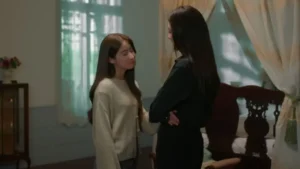
Visually, the direction leans into a warm, subdued color palette that lends a delicate aesthetic suited to internal psychological conflict. Frequent close-ups capture every flicker of doubt, fear, and hope, allowing moments of silence to carry more narrative weight than spoken lines.
The musical score acts as a subtle secondary narrator. Rather than serving as mere background noise, it steps in during emotional pivots to fill the silences between lines, enriching the melancholy tone and seamlessly complementing the directorial vision.
Novel vs. Adaptation: Page to Screen
The core strength of the project lies in its source material: the original novel by Thai author Chao Planoy. Comparing the text to its screen adaptation provides valuable insight into translating a quiet, insular narrative into a dynamic visual drama.
The novel resides heavily in internal monologues, dissecting Khun Nueng’s isolation and explaining how her upbringing under a harsh grandmother erected her emotional defenses.
These deep psychological roots unfold over pages of silent reflection that defy direct visual translation.
To adapt this, the series converts internal processing into tangible physical responses and body language.
The screenplay expands the dramatic real estate for supporting characters-such as Anong’s friends and Khun Nueng,s family-heightening tensions and adding subplots to suit episodic television, contrasting with the novel’s near-exclusive focus on the central duo.
Season 2 accelerates the pacing, condensing family confrontations to heighten dramatic stakes for screen viewing, whereas the novel maintains a slow, contemplative psychological breakdown.
The book also delves deeper into the complex backstory between Khun Nueng and Anong’s mother, whereas the show streamlines this background to prioritize direct, emotionally charged confrontations.
Where the novel retains an edge is in its patient pacing. The book allows the trust-building phase significantly more room to breathe, capturing Khun Nueng’s prolonged internal resistance before she surrenders to her feelings. The series condenses this timeline to fit production formats and keep audiences engaged.
Ultimately, the novel stands as a quiet, psychologically detailed reference text, while the series offers a visual interpretation powered by strong lead chemistry and direct cinematic beats.

Flaws and Structural Shortcomings
Despite its achievements, the series is not without noticeable flaws. Pacing stumbles emerge in the second season, where critical family resolutions and high-stakes confrontations feel rushed and somewhat superficial, undermining the careful setup built throughout Season 1. The writing for supporting characters also falters; several figures appear merely as narrative devices to trigger obstacles rather than fully realized individuals with coherent motivations.
Technically, uneven audio mixing and editing choices occasionally disrupt key moments. The score, while effective overall, is sometimes overused to force emotional weight rather than letting the performances carry the scene organically.
A major casting misstep lies in the inclusion of the characters Sam and Mon-the leads from Gap The Series, connected here as Sam is Khun Nueng’s sister. Recasting these roles with new actors who lacked the screen presence and charm of the originals was a miscalculation. The new actors struggled to capture Sam’s eccentricities or Mon’s sharp wit, severing established ties to beloved characters for returning fans.
On an individual level, Yoko Apasra’s performance as Anong encounters early friction. In initial Season 1 episodes, her depiction of innocence and charm occasionally leans into forced exaggerated mannerisms, making the character feel overly juvenile rather than spontaneously youthful.
This unpolished approach created a stark contrast against Faye Peraya’s grounded, measured presence, briefly leaving the impression of a veteran actor carrying an inexperienced co-star. Long dialogue scenes also revealed a limited vocal and facial range early on.
However, Yoko demonstrates marked growth by Season 2, showcasing far greater control in handling heavy emotional reveals and family conflicts.

As for Faye Peraya, despite wide fan acclaim, her performance isn’t entirely immune to critique.
Her commitment to playing a reserved, stoic woman occasionally results in rigid body language and overly guarded expressions in early episodes, making Khun Nueng appear detached when scenes called for emotional fluidity.
Furthermore, character choices written for her-such as using her doctor friend to provoke Anong’s jealousy and repeatedly avoiding direct confrontation—feel inconsistent for a woman in her mid-thirties, briefly testing audience empathy.
Finally, Faye’s commanding screen presence creates an ensemble imbalance; her sheer dominance on screen leaves surrounding cast members feeling underwhelming by comparison, disrupting the overall harmony of group scenes.

Final Thoughts
Blank The Series succeeds in transcending simple melodrama to deliver a thoughtful story about acceptance, emotional healing, and confronting societal expectations. Its success across both seasons stems from respecting its audience through patient narrative construction, dedicated performances, and a refined artistic vision that leverages imagery and sound to explore its central themes.