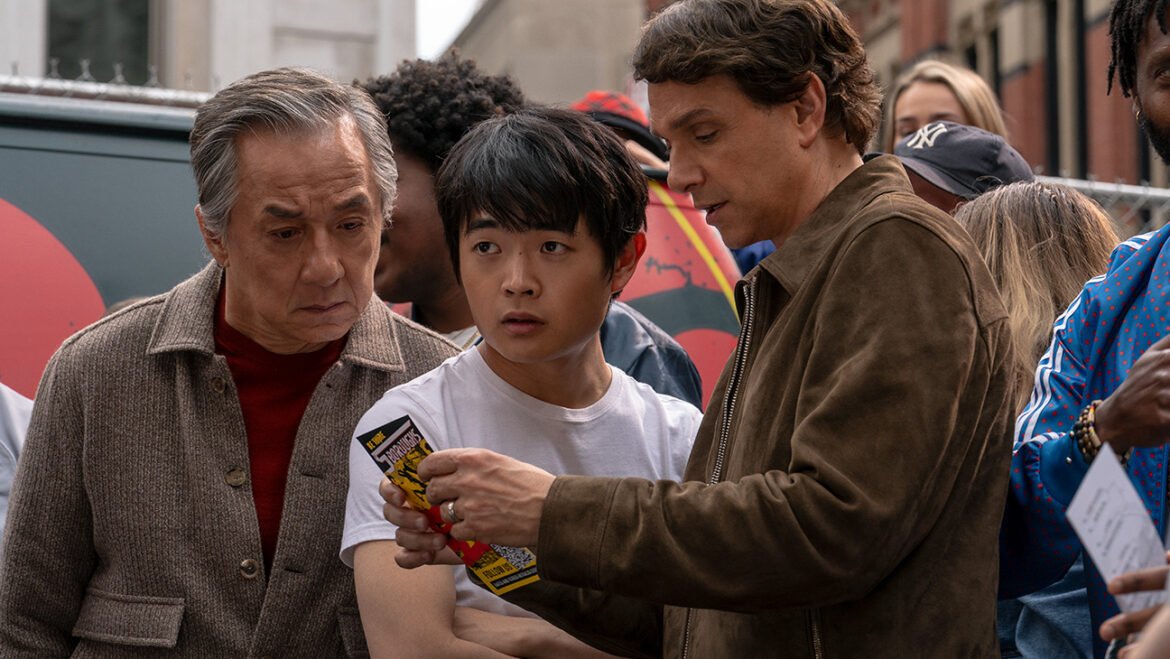
In a cinematic landscape dominated by gritty reboots and complex multiverses, Jonathan Entwistle’s Karate Kid: Legends arrives as a refreshing, albeit unapologetically “cheesy,” return to form. By uniting the two most iconic mentors of the franchise—Jackie Chan’s Mr. Han and Ralph Macchio’s Daniel LaRusso—the film successfully bridges forty years of martial arts lore with a story that feels like a warm, analog hug from the 1980s.
The plot follows Li Fong (played with breakout charm by Ben Wang), a young kung fu prodigy who moves from Beijing to New York City following a family tragedy. When he runs afoul of a local karate champion, he finds himself caught between two different philosophies of fighting. What follows is a “retro corn” masterpiece that proves some formulas are classics for a reason.
A Collision of Styles and Eras
The film’s greatest strength lies in the chemistry between its veteran stars. Watching Chan and Macchio bicker over the nuances of “wax on, wax off” versus the more direct discipline of kung fu provides the movie’s most endearing moments. Chan brings a soulful, weathered gravity to Mr. Han, while Macchio slips back into the role of Daniel LaRusso with a paternal grace that honors the late Pat Morita’s legacy.
Karate Kid: Legends doesn’t try to reinvent the wheel. Instead, it leans heavily into the tropes that made the original 1984 film a phenomenon:
• The Underdog Arc: Li’s journey from a grieving outsider to a confident competitor is handled with a “sincere-analog” earnestness that ignores modern irony.
• The Urban Melodrama: Set against a gritty yet cozy version of New York, the stakes involve saving a local pizzeria—a plot point straight out of a classic Saturday-afternoon crowd-pleaser.
• The Hybrid Warrior: The training montages, featuring a mix of rooftop gardens and back-alley sparring, culminate in a “dragon kick” evolution that serves as the film’s high-octane climax.
The “Retro Corn” Factor
Critics are calling the film “likable retro corn” specifically because it refuses to be cynical. At a lean 90 minutes, the movie sprints through its subplots—including a romance with a local boxer’s daughter (Sadie Stanley) and a rivalry with a one-dimensional bully—with a relentless pace that keeps the energy high even when the dialogue leans into sentimentality.
While the film has faced minor criticism for its “overstuffed” secondary characters (including Ming-Na Wen as Li’s protective mother), the core trio of Chan, Macchio, and Wang keeps the narrative grounded. The score, bombastic and unashamedly dramatic, reinforces the feeling that you are watching a lost gem from a simpler era of filmmaking.
The Verdict
Karate Kid: Legends is a textbook example of how to handle legacy IP with heart. It understands that its audience isn’t looking for a dark deconstruction of the mythos, but rather a reminder of why they loved the “crane kick” in the first place.
As the credits roll over a final tournament that hits all the expected beats, one thing is clear: in the world of The Karate Kid, the student may change, but the wisdom remains timeless. For anyone looking for a dose of “cheesy-sincere” inspiration, this is the must-see dojo of 2025.