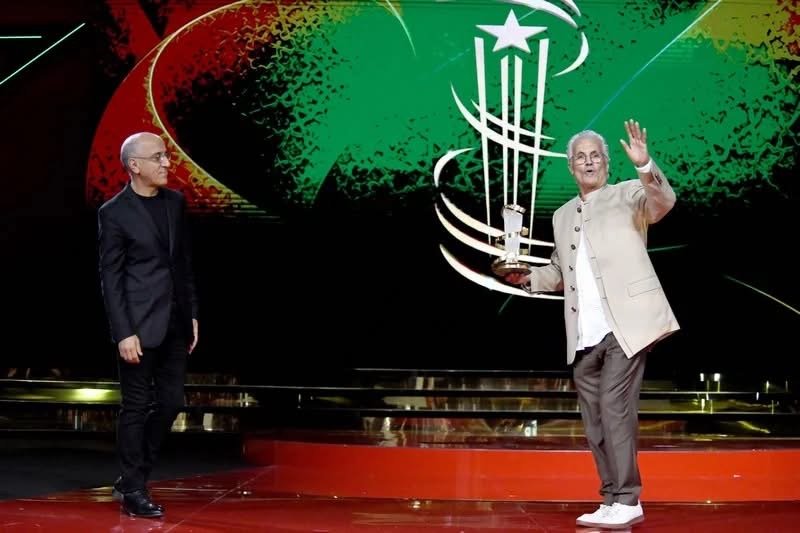
Spanning nearly five decades, Younes Megri’s career has unfolded at the intersection of music and cinema.
Far from simply moving between artistic disciplines, he has forged a distinctive path shaped by the interplay of musical expression and a continuing search for his own cinematic voice.
Against this backdrop, his tribute at the Marrakech International Film Festival was more than a celebration of an accomplished artist.
It was an acknowledgment of a Moroccan career that transcended conventional artistic boundaries and helped shape the country’s contemporary cultural landscape.
On Wednesday, November 25, 2026, the Moroccan artist received the festival’s honorary Golden Star during the 23rd edition, presented by comedian and actor Hassan El Fad.
The ceremony offered an opportunity to revisit his artistic beginnings, the influence of his family environment, and the defining milestones of a journey spanning singing, songwriting, composition, instrumental performance and acting.
Megri expressed his appreciation for the honor, noting that being celebrated in Marrakech alongside international cinema figures such as Jeff Goldblum and John Turturro carried particular significance for him.
He was also keen to emphasize that the recognition extended beyond his own achievements.
He dedicated it to those who had accompanied him throughout his journey, including his family, his wife Nadia Niazi, his daughters Sana and Izana, and the audience, which he described as the very foundation of an artist’s existence and longevity.
Reflecting on his upbringing, Megri recalled a household in which music was woven into everyday life.
His father was an oud player and visual artist, while his mother sang with a spiritual music ensemble.
His brothers and sisters were equally immersed in singing, playing instruments and composing.
Growing up in such an environment shaped his early relationship with the arts. Yet at 17, he decided to strike out on his own, determined to develop an artistic identity and musical voice distinctively his own.
He described the decision as both a challenge and an act of liberation, allowing him to create original music rather than simply reproduce the artistic traditions he had inherited from his family.
As he recalled, his generation shared an ambition to take Moroccan music beyond its local boundaries and introduce it to wider audiences.
That aspiration informed his musical choices and his continued efforts to explore new directions in singing and composition.
For Megri, cinema was never a departure from music, but rather a natural extension of an artistic journey that welcomed him with opportunities and generosity.
It allowed him to collaborate with actors and filmmakers while exploring new dimensions of his artistic identity.
He also spoke about the role of his wife, Nadia Niazi, who has shared nearly five decades of the industry’s uncertainties and demands with him, through its joys, doubts, sacrifices and absences. He considers her an integral part of the recognition he received.
Born in Oujda on November 15, 1951, into a family deeply rooted in music and singing, Younes Megri began composing and performing at an early age, initially relying on his voice and guitar.
He gradually established himself as a singer, composer and musician, while also venturing into film scoring.
His musical career has consistently reflected an effort to move beyond the conventional formulas of Moroccan popular song.
His screen career, meanwhile, spans more than three decades, with appearances in Moroccan and international productions.
His credits include Ahmed Boulane’s The Return of the Son, Aziz Salmy’s Veil of Love, Kamal Kamal’s Moroccan Symphony and Mohamed Mouftakir’s The Blind Orchestra.
He has also appeared in international productions, including Peter Kosminsky’s The Government Inspector and Jean Delannoy’s Mary of Nazareth, further establishing his credentials as an actor alongside his longstanding musical identity.
Megri’s tribute forms part of the 23rd Marrakech International Film Festival’s celebration of artists whose contributions have left distinctive marks on cinema, among them Jeff Goldblum and John Turturro.
What makes his recognition particularly significant, however, is the opportunity it offers to revisit a Moroccan artistic journey that was never confined to cinema alone.
Shaped by the interplay of music, image and performance, Megri’s career stands as a testament to the breadth of artistic identity and its ability to transcend generations and creative mediums.