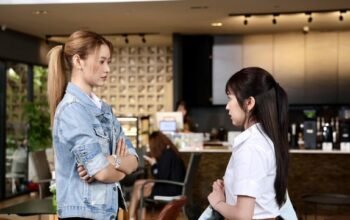
If you have already seen Somewhere Somehow prior to diving into My Marvellous Dream Is You, brace yourself for a sharp letdown. The disappointment stems not merely from encountering a lesser production, but from watching two lead actresses—blessed with undeniable screen chemistry, deep emotional intuition, and genuine talent—marooned in a project that fails to match their intrinsic spark. Their signature hit, Somewhere Somehow, likely wouldn’t have reached its artistic peak were it not for the raw mileage the duo clocked in My Marvellous Dream Is You—a gambit that relied almost entirely on their performative weight to offset a frail technical backdrop.

Surrealist Vision and Concept

Credit is due first and foremost to the series’ high-concept premise, which weaves dreams and reality into a dramatic tapestry that neatly breaks away from standard Thai GL tropes often restricted to schoolyards and corporate hallways. Leveraging dreamscapes as a conduit for repressed desire grants the narrative an alluring fantasy dimension, particularly across early episodes that deftly delineate this dual existence.
The show further elevates itself above genre peers through its underlying thematic daring. The hidden parental storyline stands as one of the most audacious detours from traditional romance territory: a traumatic catalyst shatters two households when Dawan’s father and Kimhan’s father abruptly abscond together after hiding their secret, years-long queer romance.
The drama examines the fallout of this delayed revelation and desertion, capturing the daughters’ descent into betrayal and emotional rupture as their mothers and households navigate the ensuing stigma. Yet, this shared trauma becomes the very catalyst that thaws the ice between Dawan and Kimhan. Recognizing each other as the only souls capable of grasping the magnitude of the disaster, they draw close. The writers cleverly project this crisis onto the leads: both suppress their feelings in the waking world for years, taking refuge in dreams to express their love out of fear of repeating the taboo scandal that wrecked their families.
While constructing this psychological trauma as a foundational hurdle is inspired, the series fails to explore the social fallout with sufficient gravity. Instead, the fathers’ flight is treated merely as an initial plot device to tether the girls together before the narrative swiftly pivots to soft romance and surrealism, leaving the long-term emotional repercussions on broken family dynamics largely unexamined.

Oneiric Telepathy
My Marvellous Dream Is You leans heavily into a metaphysical framework grounded in “Oneiric Telepathy” and “Entangled Souls.” Here, dreams are not treated as fleeting subconscious blips, but as an ethereal corridor—an independent spatio-temporal realm where spirits commune long before their physical bodies align in the waking world.
This metaphysical lens defines the spiritual architecture between Wan and Kim. The series posits that dreams are the true dimension where the soul sheds fear, repression, and social constraints. Dreams act as a mutual energy mirror; what one experiences in her slumber is not mere fantasy, but a direct reflection of the other’s spiritual presence. The narrative asserts that soul connection precedes physical acquaintance—a “Soul Covenant” sealed in the ethereal realm, making their earthly encounters an inevitable manifestation of feelings born in the ether. Crucially, this metaphysical sanctuary offers a refuge from real-world trauma, keeping their bond unpolluted by their parents’ self-serving legacy.

Twin Flames Dynamics
The central dynamic transcends conventional romantic attraction to embody a full-fledged “Twin Flame” mirror. Each lead sees in the other her missing piece and forgotten memory; telepathy occurs not through dialogue, but through the instinctual sensing of the other’s fear and emotional strain.
This bond operates on a distinct energetic code where presence in a dream establishes a tether extending into waking life, evoking an absolute sense of safety once they converge. At its core, the connection carries a pristine, almost elemental innocence where transactional motives and social judgment dissolve. Rooted in the subconscious rather than daily mundane friction, their bond feels resilient against external sabotage.

Cinematography and Visual Construction
Among the production’s strongest assets is its nuanced lighting direction and deliberate color grading. The direction excels at establishing a clear visual and psychological partition between worlds, deploying soft lighting with moody blue and purple hues for surreal dream sequences, contrasted against warm, natural tones for reality.
A standout directorial choice occurs when reality absorbs the dreamscape following Dawan and Kimhan’s first genuine moment of intimacy after fleeing the wedding. As Dawan steps out of the tent the following morning, she finds Kimhan bathed in bright sunlight on a swing against a lush green expanse—a serene visual echo of the dream vision that haunted her for years, now fully materialized in the waking world.

Performance and Chemistry
As the central duo, Fay and May deliver intimate romantic beats marked by delicate grace, relying on potent eye contact to articulate their shared tether. However, their relative acting inexperience at the time remains evident; key conversational scenes occasionally feel mechanical and lack spontaneity, particularly during moments demanding heightened dramatic escalation.
In terms of romantic pacing, the series comfortably occupies the rare slow-burn space. Across 12 episodes, the acting shines brightest in understated moments of mutual longing. Dawan and Kimhan embody a palpable fear of destroying their friendship, translating hesitation and hidden jealousy into flustered, hesitant glances rather than explicit dialogue.
The framing adeptly contrasts these two realms: reality is dominated by cautious innocence, flustered sweetness, and strict boundaries, whereas the dream realm strips away inhibition to unleash explicit passion and pent-up chemistry. Ultimately, Fay and May succeed in capturing the gentle purity of first love between childhood friends, transitioning smoothly from sisterly affection to romantic longing.

Pacing and Screenplay
The first three episodes represent the show’s weakest link in execution; viewers lacking patience may well abandon the series out of boredom before reaching its compelling core. Yet, the brunt of the technical shortcomings falls on the writing and direction, which struggle with pacing. Despite a generous 12-episode runtime, the narrative frequently stalls in the middle stretch, repeating romantic loops without driving dramatic momentum forward. Furthermore, secondary characters are reduced to purely functional tools, lacking standalone arcs or meaningful development.
The Pivotal Sequence

The Episode 11 love confession serves as the undeniable master scene and emotional climax of the entire series—the focal point toward which the slow dramatic build was relentlessly steering. Its power stems from marking the definitive turning point where both characters break free from silence and dreams to confront reality.
What truly elevates the sequence is the performance of the actress playing Kim, whose acting reaches its peak maturity here. Navigating the delicate space between composure and raw emotional breakdown without resorting to theatrical screaming, she relies on expressive eye work, a wavering voice, and hesitant body language to convey the terror of rejection alongside an overwhelming urge to confess. It stands as a defining turning point that proves her capacity to anchor heavy dramatic material.

Gratuitous Melodrama
A glaring flaw that undercuts the show’s overall standing is the writer’s decision to kill off the mother following a battle with cancer in the penultimate episode. The character’s death feels like an unearned, gratuitous tragedy devoid of dramatic necessity. A narrative resolution centered on recovery and healing would have better symbolized the triumph of love over past trauma. Instead, the sudden bereavement feels like a forced bid for cheap melodrama, imposing heavy grief on a resolution that ought to have celebrated resilience.
This tragic detour tarnishes the overall narrative architecture. Having already endured childhood trauma and familial collapse, the leads are subjected to yet another round of grief, shifting the ending from a celebration of survival to a grim exercise in coping. Ultimately, this heavy-handed attempt at grim realism feels fundamentally misaligned with the series’ surreal, romantic DNA.