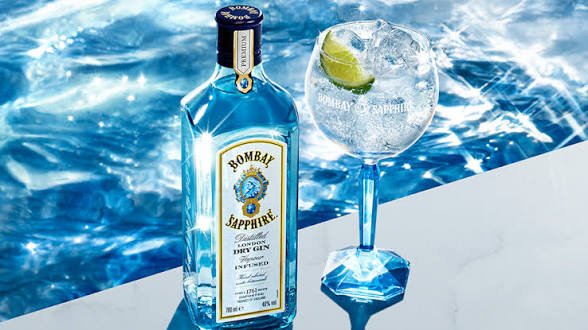
In a global spirits market crowded with aggressive flavor profiles and niche craft experiments, Bombay Sapphire has achieved something much rarer than commercial success: it has become the definitive benchmark for the modern cocktail.
While competing brands fight for raw volume or chase eccentric flavor trends, the iconic blue bottle has carved out a unique institutional strongpoint. It stands comfortably as the world’s second best-selling premium gin, but more importantly, it remains the undisputed “gold standard” for bartenders worldwide who demand a flawless balance of price, versatility, and structural reliability.
The Alchemy of Vapor: Engineering a Smoother Spirit
The secret to Bombay Sapphire’s distinct character lies not in clever marketing, but in its structural distillation. Most traditional gins—including the brand’s own Bombay Original—rely on boiling botanicals directly in the spirit, a process that often extracts harsh, overly medicinal notes. Sapphire, however, pioneered a process known as Vapour Infusion.
By suspending its ten hand-selected botanicals (including lemon peel, almonds, and licorice) in copper baskets, the liquid never touches the herbs. Instead, heated alcohol vapors pass gently through them, capturing only the delicate, aromatic essential oils. This results in an exceptionally smooth, accessible palate that strips away the aggressive bitterness of traditional juniper. For newcomers, it is highly approachable; for mixologists, it offers a clean, unobtrusive canvas that enhances rather than dominates a drink.
Market Dynamics: From Street-Level Value to Boutique Luxury
To understand Bombay Sapphire’s true market equity, one must look at how it navigates a highly competitive, three-tiered landscape:
The Global Titans: In terms of sheer volume, Bombay Sapphire is locked in a perpetual, neck-and-neck rivalry with Tanqueray for premium dominance, while Gordon’s continues to anchor the mass-market value sector with its straightforward, no-nonsense profile.
The Smart-Money Alternatives: For consumers seeking reliable quality on a tighter budget, Beefeater remains a formidable rival. Bartenders often prefer Beefeater’s punchier, juniper-forward spine for heavy, bitter-sweet drinks like the Negroni, where the gin needs to fight through dense modifiers. Meanwhile, the historic Greenall’s offers a softer, remarkably smooth British alternative that mimics Sapphire’s texture at a lower price point.
The Artisanal Fringe: At the ultra-premium end of the spectrum, boutique labels cater to more eccentric palates. Hendrick’s remains a cultural favorite for its signature cucumber and rosewater notes, while Germany’s Monkey 47 routinely sweeps absolute quality ratings, though it commands a price tag nearly double that of Bombay.
The Verdict
The brilliance of Bombay Sapphire is that it does not try to be the most expensive or avant-garde spirit on the shelf. Instead, it has mastered the art of “liquid diplomacy.” By delivering a premium aesthetic and a world-class sensory experience at an accessible price point, it remains the safest, most dependable anchor in contemporary bar culture.