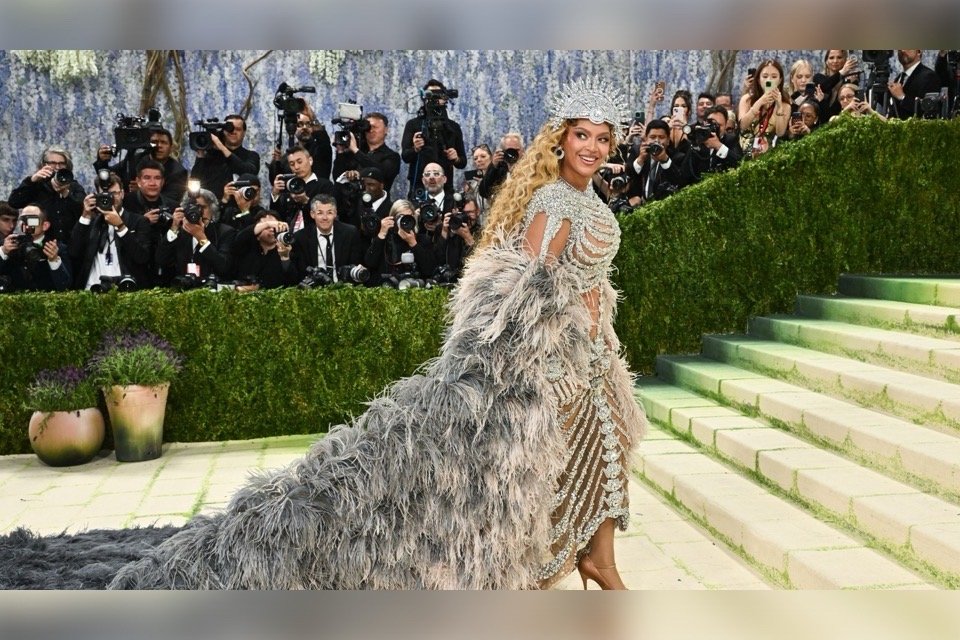
In a night defined by high-concept artistry and structural innovation, the most anticipated moment of the 2026 Met Gala arrived when Beyoncé stepped onto the red carpet for the first time in ten years. Serving as an honorary co-chair for the “Costume Art” exhibition, the music icon ended her decade-long hiatus with a visual statement that bridged the gap between biological anatomy and high fashion.
Her arrival at the Metropolitan Museum of Art was more than just a red-carpet appearance; it was a family milestone. The singer was accompanied by her husband, Jay-Z, and their 14-year-old daughter, Blue Ivy Carter, who made her official Met Gala debut. The trio’s presence underscored the evening’s theme, proving that fashion is not just an aesthetic choice but a multigenerational legacy.
The “Skeleton” of Haute Couture
For her return, Beyoncé collaborated with designer Olivier Rousteing to create a look that took the “Fashion Is Art” dress code literally. The centerpiece was a translucent, diamond-encrusted gown designed to mimic the human skeletal system. The intricate beadwork traced the lines of the ribcage, spine, and pelvis in shimmering silver, creating a “naked” effect that was both daring and clinical.
The ensemble was elevated by several dramatic elements:
• The Feathered Horizon: A massive, architectural cape in shades of grey and white cascaded behind her, filling the museum’s grand staircase with a cloud-like texture.
• Royal Adornment: She wore a custom-forged silver tiara and a matching headpiece that echoed the crystalline structure of the gown.
• Modern Texture: Moving away from her signature sleek hair, she opted for long, crimped waves that added a soft, ethereal contrast to the rigid “bone” structure of her dress.
A Full-Circle Moment
The last time Beyoncé graced the Met steps was in 2016 for the Manus x Machina theme, where she famously wore a floral-embellished latex Givenchy gown. Her decision to return as a co-chair alongside figures like Nicole Kidman and Venus Williams marks a new chapter in her relationship with the Costume Institute.
Speaking on the carpet, the artist described the experience of sharing the night with her daughter as “surreal.” Blue Ivy’s appearance also signaled a shift in the event’s notorious “18 and over” rule; organizers noted that exceptions are now being made for teenagers accompanied by their parents, making the 2026 gala a truly familial affair for fashion’s most elite circles.
Cultural Impact
Fashion critics have hailed the “skeleton” look as a triumphant comeback, noting that it managed to satisfy the demand for spectacle while maintaining a high level of artistic integrity. By focusing on the “body beneath the clothes,” the outfit served as a living embodiment of the exhibition’s core philosophy.
As the 2026 gala concludes, the narrative is clear: Beyoncé’s absence only served to heighten her influence. In a sea of avant-garde costumes and celebrity cameos, her return was a powerful reminder that while trends change and icons may step away, the “Queen” never truly loses her crown.