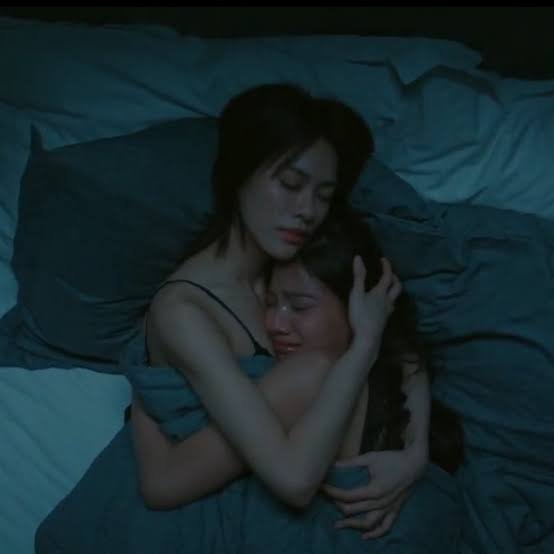
It is never easy to watch a series whose leading duo possesses every quality required to make you deeply invested, only to find yourself ultimately forced to critique the very storytelling that brought them together. This is the central dilemma posed by the Thai drama Moon Shadow, a project fronted by a pairing capable of generating palpable emotional intensity with a mere glance, a quiet pause, or a passing gesture, yet failing to provide that chemistry with the screenplay it so richly deserves.
The core issue does not stem from a lack of spark between Chan and Kie, nor does it lie in actresses Emi and Bonnie lacking the range to portray a dynamic transcending initial fascination. On the contrary, the paradox is that their performances frequently succeed in convincing us of emotional developments that the text itself failed to properly pave the way for. We feel as though the characters have traversed a considerable distance in their relationship, yet when we try to retrace the steps that brought them here, we realize that crucial phases unfolded far too rapidly.
Read the Short version of This Review!
Thus begins the crisis of Moon Shadow. It is a series that excels at crafting intimate moments, yet stumbles when it comes to constructing the narrative arc that should render those moments a natural consequence of what preceded them.

A Relationship Born in a Gray Area
Adapted from the novel by Flower of Memory, the series establishes a starting point designed to explore an inherently asymmetrical dynamic.
The bond between Chan and Kie does not originate under conventional romantic conditions; instead, it commences with a fleeting night followed by an agreement that positions one woman as the financial benefactor calling the shots, while the other accepts the role of a protégé in exchange for remaining within her orbit. From this gray zone, where desire intertwines with pragmatism and attachment merges with necessity, the narrative attempts to forge a connection that transcends the transactional agreement that birthed it.
It is a dramatically fertile launchpad. The relationship confronts not only the familiar question of whether physical attraction can blossom into love, but also much deeper inquiries: Can an egalitarian bond truly flourish between two women starting from unequal footing?
Can one distinguish between the desire to possess another and the terror of losing them? And can a woman accustomed to exercising absolute control over every facet of her life submit to a dynamic defying rigid categorization?
These foundational premises carried immense dramatic potential. When two characters enter a dynamic not initially rooted in mutual, unambiguous love, the evolution of their feelings serves as a litmus test for the screenplay’s ability to track psychological shifts.
When does habituation transform into genuine attachment? When does desire cease to be merely a longing for physical proximity and evolve into a shared life?
And how can two individuals navigating disparate starting points converge on an egalitarian partnership built on free choice and mutual trust?
These questions could have served as the vertebral column of the series.
Yet Moon Shadow failed to afford them adequate time to mature.
This precisely highlights the gulf between presenting a romance and developing one. In the former instance, watching two characters draw close and sensing mutual attraction suffices; in the latter, we must comprehend why they gravitated toward one another, what shifted within each of them, and what made turning back more formidable than pressing forward.
Moon Shadow possessed the raw material required to engineer this evolution, yet failed to invest in it with the required depth across all stages. Consequently, the primary critique falls squarely upon the screenplay.

Exquisite Romance Is Not Enough
Director Kanittha Kwanyu clearly understands how to render her cinematic world visually alluring.
Cinematography, lighting, and framing endow several sequences with a soft visual texture harmonizing with the narrative’s emotional currents. Furthermore, building on her prior collaboration with the leads, the director recognizes the significance of spatial distance, posture, stillness, and the pregnant pauses preceding or following an admission of feeling.
Romance is never merely a collection of polished imagery and intimate interludes; it is a trajectory wherein each character’s perception of the other and of themselves undergoes fundamental transformation.
The series leverages this visual language to demonstrate that the relationship’s finest moments bypass physical proximity entirely, shining instead in scenes permitting both characters to converse, expose vulnerability, and offer mutual emotional fortification.
The deliberate choice to place boundaries on physical intimacy within the framework of Chan and Kie’s agreement afforded the show an opportunity to explore intimacy through an alternative lens, framing the dynamic as an exercise in trust-building rather than a string of titillating set-pieces.
Yet this partial triumph begs the crucial question: Why, precisely, did Chan fall in love with Kie? This inquiry does not question the leads’ undeniable magnetism, but rather interrogates the screenplay’s efficacy in convincing the audience of the internal pivot that occurred.
In a well-crafted romance, knowing one character loves the other is insufficient; we must understand what discoveries were made, how self-perception shifted, and what singular moment rendered continuing the relationship more vital than preserving safe emotional distance.
This is precisely why certain sequences in Moon Shadow resonate with less impact than intended. The series possesses romantic intuition, but needed far greater discipline in its dramaturgical execution.
Read the Short version of This Review!

A Heated Opening at the Expense of Narrative Cohesion
Narrative fumbling manifests from the very first episode, which opens with an intimate flash-forward between the protagonists before rewinding to chronological zero, pacing forward until it catches up to that opening sequence just before the main titles.
At first glance, this framing device might seem an attempt to hook viewers and provoke curiosity regarding the circumstances leading to that moment.
However, it yields little genuine narrative capital, instead exposing a shortcut in storytelling craftsmanship.
The scene derives its impact not from its placement at the top of the hour, but from the surrounding context; when torn from that context before viewers have grasped the characters or their dynamic, it emerges as a jarring distraction rather than an intelligent portal into the narrative.
The decision feels closer to a commercial gimmick engineered to capture attention within the opening minutes through a premature dose of intimate romance, forsaking character-driven suspense.
Paradoxically, while the series deploys the sequence as a promise of what is to come, it pays the price later through chronological confusion and muddled context, particularly since the scene introduces no real mystery warranting such treatment while delaying exposition that could have been delivered more seamlessly. Bending the timeline thus feels less like an organic artistic necessity and more like an attention-grabbing contrivance, executed at the expense of narrative fluidity and cohesive immersion.

Smart Dialogue
Among the sharpest moments in episode four is the confrontation between Kie and Jai, which refreshingly subverts the expected trajectory of a rivalry between two women vying for a third’s heart.
It would have been easy to devolve the meeting into petty provocation or competitive posturing; instead, the narrative opts for a far richer, more unconventional path.
Kie bares her soul to Jai regarding her genuine feelings for Chan, yet she does so not from a position of triumphant bravado designed to intimidate a rival, but from the clear-eyed perspective of a woman keenly aware of the precariousness of her station.
In Chan’s eyes, she is merely a sugar baby—a relationship governed by rigid parameters that do not automatically grant her the prerogative to demand love, jealousy, or emotional validation.
More compelling still, Kie refuses to mask this contradiction or feign greater leverage than she possesses. She lays bare her vulnerabilities with a raw courage suggesting she has nothing left to lose.

The dialogue takes an unexpected turn as competition temporarily yields to rare candor between two women ostensibly cast as mutual obstacles.
Kie neither solicits Jai’s sympathy nor weaponizes her confession for pity; rather, she articulates her true standing without artifice. There is a degree of surrender in this confession, yet it is far from ignoble, mirroring the shedding of feigned strength when such armor is no longer required to conceal reality.
The brilliance of the scene lies in Kie refusing to defeat Jai through conventional competitive tropes; instead, she upends the rules of engagement entirely.
How does one wage battle against someone refusing to camouflage their fragility or deny the precariousness of their romantic standing?
How can one treat such an individual merely as an adversary after they have bared their deepest vulnerability?
Through this dialogue, the series carves out a space for the Kie-Jai dynamic that transcends petty jealousy, demonstrating that radical honesty can prove far more disorienting than any tactical maneuver, and that acknowledging potential defeat does not equate to abandoning love.
It is a masterclass in writing because Kie does not strive to appear invulnerable; she possesses the courage to stand unshielded, complete with all her contradictions and frailties.
Healing Childhood Wounds with Love
To truly comprehend Kie and her bond with Chan, reducing her to a bubbly, audacious young woman who unabashedly pursues her desires falls short.
Beneath this veneer of lightness lies a child who endured an upbringing where the person meant to serve as a sanctuary instead became a source of terror and harm.
Kie suffered verbal and physical abuse, abandonment, and rejection, with her mother locking her outside under the spurious guise of protection.
Crucially, the mother pinned her own psychological struggles on her pregnancy, unfairly burdening Kie with a trauma she never chose nor could prevent.
Consequently, the rejection Kie faced in childhood extended far beyond a mere dearth of affection, serving as an early, corrosive lesson undermining her fundamental sense of worthiness and security.

Psychologically, Kie’s profile maps neatly onto avoidant attachment, an insecure relational pattern taking root when a child learns that expressing emotional needs yields no containment, while drawing close to caregivers invites peril rather than safety.
In such cases, hyper-independence becomes a psychological shield, rendering vulnerability and dependency perilous undertakings.
This does not imply an absence of yearning for love; rather, it reflects an intense desire coexisting with a profound inability to surrender to the risks of trust and exposure.
This highlights one of her character’s most fascinating paradoxes: Kie is the one who initiates proximity with Chan, proposing to anchor herself in her life despite strict contractual limits.
She projects boldness in expressing desire and offering care, yet simultaneously keeps her most fragile emotions locked away from the person she loves.
She prefers the agency of the giver over the vulnerability of the receiver. Bestowing care affords her a semblance of control, whereas acknowledging her need for Chan exposes her to the terrifying prospect of rejection and pain.
This tension crystallizes when the narrative unpacks her childhood further, particularly following the assault by Chan’s mother, who weaponizes Kie’s past against her. Kie cannot simply articulate her abuse on command just because she has entered a romance.
When traumatic memories resurface and engulf her, she cannot magically bypass them by sheer willpower or immediately lean on Chan for rescue.
The sequence underscores a universal truth: entering a love affair does not instantly erase the defensive architecture constructed for survival. Under acute stress, withdrawal and isolation remain her default refuges, superseding the risk of emotional exposure.
Herein lies the true depth of the Chan-Kie dynamic. Kie’s ultimate challenge is not merely securing Chan’s love, but learning how to remain anchored when the stakes rise, permitting support without feeling diminished in her autonomy.
Conversely, for Chan, loving or defending Kie publicly is insufficient; the relationship requires a sanctuary where Kie can articulate her past on her own terms, seek solace without fear of judgment, and discover through time that vulnerability does not invite punishment.

Maternal Acceptance: A Shortcut Too Swift
Emotional conclusions demand as rigorous a build-up as emotional beginnings.
When a narrative introduces familial or societal obstacles as structural hurdles for lovers, it generates an expectation that overcoming those barriers will require arduous negotiation and lasting friction.
Thus, the swiftness with which maternal acceptance is secured feels disproportionate to the dramatic potential of the conflict.
After investing significant runtime in solidifying fierce maternal opposition, the pivot toward reconciliation arrives with undue haste.
The glaring misstep lies in omitting the crucial week Kie spends in the company of Chan’s mother.
The text approaches this temporal span through lazy narrative shorthand via a time-skip and omission.
That week should have served as the ultimate crucible where psychological frost melted and the mother’s perceptual shift crystallized.
Rather than staging vivid scenes dramatizing this convergence or clash, the screenplay merely reports the final verdict through perfunctory dialogue, robbing audiences of the chance to track the evolving emotional dynamics step-by-step.
This omission fosters a pervasive sense that emotional breakthroughs and sudden reconciliations were engineered by fiat rather than organic character interaction.
Short-circuiting the path to reconciliation devalues its emotional weight.
Audiences require more than a decree of maternal approval; they need to witness what lessons were learned, what realizations dawned, and what hurdles were conquered to reach that verdict.
Bypassing this journey yields a hollow, unconvincing resolution, signaling that the production was more eager to reach the finish line than to earn the journey.

Read the Short version of This Review!
Technical Breakdown of the Series
Narrative Architecture and Text
The root of the series’ structural flaws lies within the adapted screenplay.
The source material hinges on the literary concept of the shadow, an entity existing solely through the presence of light, a resonant metaphor rich in internal psychology.
However, in translating this literary text into a television treatment, the screenplay falters in constructing a cohesive subplot supporting its central spine.
It lapses into circularity, trapping Chan and Kie in a repetitive loop of approaching and retreating without generating genuine dramatic momentum capable of driving character maturation.
Furthermore, introducing a stark power imbalance and a financial contract compromises the moral architecture of the narrative; failing to rigorously deconstruct this dynamic renders the sudden leap to egalitarian romance unearned and unconvincing.

Erratic Pacing
Another major impediment to the viewing experience is uneven pacing.
Certain stretches indulge in atmospheric scene-setting, while critical emotional turning points are rushed through without adequate breathing room. This creates a jarring paradox: viewers awaiting character evolution are shortchanged, thrust into final outcomes devoid of the preparatory milestones necessary to make them land with authority.
This does not argue for over-explanation or didactic dialogue; effective economy differs radically from narrative amputation. A series can remain laconic in speech provided its psychological transitions register clearly in behavioral shifts.
When evolution is hurtled past, audiences are forced to bridge chasms of logic purely through star-billing goodwill.
While affectionate investment aids a show intermittently, it absolves neither script nor director of foundational storytelling obligations.

Directorial and Visual Vision
From its opening frames, the series establishes a distinct aesthetic identity courtesy of a cinematographer possessing a refined sensitivity to light and shadow.
The title Moon Shadow is not merely metaphorical; it is physically manifested through low-key lighting and cool color grading, mirroring emotional isolation and distance.
The camera relies on tight framings and precise compositions enclosing characters within confining architectural constraints or behind glass partitions, sustaining an ambient sense of psychological enclosure and guardedness.
High production values, meticulous art direction, and striking costume design impart an undeniable visual luxury.
Yet this aesthetic excess occasionally traps the direction in formalism, where select sequences resemble glossy commercials engineered for ocular appeal at the expense of emotional current, freezing motion and encumbering the rhythm.

Performances of Emi and Bonnie
The casting of Emi and Bonnie remains the production’s crowning asset. Their on-screen chemistry transcends surface-level aesthetics or competent romantic beats, rooting itself in granular details that animate the dynamic.
Differing expressive styles enrich their interplay, with both actresses masterfully signaling hesitation, anxiety, or yearnings for proximity without expository crutches.
These nuances prove indispensable for a character-driven romance predicated on gradual evolution. Emi anchors Chan with precise psychological rigor, charting the oscillation of an independent executive whose formidable armor masks past trauma and profound emotional fragility.
Her command of micro-expressions and somatic restraint communicates apprehension and fear of commitment.
Meanwhile, Bonnie injects Kie with vitality and spontaneity, puncturing the script’s rigidity. Effortlessly toggling between seductive allure and subterranean need, she invests the character with undeniable human dimension despite textual constraints.
Yet their success inadvertently underscores the script’s shortcomings: the more convincingly they sell emotional depth, the more glaringly the text’s structural scaffolding lags behind.

Wasted Potential in Supporting Characters
Jai enters the narrative as Chan’s former flame, carrying historical baggage that defies easy closure.
Her presence tests whether love is merely a relic of our past or a conscious choice forged by personal evolution. Consequently, Jai transcends mere rivalry; she personifies a preceding chapter of Chan’s life that may never have been fully exorcised.
Her return forces the protagonist past simple binary choice: Does she revert to the familiar, or has she grown equipped to elect a partnership diverging from past templates?
Their initial triangle encounters yielded potent sparks, particularly during their first collective assembly where each participant’s standing was laid bare, crystallizing a tangled dynamic into clear dramatic opposition.
Yet the jealousy deployed by the narrative functions merely as plot-motor rather than psychological catalyst.
The burning question is not whether jealousy flares, but what lessons are extracted from the crucible.
A romance surviving a trial does not automatically graduate to strength; it earns resilience only when its participants dissect the fractures and consciously reconstruct their terms of engagement.
Similarly, other supporting figures, such as childhood friend Phu, sweet on Chan’s secretary, or Ella, who barely initiates flirtations with Jai, are denied the narrative real estate needed to blossom.
Conversely, Jai secures a thorough, multi-stage closure arc that, while emotionally sound, overstays its welcome due to contractual or production concessions, bloating screen time at the expense of a leaner, tighter ensemble canvas.

Sound Design
The original soundtrack and musical scores emerge as standout assets; original tracks like Red Kiss, Glitch, and Moonkey operate as direct conduits for the characters’ internal psychology.
A masterstroke of sound design is the deployment of textured silence, where ambient quiet envelops the dialogue, serving as an eloquent substitute for verbal inadequacy. Conversely, certain pivotal sequences suffer from over-scored, melodramatic cues that lean too heavily on the thumb-scale of emotional manipulation, subverting organic resonance.

Flaws and Summary Negatives
Evaluating the production critically reveals systemic structural liabilities preventing masterpiece status: erratic pacing shifting from sluggish repetitive loops to forced hyper-speed; rushed emotional transitions bypassing preparatory groundwork; sidelined supporting arcs bloating or starving secondary players; excessive formalist sheen masking substantive narrative vacuum; and glaring narrative gaps in the finale, most notably the inexplicable absence of family and friends during the wedding ceremony, including Kie’s family and Chan’s mother and sister, rendering a milestone event eerily sterile and culturally orphaned, especially when framed as their second wedding.
Conclusion
Moon Shadow is neither devoid of beauty nor incapable of manufacturing affecting moments. On the contrary, its strength lies in eliciting profound viewer investment in the minutiae of its central pairing.
Yet that very investment heightens our awareness of squandered potential, of milestones rushed and narrative roads untraveled.
Ultimately, the series delivers emotional gratification, capitalizing on the leads’ magnetism to secure a crowd-pleasing finale. The wedding holds clear symbolic weight even if the road leading there was truncated.
It transcends mere spectacle, gesturing toward the culmination of a grueling journey where old doubts recede and a bond forged under murky auspices matures into deliberate, responsible partnership.
Moon Shadow succeeded in making us crave Chan and Kie’s union, but faltered in convincing us that the path charting that convergence was fully realized.
We depart with mixed sentiments: deep gratitude for two performers who breathed transcendent life into their roles, and lingering regret for a screenplay that failed to invest in that life with the rigor it merited.

Read the Short version of This Review!