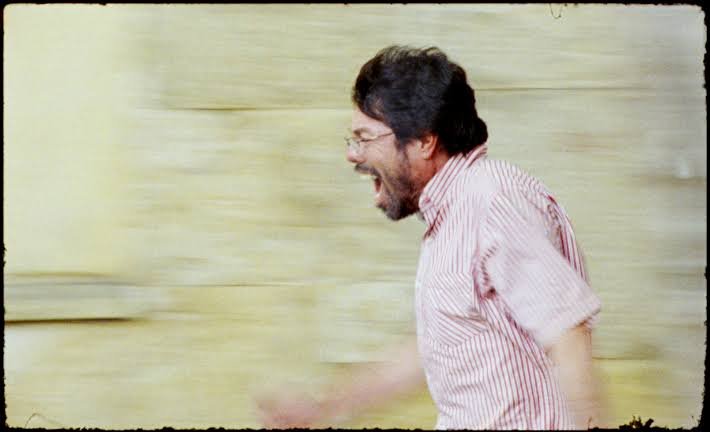
After the raw, harrowing intensity of his debut feature Amparo, director Simón Mesa Soto has pivoted toward a more sardonic, albeit equally sensitive, exploration of the human condition with his latest masterpiece, A Poet (Un Poeta). This second feature, which secured the Un Certain Regard Jury Prize at Cannes, is a deceptive work—initially masquerading as a classic teacher-student drama before deconstructing itself into a biting sociological farce.
The Anti-Hero of the Absurd
At the heart of the film is Oscar Restrepo, portrayed with a miraculous blend of irritation and vulnerability by non-professional actor Ubeimar Rios. Oscar is a man out of time, a middle-aged philosophy teacher and failed writer living in virtual penury with his aging mother. He clings to a tattered self-image of the “tortured artist,” using his poetic aspirations to justify his unemployment, his drinking problem, and his habit of borrowing money from his teenage daughter, Daniela.
Rios’ performance is the film’s greatest asset. With a hunched posture, buck teeth, and a gaze that flickers between arrogance and abject humiliation, he avoids the cliché of the “inspirational mentor.” He is, at times, genuinely insufferable, yet Soto’s direction ensures we see the “saintlike purity” beneath the delusion—the only person in a room who cares about the word itself rather than the profit it might yield.
Mentorship or Mirroring?
The narrative engine ignites when Oscar discovers the latent talent of Yurlady (Rebeca Andrade), a 15-year-old student from a struggling background. Oscar’s attempt to cultivate her voice initially feels like a path to redemption, but the film quickly interrogates his motives. Is he saving Yurlady, or is he trying to vicariously erase his own failures through her success?
The dynamic between the two is brilliantly drawn. While Oscar is obsessed with legacy and “artistic struggle,” Yurlady is a realist whose ambitions are far more grounded (at one point preferring a career as a nail technician over the “glory” of poetry). This tension exposes the rift between the romanticized ideal of the artist and the harsh demands of the real world.
A Critique of the Cultural Machine
Soto uses the backdrop of Medellín to launch a cynical, yet hilarious, critique of the “creative industry.” The film’s middle act relishes in the irony of the local poetry scene, where elites and tokenizing financiers pressure marginalized writers to produce “poverty porn”—sensationalized stories of misery—to win awards.
• Visual Texture: Shot on grainy 16mm film, the movie possesses an archaic, nostalgic aesthetic that mirrors Oscar’s own refusal to enter the modern world.
• The Comedy of Humiliation: The script is teeming with verbal wit, often landing like a punchline through sharp scene transitions.
• Social Commentary: A particularly pointed scene involving a Dutch ambassador highlights the exploitation within the arts, where autonomy is often traded for visibility.
The Final Verse
Despite its shaggy edges and occasional meanderings, A Poet is a profoundly mature work. It avoids the easy “Hollywood ending,” choosing instead a path of quiet, devastating realism. The film argues that true poetry is not found in the awards we receive or the images we manufacture of ourselves, but in the painful, honest recognition of who we actually are.
Simón Mesa Soto has crafted a meta-meditation on creation that is both a “riotous farce” and a tender character study. By the time the credits roll, Oscar Restrepo remains as messy and “tortured” as ever, but for the first time, he—and the audience—might finally see the difference between a dreamer and a delusion. In the landscape of contemporary Colombian cinema, A Poet stands out as a unique, deeply human achievement that demands to be seen.