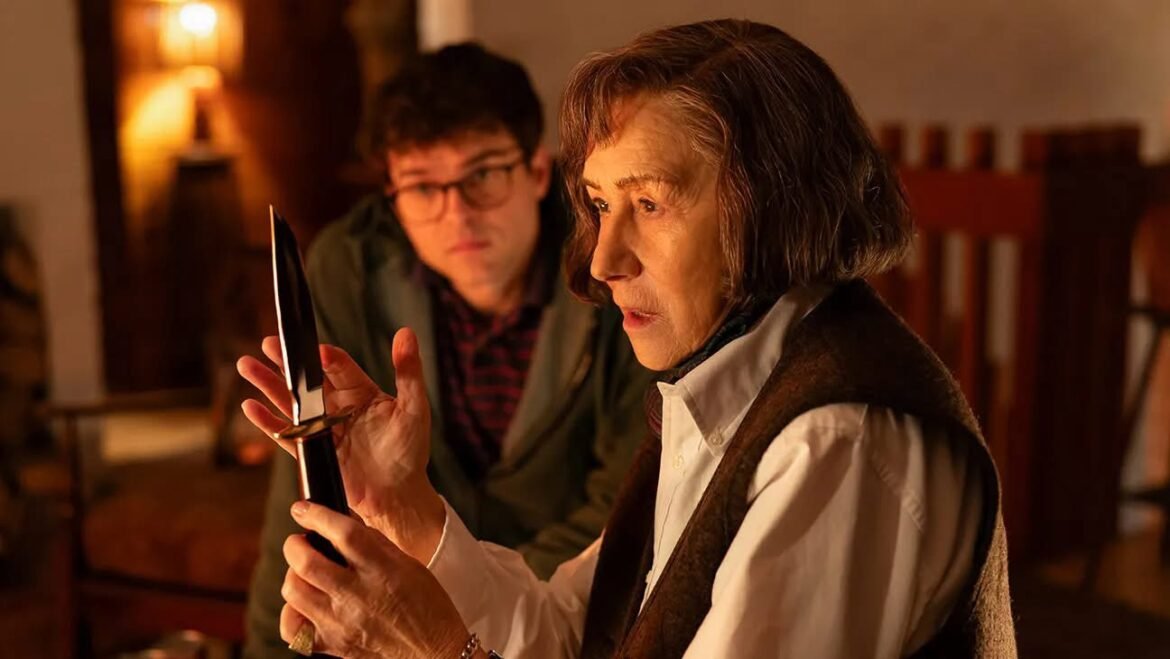
What happens when a crime writer encounters a man who feels dangerously like one of her own fictional creations? That is the sly premise powering Anton Corbijn‘s “A Talent for Murder,” a cerebral psychological puzzle box that eschews the standard biopic playbook to trap literary icon Patricia Highsmith inside a sinister chamber piece of her own making. Premiering at the Toronto International Film Festival, the film pits a razor-sharp Helen Mirren against Alden Ehrenreich in an unnerving duel where truth, illusion, and malice constantly bleed into one another.
A Cat-and-Mouse Parlor Game
Adapted by Joanna Murray-Smith from her stage play “Switzerland,” the story unfolds in 1995 within Highsmith’s isolated alpine sanctuary. Enter Edward Ridgway (Ehrenreich), a seemingly naive young executive dispatched by her publisher to coax out one final Tom Ripley novel. But Edward is hardly a routine errand boy. From the moment he crosses her threshold, Highsmith sizes him up like a fresh specimen, dissecting his cadences and probing his suspicious familiarity with her body of work. He, in turn, possesses an intimate grasp of her darkest character motivations. Corbijn cleverly flips the classic thriller mechanism: rather than asking who will pull the trigger, the film keeps audiences guessing as to who has been pulling the strings all along.
The Shadow of Tom Ripley
The ghostly imprint of Tom Ripley looms large over the narrative. As Highsmith begins sketching out a potential new storyline, the boundaries between the physical world and her literary imagination disintegrate. The narrative drifts into meta-textual territory when Edward manifests inside her imagined prose—taking on Ripley-esque attributes—while Clementine (Olivia Cooke) evolves from a chance train companion into a pivotal conspirator. Rather than offering a simple meditation on art imitating life, the film posits a far more unsettling proposition: what if the story begins actively authoring reality?
Mirren Commands the Screen
If Murray-Smith’s script provides the intellectual scaffolding, Mirren supplies the ferocious vitality. Refusing to sanitize Highsmith’s notoriously abrasive, misanthropic traits, Mirren leans hard into her subject’s razor-edged cynicism. She smokes, drinks, stares down her visitor, and lets ominous silences do the heavy lifting. Opposite her, Ehrenreich delivers a cleverly calibrated performance that starts as polite deference before revealing intriguing fractures beneath his polished veneer. Meanwhile, Cooke injects a crisp, magnetic energy into the meta-narrative sequences.
Atmospheric Dread and Precision Craft
Corbijn leverages his background in portrait photography to turn Highsmith’s pristine Swiss refuge into a space of quiet claustrophobia. Robbie Ryan’s luminous cinematography juxtaposes the sterile elegance of the Alps with the lavish, Ripley-esque vistas of Rome. Corbijn exercises admirable restraint, eschewing cheap jump scares in favor of lingering close-ups, icy dialogue beats, and deliberate pacing that lets the tension fester naturally.
While the final act stumbles slightly as it attempts to resolve its sprawling thematic queries on identity and the nature of evil, the film remains an undeniably stylish exercise in psychological suspense. “A Talent for Murder” is not a conventional biography of Patricia Highsmith; it is a fittingly devious tribute to her literary legacy that leaves viewers delightfully uncertain of where the author ends and the killer begins.