CANNES — Raghda Safwat
Egyptian box-office draw Laila Eloui treats cinema as a year-round masterclass. Driven by an enduring appetite for the medium and a deep engagement with the silver screen—the backdrop for her dozens of commercial hits and critically acclaimed leading roles—Eloui arrived at the 79th Cannes Film Festival to analyze the latest trends in global cinema alongside international auteurs, executives, and buyers during the 12-day industry marquee event.
Amid the sprawling international marketplace on the Croisette, Eloui’s presence represents a significant cultural anchor. Far from a standard promotional or protocol appearance for a regional star, her attendance marks a nearly four-decade track record of screening, producing, and acting on the international circuit.
At this year’s edition, Eloui’s itinerary extended beyond tracking the competitive slates. She attended a high-profile archival retrospective honoring a legendary director who championed her early career and made a notable appearance at a major festival gala. Yet, her primary focus remained on the ground, joining The Master Scene for an exclusive walkthrough of the festival’s main hub to gauge the shifting dynamics of the world’s most prestigious film market.
Sitting down with us, Eloui unpacked her extensive festival archive, outlining the core philosophy governing her approach to performance, continuous professional development, and cross-cultural distribution.



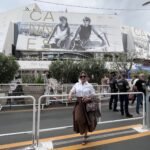


Navigating the festival corridors this year, you’ve been reflecting on your history with Cannes, specifically tracing back to the late 1980s. What did your initial entry point into the festival circuit look like?
I remember it clearly. We would catch the 8:00 AM screenings daily. The Grand Théâtre Lumière would be at maximum capacity, to the point where I had to secure a seat in the highest balcony. One morning, right as the lights went down for a screening, I scrambled into the last available seat, only to find myself sitting right next to auteur Youssef Chahine.
Back in 1989, I didn’t arrive on the Croisette as an A-lister under the media spotlight; I came strictly as a cinephile studying international cinema. I made a strategic decision to experience Cannes purely as an observer. I spent my days moving between screening rooms like a student of the craft—monitoring directorial techniques, tracking international critical consensus, and analyzing how filmmakers from vastly different cultural backgrounds packaged universal human themes. That maiden voyage was a massive intellectual wake-up call. It expanded my cinematic vocabulary in ways I could never have realized without seeing global cinema operating at its competitive peak.
How did that exposure 37 years ago alter your career trajectory once you returned to the Egyptian market?
When I returned to Cairo after that initial trip, I was charged with an intense creative energy and a constructive professional jealousy for our own rich cinematic heritage. I kept asking myself: why aren’t we maintaining a more commanding presence on the global festival circuit?
That exact drive is what eventually pushed me to venture into independent film finance, producing Sama’ Has (Listen Up) in 1991 alongside director Sherif Arafa and the late actor Mamdouh Abdel-Aleem. At the time, it was an avant-garde musical satire—a high-risk genre that traditional commercial producers refused to finance. But the broader industry perspective I acquired at Cannes gave me the conviction that creative excellence requires commercial risk. A true artist must gamble, finance their own path, and break away from prevailing box-office formulas.

An Ongoing Industrial Masterclass
You frequently describe Cannes not just as an industry celebration, but as an active educational institution. How does that feed into your longevity in the business?
I am a firm believer that the moment a performer stops learning, their creative drive stagnates, leading to artistic obsolescence. Throughout my career, I have never stopped treating myself as a student, and Cannes is the ultimate arena to practice that philosophy. Attending this festival is a vital professional and educational necessity for any actor who respects their craft and wants to evolve their dramatic tools.
Cinema reinvents its metrics daily; directorial techniques advance, narrative structures shift, and visual storytelling becomes increasingly sophisticated. How can a performer isolate themselves from these industry innovations and still expect to deliver impactful work? When I sit in a theater alongside filmmakers from Latin America, Asia, or Europe, analyzing how they translate complex human emotions onto the screen, I’m not just watching a feature film—I’m reading a text on psychology and sociology. Major festivals provide a visual and intellectual reserve that automatically elevates an actor’s subsequent script selections and their performance in front of the lens. Cinema actively teaches us how to decipher human nature.
Your commitment to the moving image is absolute. From a media perspective, how do you evaluate the cultural leverage of film today?
My passion stems from the fact that cinema remains the most expansive window onto global cultures. It is the only universal language that requires no translation to achieve high audience resonance. Film allows us to immerse ourselves in the culture of the “other,” understanding their ideologies, social frameworks, and daily anxieties. Through the screen, we discover that despite differences in demographic background or geography, core human emotions are identical; audiences everywhere respond to the pursuit of justice, security, and connection.
In an era increasingly defined by geopolitical fragmentation, cinema actively builds the bridges that politics dismantles. When we comprehend another culture through its art, industry barriers and hostility diminish, replaced by empathy and cross-cultural acceptance. That is why I view filmmaking as a serious cultural mission rather than mere entertainment—and it is precisely why my dedication to the industry remains absolute, untouched by the passing years.

The Legacy of Al-Maseer and Tears on the Croisette
It is impossible to discuss your history with Cannes without mentioning year 1997, when you walked the red carpet for the main competition screening of Youssef Chahine’s Al-Maseer. What does that milestone look like in retrospect?
The dream that was born in 1989 when I was a spectator in the back rows came full circle in the most spectacular way possible. I ascended the steps of the Palais des Festivals not as an observer, but as the leading lady of a feature competing for the Palme d’Or. It was the definitive night of my career.
The international audience and critics gave the film a continuous standing ovation that lasted nearly fifteen minutes. Traditional Egyptian celebrations mixed with genuine emotion on the steps in a historic moment, which culminated in Youssef Chahine receiving the festival’s 50th Anniversary Prize. I still remember how “Joe” embraced me on the red carpet that night, whispering that my casting had brought a special grace and fortune to the project.
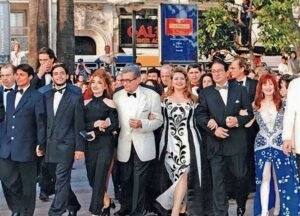
Ultimately, Eloui’s enduring relationship with Cannes remains grounded in mutual leverage between a star of her caliber and a festival of global standing. Through her insights and commanding presence, she models the modern Arab artist who refuses to settle for regional stardom, consistently seeking to be an active participant in the global cultural dialogue. Cannes, as she demonstrates, remains her definitive compass for renewing her creative edge and continuing her journey in the service of the silver screen.

Published By :
May 21, 2026.