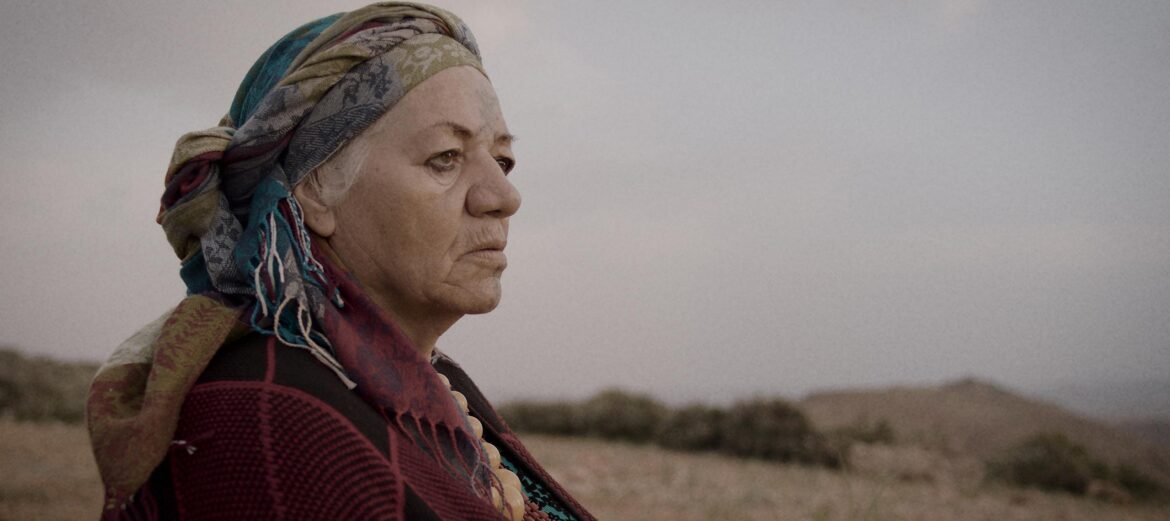
Rarely does cinema place an older woman at the center of its narrative, giving her the space to pursue love, freedom, and the possibility of starting over.
It is from this perspective that Moroccan filmmaker Yassine El Idrissi presents Halima, his feature directorial debut, screened in the Moroccan Cinema Panorama section of the 23rd edition of Marrakech International Film Festival.
The film opens with intimate scenes of an elderly couple sharing the quiet rhythms of everyday life by the sea.
A phone call then takes the narrative five years back, gradually revealing fragments of Halima’s past and the secrets surrounding her life.
Set in the Rif Mountains, the film introduces its protagonist as a widow who has lost her livestock to drought.
She is also embroiled in a legal battle to defend her home against eviction, while making a living through illicit cannabis trafficking.
Halima’s world gradually unfolds through the details of her daily routine, her work, and her movements along the mountainous trails.
The film does not rely solely on dialogue to establish its central character.
Her facial expressions, glances, and interactions with animals, alongside the recurring presence of food, reveal her emotional shifts, moving between sternness and suspicion, tenderness and humor.
Khadija El Ammari delivers a natural and convincing performance, drawing on subtle facial expressions and physical gestures to portray a woman weighed down by the passage of time without losing her resilience.
Her nuanced portrayal allows the audience to get close to Halima and understand her contradictions without reducing her to a single dramatic image.
A warmer side of the character emerges when she takes in a young man who dreams of becoming a singer but has drifted into cannabis trafficking in pursuit of quick money.
Through music, Halima gradually sheds some of her guarded exterior, revealing a longing for companionship.
This human connection ultimately leaves its mark on the film’s trajectory.
The humor, meanwhile, often stems from her seriousness and unexpected reactions, lending the character an additional layer of vitality.
El Idrissi gives a strikingly paradoxical dimension to the pivotal turning point in Halima’s life.
After winning her legal battle to retain her home, she decides to leave it behind.
Hearing the young man begin to pursue his musical ambitions prompts her to reconsider her own life.
She chooses to leave the mountains for the coast, in the hope of making a fresh start.
In one particularly evocative scene, Halima steps into the water, briefly reclaiming something of childhood’s lightness after a lifetime spent navigating the rugged mountain terrain.
Yet the film does not present her decision as a complete liberation.
The past eventually resurfaces, reminding her that new beginnings cannot erase the consequences of earlier choices.
During the post-screening discussion, El Idrissi explained that his decision to make an older woman the protagonist stemmed from his desire to shed light on people who worked in the cannabis trade before the partial legalization of certain cannabis uses, including members of the older generation.
He also noted that his background in journalism helped shape the film’s premise.
Made independently on a limited budget, Halima was conceived primarily with Moroccan audiences in mind.
Running 85 minutes, the film stars Khadija El Ammari alongside Idriss Samadi, Achraf Tahiri, Omar Beloud, Rabie El Faqih, and Nasser Medghari.
The film has received the Best Director and Best Actress awards at the Shanghai International Film Festival, in addition to a Special Mention from the jury of the Feature Film Competition at the El Gouna Film Festival.
Through its screening in Marrakech’s Moroccan Cinema Panorama, Halima brings to the forefront a protagonist rarely given such narrative prominence: an older woman who cannot be defined solely by her circumstances or past mistakes, but remains capable of making her own decisions and redirecting the course of her life.
At the same time, the film leaves room to contemplate the delicate tension between the desire for liberation and the need to confront the consequences of the past, suggesting that the hope of a new beginning does not diminish the complexity of the human experience.