Thai BL productions rarely venture far beyond the romantic territory that has long defined the genre.
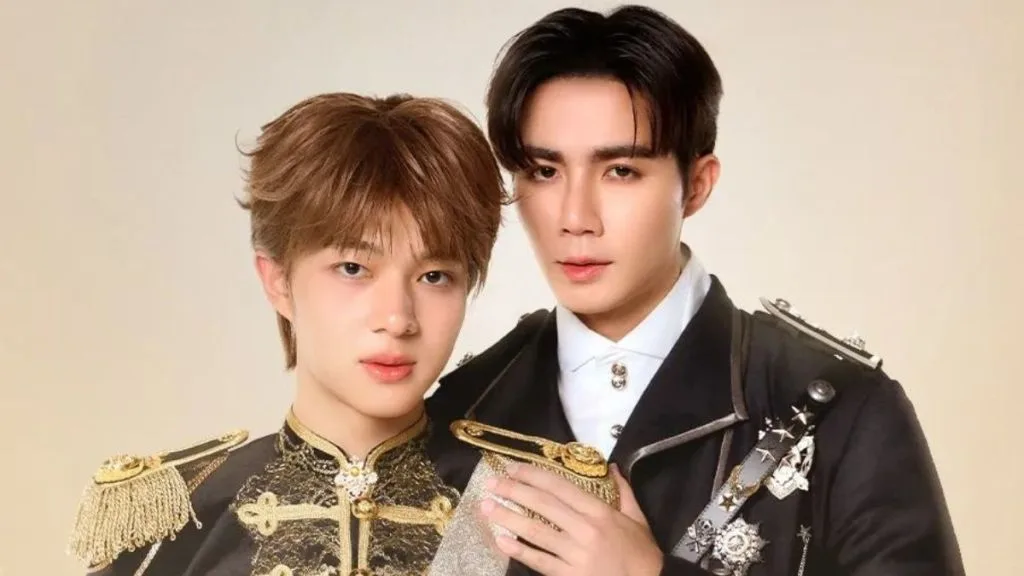
The Next Prince attempts to break away from that formula by introducing an imagined royal world shaped by power struggles, questions of legitimacy, family rivalries, and social hierarchy, all intertwined with a romance between a prince and his bodyguard.
Adapted from the novel of the same name, the series clearly aspires to be more than a conventional love story.
Yet despite its ambitious premise and lavish production, it struggles to turn its expansive fictional universe into an equally compelling narrative.
Visual Opulence Without Narrative Depth
One of the series’ greatest strengths is its visual identity.
The elaborate palaces, royal costumes, jewelry, and production design create an appealing sense of grandeur, distinguishing it from the familiar settings of Thai BL.
The cinematography and attention to visual detail help establish a convincing royal aesthetic.
However, visual extravagance cannot compensate for underdeveloped storytelling.
A fictional kingdom requires more than impressive sets and ceremonial costumes; it needs a coherent political and social structure that actively shapes its characters and their decisions.
Too often, the royal setting functions as little more than an elaborate backdrop for the central romance.
The succession struggle, family rivalries, and shifting power dynamics promise a much richer political drama than the screenplay ultimately delivers.
A Romance That Fails to Exploit Its Dramatic Potential
The relationship between Khanin and Charan offers a compelling foundation. One is a young man unexpectedly drawn into royal life, while the other is his personal bodyguard, bound by professional duty and institutional loyalty.
Their relationship naturally raises questions about class, authority, emotional dependence, and the conflict between personal desire and responsibility.
Unfortunately, the screenplay rarely explores these contradictions with sufficient depth. Instead, it repeatedly returns to familiar romantic beats of jealousy, intimacy, and attachment, leaving the more interesting dimensions of their relationship largely unexplored.
Charan’s struggle between duty and desire could have provided substantial psychological tension, while Khanin’s newfound royal status could have challenged his understanding of freedom and personal choice.
The same weakness affects their individual character arcs.
Khanin’s discovery of his true parentage should have had a lasting psychological impact, yet the revelation quickly loses narrative significance. Likewise, Charan’s fear of rain, rooted in his mother’s death, introduces an emotional backstory that is never fully integrated into his characterization.
The series has promising ideas about its protagonists but repeatedly fails to develop them into convincing psychological portraits.
Ramil and Paytai: An Underused Dramatic Asset
Ironically, some of the most intriguing material comes from the secondary pairing of Ramil and Paytai.
Their relationship introduces a different power dynamic, offering opportunities to explore authority, vulnerability, submission, and emotional dependence.
Jimmy and Ohm also share an engaging screen chemistry that makes their limited appearances particularly memorable.
Yet their storyline never receives the attention necessary to reach its full potential.
The series hints at complex emotional conflicts but rarely develops them beyond scattered moments.
Princess Ava suffers a similar fate.
Her position within a male-dominated royal hierarchy could have opened up a compelling discussion about gender and power, but her character remains underwritten.
Calvin’s storyline, meanwhile, occasionally feels disconnected from the central narrative.
Chemistry Cannot Always Rescue the Writing
Zee Pruk and NuNew Chawarin remain among the production’s strongest assets.
Their established rapport creates an easy intimacy in romantic scenes, and their contrasting screen energies help sustain the appeal of the central pairing.
However, there is a difference between the chemistry shared by two performers and the emotional credibility of the relationship they portray.
At times, their performances seem to compensate for a screenplay that provides insufficient character development.
Jimmy and Ohm also bring considerable appeal to their respective roles, reinforcing the impression that some of the series’ strongest moments emerge from its supporting relationships rather than its central romance.
Pacing, Overloaded Subplots, and Tonal Inconsistency
Across its fourteen episodes, The Next Prince struggles to maintain the momentum established by its promising opening.
Several storylines disappear for extended periods before resurfacing without meaningful development, while repetitive romantic scenes consume time that could have been devoted to more substantial character work.
The screenplay also attempts to combine romance, comedy, political intrigue, action, and social commentary, including an air pollution storyline.
Rather than complementing one another, these elements occasionally compete for attention, resulting in an uneven narrative rhythm and inconsistent tonal shifts.
The political conflict, in particular, never achieves the sustained escalation its premise demands.
Important developments are sometimes rushed, while less consequential details receive disproportionate attention.
By the finale, the series is left struggling to resolve multiple narrative threads that were never adequately developed, resulting in a conclusion that feels less satisfying than the setup promised.
A Progressive Kingdom With Traditional Contradictions
Another missed opportunity lies in the social structure of the fictional kingdom.
Same-sex relationships appear to enjoy a degree of acceptance, freeing the story from the familiar melodrama of concealed identities and social rejection.
Yet traditional gender roles and hierarchical structures remain firmly embedded in this supposedly progressive society.
This contradiction could have provided a fascinating exploration of the relationship between personal freedom, class privilege, and institutional power.
Acceptance of same-sex relationships does not automatically make a society free from other forms of discrimination.
Unfortunately, the series merely gestures toward these questions without developing them into a meaningful thematic argument.
Ambition Beyond the Screenplay’s Reach
Ultimately, The Next Prince does not suffer from a lack of ideas, but from an inability to accommodate them.
Its visual ambition, distinctive setting, appealing cast, and promising character dynamics suggest a production capable of delivering something considerably more substantial than a conventional BL romance.
Yet its sprawling world, oversized cast, and numerous competing storylines expose the limitations of its screenplay.
The central irony is that the series invests so much in constructing an entire kingdom, yet rarely makes that kingdom feel fully alive beyond the scenes unfolding on screen.
A fictional world is built not through palaces and crowns alone, but through the institutions, conflicts, and social contradictions that shape the lives of its inhabitants.
The Next Prince succeeds in offering a visually distinctive take on Thai BL, but fails to translate its ambitious premise into an equally accomplished dramatic experience.
Its aspirations consistently exceed its storytelling capabilities, leaving a series that is ultimately more compelling for what it could have been than for what it actually delivers.