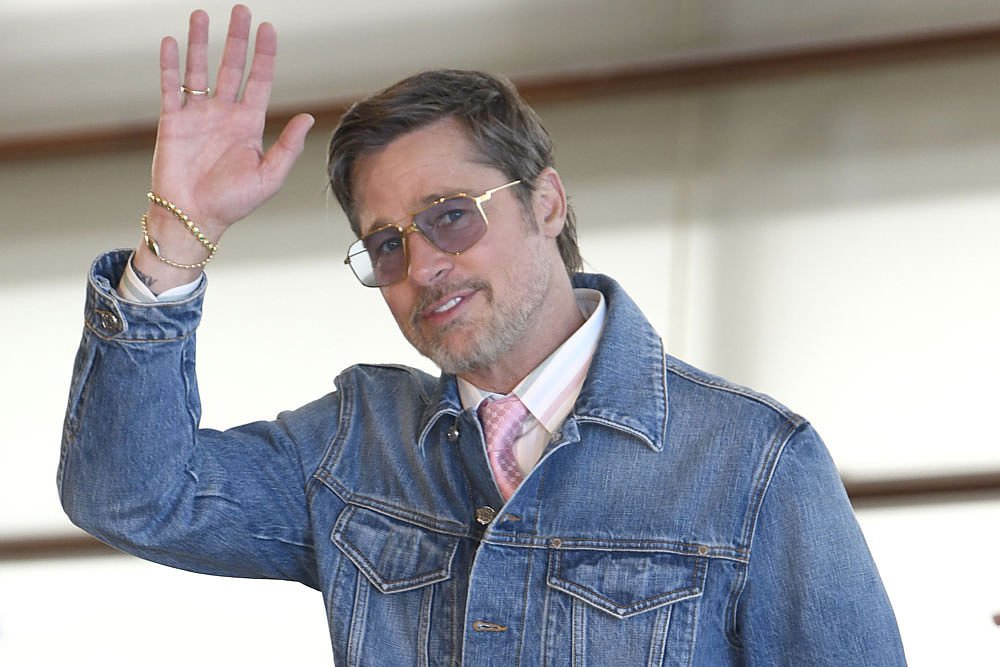
At the 74th San Sebastián International Film Festival, Pitt and Ayer discussed stripped-down storytelling, their reunion a decade after ‘Fury,’ and why the indie cinema landscape feels like the 1990s again.
SAN SEBASTIÁN — When Brad Pitt and director David Ayer arrived at the 74th San Sebastián International Film Festival to present Heart of the Beast, they didn’t bring just another high-stakes wilderness thriller. At a press conference held on September 23—where the film screened Out of Competition as part of the festival’s Official Selection—Pitt, Ayer, and producer Olivia Hamilton offered a deeper look into a project that strips humanity down to its most raw, vulnerable elements.
Directed by Ayer from a screenplay by Cameron Alexander, the 101-minute drama stars Pitt as James Belmont, a former Special Forces officer stranded in the unforgiving Alaskan wilderness following a harrowing plane crash. His sole companion in the frozen brutal landscape is Odin, a retired combat dog. Co-starring J.K. Simmons and Anna Lambe, the film places survival front and center, where every decision becomes a matter of life and death.
Yet despite the extreme setting and perilous sequences, the press conference shifted away from spectacle, focusing instead on the central bond between man and dog. Pitt highlighted that emotional core as the true heart of the picture, observing that a person often finds the strength to fight harder for another than for themselves. Care, love, and loyalty, Pitt noted, function as survival tools every bit as vital as weapons or tactical skills.
That emotional anchor reframes Heart of the Beast beyond traditional survival cinema. Belmont doesn’t merely endure nature alone, nor is Odin just a sidekick; their connection redefines what survival actually means. As the elements grow harsher, their bond becomes paramount, suggesting that when everything else is lost, a person discovers not only their strength, but whom they are willing to give it to.
For Ayer—whose filmography has frequently explored violence, masculinity, and psychological tension within rigid structures—the Alaskan wilderness marks a stark shift. Stripping away cities, military hierarchies, and social rules, Ayer places his protagonist in an uncontrollable environment that forces a confrontation with personal limits. The title itself carries a dual meaning: the “beast” isn’t merely an external threat, but nature itself, the fear lurking within, or the raw survival instinct pushed to its absolute limits.
The conversation also turned to the state of independent cinema. Pitt expressed optimism about today’s climate for indie projects, pointing out that more eyes are tuning into smaller, character-driven works and comparing the current momentum to the independent cinema boom of the 1990s. Ayer added that new avenues are continually emerging for discovering fresh directorial voices and expanding how stories reach audiences worldwide.
That indie ethos shines through Heart of the Beast. Though driven by A-list firepower and major industry backing, the narrative rests on a remarkably simple foundation: a man and a dog against an unforgiving world. That simplicity keeps performance, atmosphere, and imagery at the forefront rather than relying on heavy exposition or sprawling casts.
The festival appearance also marks a notable milestone for Pitt, returning to San Sebastián after 17 years. His last visit was in 2009 for Quentin Tarantino’s Inglourious Basterds. Heart of the Beast also reunites him with Ayer for the first time since their 2014 World War II drama Fury.
The contrast between the two collaborations is striking: in Fury, Pitt’s character was encased in a war machine, surrounded by a squad in a crucible of industrial violence. In Heart of the Beast, he is entirely isolated—no tank, no unit, no military apparatus. Just a man and a silent companion who understands him better than anyone else.
Ultimately, the takeaway from San Sebastián wasn’t just about surviving the elements, but asking what remains of a human being when every layer of authority and structure falls away. The answer Heart of the Beast offers is simple yet resonant: the bond remains, loyalty remains, and it is the connection to another that makes survival worth enduring.