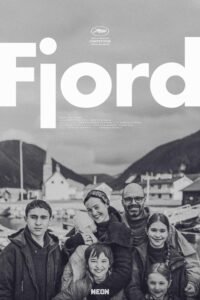
With the premiere of Fjord at the 79th Cannes Film Festival in May 2026, the international cinematic community received precisely what it expected from Cristian Mungiu: a razor-sharp, clinical autopsy of human morality. A towering figure of the Romanian New Wave, Mungiu has spent his career translating localized sociopolitical friction into grand existential anxieties. His latest feature—which deservedly captured the Palme d’Or—stands as his most visually arresting and intellectually demanding work since his breakout masterpiece, 4 Months, 3 Weeks and 2 Days (2007).
Yet, Mungiu completely breaks away from the bleak, crumbling concrete landscapes of communist-era Romania. Instead, he embeds his camera into an ostensibly tranquil paradise: a remote coastal enclave in northern Norway, hemmed in by colossal cliffs and the stagnant, icy waters of a deep inlet. Through this deceptive canvas, the film transcends its procedural premise, mutating into a chilling allegory of institutional overreach, xenophobia, and the paralysis of a community caught in the crosshairs of a profound cultural schism.
The film navigates this ideological minefield with a calculated, mathematical detachment. It tackles one of the most volatile friction points of the modern era—the collision between institutional progressivism and religious conservatism—using a premise inspired by real-world friction surrounding Norway’s child welfare system (Barnevernet) and its encounters with immigrant families.
Starring Sebastian Stan and Renate Reinsve, the film polarized the Croisette. Critics were sharply divided between praising the work as a fearless, morally gray intellectual tightrope walk, and dismissing it as an overly cerebral thesis film that sacrifices human blood and bone for political debate.
The Blueprint: Fracturing the Scandinavian Utopia
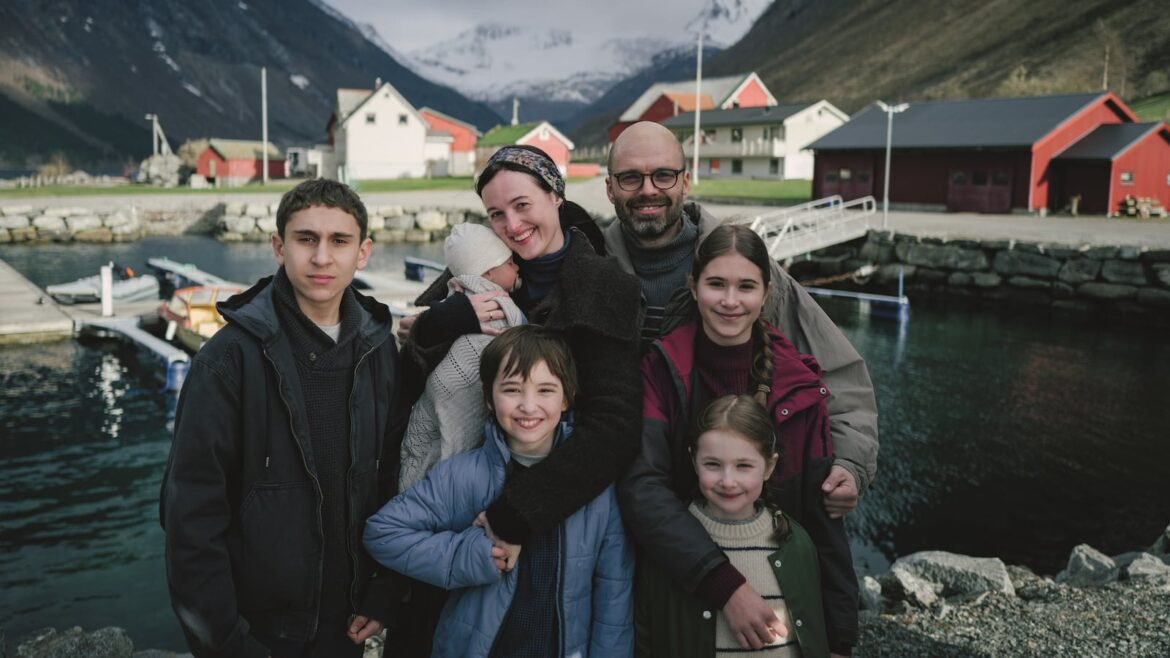
The narrative engine ignites with the relocation of the Gheorghiu family to the isolated town of Ålesund. The mother, Lisbet (Renate Reinsve), a nurse, is returning to her native roots, while her husband, Mihai (Sebastian Stan), is a fiercely traditional Romanian immigrant. Together with their five children, they inhabit an domestic world governed by strict Evangelical principles; smartphones and social media are entirely banished, replaced by a rigid routine of daily scripture and old-world parenting discipline.
The fragile domestic peace is systematically dismantled when a school official notes two small bruises on one of the daughters. Armed with Mihai’s candid, written acknowledgment that he employs mild physical discipline as part of his paternal duties, the Norwegian child welfare machinery moves with terrifying efficiency, seizing all five children instantly. What begins as a localized domestic welfare check rapidly spirals into a ferocious legal, social, and media crusade, escalating into a public trial of the family’s entire cultural and spiritual identity.
Anatomy of an Institutional Nightmare
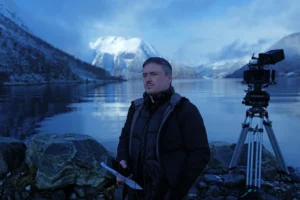
Instead of focusing on a standard courtroom drama, Mungiu constructs Fjord as a cold-blooded ideological trap, forcing the audience into a deeply uncomfortable moral blind spot. He subverts the typical Hollywood “David vs. Goliath” trope by making his protagonist explicitly unsympathetic. Mihai’s worldview is stubborn, outdated, and legally indefensible under modern norms. Yet, by pitting this flawed patriarch against a clinical, monolithic state apparatus, the film morphs into a modern horror story about forced assimilation. Mungiu isn’t defending religious fundamentalism; he is probing the terrifying moment when progressive welfare systems stop protecting individuals and start aggressively policing cultural dissent.
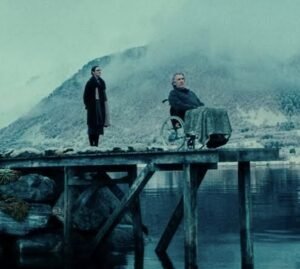
Visually, the film operates on a thesis of environmental hostility. Working in expansive widescreen format, the camera strips the Norwegian landscape of its postcard-perfect tourism appeal, transforming the majestic mountains and icy waters into an extension of bureaucratic apathy. The frame feels hollow, vast, and utterly indifferent to human suffering. This geographic isolation mirrors the psychological alienation of the immigrant family, rendering the pristine Scandinavian town as a sunlit panopticon where ideological non-conformity is the ultimate sin. The film frequently evokes the metaphor of a slow-motion avalanche—a distant rumble that the locals observe with passive resignation—echoing the inevitability of the state machinery crushing the family.
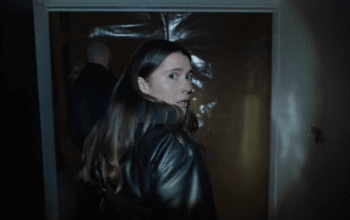
The performances are similarly scrubbed of any easy emotional manipulation. Sebastian Stan delivers a masterclass in controlled friction, portraying Mihai not as a tragic victim, but as a deeply frustrated man weaponizing his own alienation into a holy crusade. He plays the character with jagged, unpolished edges that keep the audience at arm’s length. Meanwhile, Renate Reinsve provides the film’s tragic anchor, delivering a hallowed, physically diminished performance that externalizes the psychological violence of state intervention. Her quiet breakdown—particularly in a devastating sequence where she realizes her breast milk has dried up due to the forced separation from her infant—becomes a stark, visceral reminder of the human collateral left in the wake of systemic efficiency.

Fault Lines in the Thesis
Despite its critical triumphs and strong footprints on aggregate platforms like Metacritic and Rotten Tomatoes, Fjord occasionally stumbles under the weight of its own ambitions, falling short of the narrative heights achieved in Mungiu’s earlier filmography.
The Flattening of the Bureaucracy: The local Norwegian officials and progressive townspeople are occasionally reduced to bloodless, cartoonish archetypes. By rendering them as faceless, icy antagonists, Mungiu slightly undermines the nuance of his own ethical debate, making certain acts feel less like an exploration of institutional failure and more like a targeted political grievance against Scandinavian liberalism.
The De-individualization of the Children: Although the five children are the absolute axis upon which this entire universe spins, the film deliberately keeps them at an emotional distance. The dialogue given to the teenagers feels hyper-stylized and unnaturally detached—channeling the deadpan, sterile absurdism of Yorgos Lanthimos—which frequently reduces the narrative to a legal dissertation rather than a living human tragedy.
A Reticence to Define Abuse: Mungiu conspicuously evades the actual parameters of physical abuse. By keeping what transpired behind the family’s closed doors strictly in a narrative blind spot, the director robs the climax of the visceral, confrontational punch that typically defines the masterworks of the Romanian New Wave.
The Verdict
Ultimately, Fjord remains a razor-sharp, fiercely intelligent cinematic challenge that refuses to grant easy ideological comfort to its audience. It holds no brief for reactionary dogmatism, yet it refuses to sanitize the terrifying overreach of progressive institutions when they transform into tools of cultural coercion. It is a film engineered specifically to provoke discomfort in an era of hyper-polarization, even if its immaculate intellectual architecture occasionally leaves the human heart stranded out in the cold.