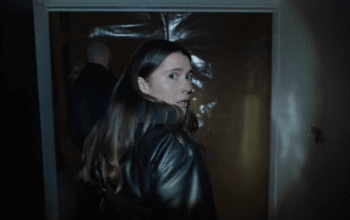
The world premiere of “VESNA” (Spring) at the 79th Cannes Film Festival marked the arrival of a devastatingly quiet new voice in international cinema.
The debut feature from Lithuanian director Rostislav Kirpičenko—a co-production spanning Lithuania, France, Estonia, and Ukraine—rejects the loud, visceral machinery of standard war cinema.
Instead, it embeds itself in the chilling, bureaucratic stillness of occupation, delivering a profound meditation on moral survival that has resonated deeply across Eastern European critical circles.
Here is a comprehensive breakdown of the artistic components that define Kirpičenko’s debut:
The Narrative Architecture: Spiritual Terror Under Siege
Kirpičenko’s screenplay approaches occupation not merely as a territorial conquest, but as a systematic dismantling of human morality.
The narrative follows Andriy, a 35-year-old Orthodox priest (played with fractured restraint by Kęstutis Cicėnas), whose sanctuary is violated when occupying forces requisition his church as a transit morgue for executed civilians. Forbidden from allowing individual burials, Andriy is forced to harbor the dead until military trucks arrive every three weeks to erase them into mass graves.
Ukrainian critics have noted that the film functions as a masterclass in “spiritual terror.” The dramatic tension does not stem from a quest for physical survival, but from an agonizing crisis of conscience.
When the brutal winter sets in, freezing the earth solid, the simple, humane act of digging a single grave transforms into a monumental, life-threatening act of martyrdom.
Kirpičenko strips away any Hollywood-style “David vs. Goliath” triumphalism, leaving behind a stark, heavy psychological reality borne by a solitary priest and a handful of townspeople.
The Visual Grammar: Capturing the “Banality of Evil”
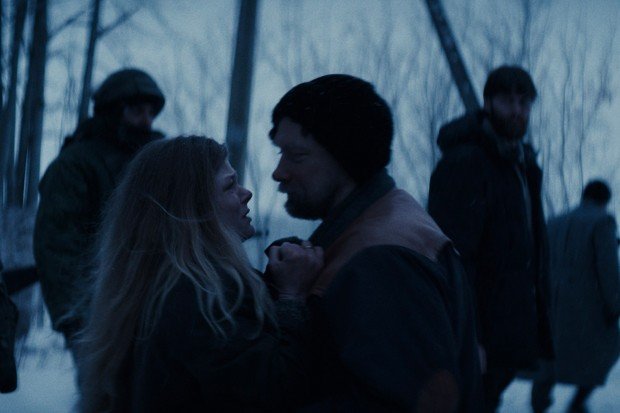
Cinematographer Vilius Mačiulskis establishes a severe, desaturated visual palette, relying almost exclusively on natural, overcast light and cold tones.
Lithuanian analysis highlights Mačiulskis’ deliberate choice to avoid explicit battle sequences or graphic violence.
Instead, the lens lingers on the mundane, mechanical routines of handling death inside the church walls.
This stylistic restraint effectively captures the “banality of evil.”
The occupying soldiers are not caricature villains; they are functionaries executing an administrative protocol to conceal war crimes. By maintaining a predominantly static camera, Mačiulskis traps the audience within the suffocating, frozen architecture of the church, amplifying the omnipresent dread.
Performance: The Power of Understatement
The emotional core of the film hinges on a masterful, subdued dynamic between Ukrainian actress Anastasiya Pustovit and Lithuanian lead Kęstutis Cicėnas.
Ukrainian reviewers have lauded Cicėnas for his internal performance, portraying a man undergoing an existential storm beneath a mask of absolute pastoral composure.
The acting across the board rejects theatricality. Character motivations and grief are conveyed through heavy silences, exhausted posture, and eyes darting between rows of shrouded bodies and the windows that threaten exposure.
It is a raw, unembellished portrait of terror that avoids any descent into cheap melodrama.
Sound Design: The Deafening Silence of Isolation
The sonic landscape, crafted by sound designer Marius Blažys alongside Josef Squire and complemented by Sten Šeripov’s minimalist score, treats silence as an active antagonist.
There are no swelling orchestral movements to dictate emotion.
Instead, the film breathes through the harsh, isolated sounds of the environment: the howling wind, the cracking of ice, the groaning of old wooden doors, and the heavy breathing of characters living on borrowed time.
This deliberate auditory emptiness underscores the profound isolation of the occupied territory, creating an atmosphere of unrelenting psychological suspense.
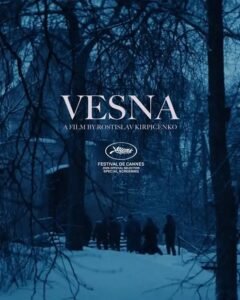
“War destroys memory, but cinema records and bears witness to events to save that memory from being erased.” — Director Rostislav Kirpičenko