
When Thai cinema ventured into philosophical sci-fi with Thanadol Nualsuth’s Uranus 2324, the film proved to be far more than a routine box-office entry. Instead, it emerged as a polarizing talking point across Asian and international cinematic circles. Viewers were confronted with a project that boldly swings between raw human romanticism and the cold mechanics of astrophysics and the multiverse. From its opening frames, the film prompts fundamental questions about modern Asian cinema’s capacity to transcend traditional melodrama in favor of cosmic scope, delivering a genre exercise that demands rigorous unpacking across its narrative structure, visual grammar, performances, and underlying philosophical currents.
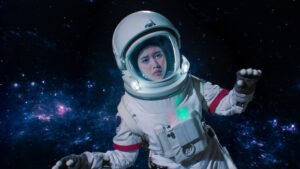
Across its first half, Uranus 2324 pivots on a precarious balance between overwhelming visual ambition and narrative ambiguity. Nualsuth utilizes deep space and deep-sea free-diving as twin visual metaphors for human isolation and separation. The abyssal silence of the ocean and the crushing expanse of outer space form parallel, heartbreaking arenas for leads Lin and Kath as they desperately try to bridge the chasms of space and time. This visual symmetry between towering altitudes and oceanic depths stands out as a sharp directorial strategy, translating humanity’s struggle against unavoidable loss, using water and air as opposing elements that converge on burning longing and the persistent echoes of a past romance.
Narratively, the film launches from a deceptively conventional premise—two lovers drifting apart due to divergent ambitions and life circumstances—before gradually pivoting toward metaphysical complexity to explore parallel realities.
While contemporary screenplays frequently tackle the multiverse paradigm, Uranus 2324 grounds these high-concept mechanics in deeply intimate emotion. Solar storms in outer space and perilous dives into oceanic trenches act as external reflections of fractured souls and divergent possibilities. Across every parallel reality, the leads re-enact the agony of separation in varying configurations, instilling a crushing sense of inescapable destiny that elevates the film beyond conventional romance into something far more existential.

A Magnetic Lead Duo
At the performance level, stars Freen Sarocha Chankimha and Rebecca Patricia Armstrong serve as the film’s crucial anchor, tethering an otherwise erratic narrative structure. Their palpable emotional harmony lends genuine weight to the affection and despair echoing across parallel timelines. The duo effectively conveys the psychological toll of characters trapped between the hope of reunion and the tragic acceptance of fate. Though subtle unevenness surfaces in secondary dialogue and during heavily CGI-reliant moments, their undeniable screen chemistry routinely compensates for structural flaws, injecting human warmth into the cold expanse of cosmic space.
Conversely, the screenplay and editing struggle to manage the precision required for such a multi-layered plot. Fitting complex multiverse concepts and intersecting timelines into a romantic drama framework demands meticulous pacing, which occasionally succumbs to visual flaunting. Abrupt jumps between realities induce audience fatigue, rendering the central narrative arc difficult to follow at crucial turning points. Furthermore, lingering scenes at the expense of character backstory dull the emotional impact of key dramatic peaks. Certain cosmic fractures feel inserted purely for visual flair rather than emerging organically from character development, creating a disconnect between the film’s loftiest thematic ambitions and its execution.



Ambitious Directorial Vision
Technically, the feature visibly strains against its production limits while striving to match global blockbuster standards. While outer space sequences, solar storm imagery, and underwater diving setups deliver admirable visual splendor, other digital effects suffer from awkward motion rendering and inconsistent integration. Nevertheless, thoughtful shot compositions, stark color-palette shifts between warm and cold tones to differentiate worlds, and a poignant musical score anchored in quiet moments sustain a bold directorial vision that strives to build a distinct cinematic realm.

War-Era Action Sequences
The World War II timeline, detailing the Japanese military presence in Thailand, offers the film’s most action-packed alternate reality, veering away from cosmic sci-fi into gritty historical warfare. Sarocha Chankimha and Rebecca Patricia Armstrong underwent intensive stunt training for these sequences, mastering close-quarters combat, tactical firearms, and chase choreography. Their physical commitment shines through crisp gunplay sequences against Japanese military forces, backed by authentic supporting cast performances. Visually, Nualsuth distinguishes this timeline with a warm, desaturated, gritty earth-toned color grade, offering a sharp contrast to the sleek, icy aesthetics of the outer-space and deep-water settings.
From a dramatic perspective, the war-era sequence culminates in one of the film’s most punchy climaxes: Kath perishes in the battle and her body is dumped into a river, leaving Lin as the sole survivor. The director uses this violent resolution to reinforce the central thesis—that separation is a relentless constant, pursuing the protagonists across every conceivable reality. However, shoehorning period combat into a narrative centered on space travel and free-diving clutters the screenplay, creating a jarring clash of genres that occasionally pulls viewers out of the central sci-fi conceit.



The Significance Behind 2324
The numerical title 2324 references the official Thai Buddhist Era calendar, which corresponds to the year 1781 AD in the Gregorian calendar—the exact year astronomer Sir William Herschel discovered Uranus. By grounding the title in this historical milestone, the filmmakers ingeniously weave Thai cultural identity with cosmic iconography, creating a symbolic anchor that bridges humanity’s discovery of the planet with the lead characters’ metaphysical voyage across space and time.

Thematic Resonance and Existential Weight
Digging deeper into the film’s thematic core reveals that Nualsuth is less concerned with hard science or astrophysics than with employing sci-fi mechanisms as a poetic meditation on the irreversibility of time.
The notion that one might traverse countless alternate outcomes across infinite multiverses yet remain powerless to rectify a single fatal flaw in baseline reality serves as the picture’s most poignant proposition.
Lin and Kath are not merely chasing a romantic reunion; they seek mutual absolution and reconciliation, recognizing that while certain bonds transcend cosmic distances, destiny remains unyielding. Ultimately, Uranus 2324 proves that Thai cinema can step beyond safe commercial formulas to embrace bold artistic risks. Despite structural missteps, its willingness to grapple with existential questions of love and loss within a genre-blending canvas remains a commendable leap forward.

Why the Special Version Matters
Upon its theatrical release in summer 2024, the original cut sparked intense debate, dividing audiences into passionate supporters and harsh critics. This reception led Velcurve Studio and director Thanadol Nualsuth to release a comprehensive recut two years later: the Special Version, designed specifically to address the original theatrical release’s structural flaws.

The primary refinements of the Special Version center on three key areas:
First, in terms of narrative structure, the Special Version establishes a significantly clearer chronological flow. It smooths out the erratic universe-hopping that previously disoriented viewers and introduces distinct timeline markers to make tracking the plot far easier.
Second, on the visual and character level, the recut incorporates previously unseen footage, including tender moments on a motorcycle, extended rooftop sequences, and expanded scenes set in New York. Crucially, visually pivotal moments such as the kaleidoscope sequence are extended, allowing the leads’ palpable chemistry to shine.
Third, philosophically and dramatically, this definitive cut offers far clearer answers to questions left ambiguous in the original release. Character arcs feel cohesive and harmonized with the film’s ambitious visual palette, delivering what many now consider the complete artistic vision intended by the filmmakers.


The Bottom Line
Far from a flawless masterpiece, Uranus 2324 remains a daring, complex endeavor worthy of critical engagement. It triumphs in visual spectacle and heartfelt performances even as it buckles under the weight of its ambitious multiverse mechanics. Ultimately, it expands the boundaries of Southeast Asian genre filmmaking, leaving a notable mark that invites critics and audiences to rethink what is possible on the big screen.